
When scientists disagree, sometimes the truth is somewhere in the middle.
That has turned out to be true for the age of an impact crater deep in the remote scrublands of Western Australia's Pilbara desert.
Initially, the team that discovered the North Pole Dome impact structure (aka Miralga) estimated its age at about 3.47 billion years – far older than any other impact evidence discovered to date.
But then a second team challenged that estimate, arguing that the crater must be less than 2.77 billion years old.
Now, the original team has studied tiny crystals in the site's impact structures, and determined that the event that created the crater took place around 3.024 billion years ago – confirming its status as the oldest impact crater known on Earth.
"The younger interpretation allowed the crater to be any age between about 2.77 billion and 400 million years old, which spans roughly half of Earth history," geologist Chris Kirkland of Curtin University in Australia told ScienceAlert.
"The new age of about 3.02 billion years places the impact firmly in the Archean, when Earth's crust, oceans, atmosphere, and early life were still evolving.
"It is, in fact, unique, the only currently recognized Archean impact crater on Earth."
If you look at Earth next to the Moon or Mercury or Mars, one difference immediately stands out. Our world is significantly less cratered than any of them.
While it's possible that Earth's atmosphere shielded it from some smaller impacts during the period of bombardment early in the Solar System's history, the main reason so few craters can be found here is that our planet is much more active, scientists think.
Between erosion and geological processes, most of Earth's impact record has probably been erased over time.
Most of the impact craters we can identify on Earth are less than 2 billion years old – less than half the planet's 4.5-billion-year age.
Prior to the discovery of the North Pole Dome, the oldest widely accepted impact structure was the Yarrabubba crater, also in Western Australia, dated to 2.23 billion years ago.
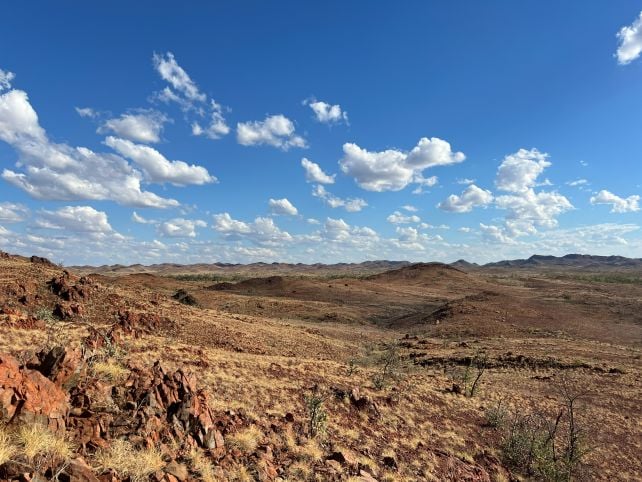
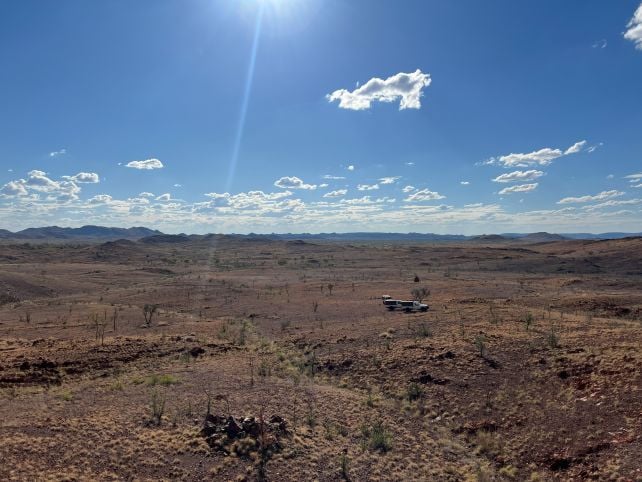
North Pole Dome doesn't look much like a crater anymore. After billions of years, it looks like a nondescript patch of Pilbara scrubland, much like any other.
But the Pilbara is unlike anywhere else on the planet.
"The Pilbara preserves some of the least disturbed Archean rocks on Earth. In places, you can still see ancient lava flows, pillow basalts, cherts, hydrothermal deposits, and rocks linked to some of the earliest evidence for life. Most rocks this old have been buried, heated, deformed, eroded, or recycled," Kirkland said.
"The Pilbara is so very special because it still preserves readable fragments of Earth's early surface that haven't been recycled away."
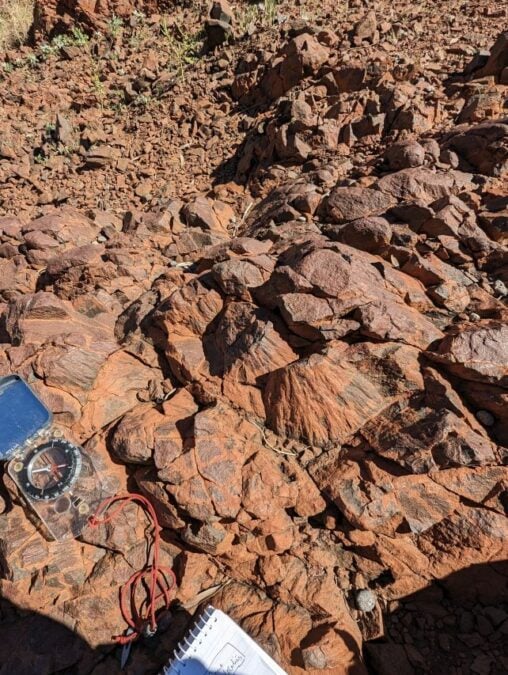
Researchers started uncovering the crater's true nature when they found some curious rocks in surface outcrops: shatter cones.
Shatter cones are among the key diagnostic features of an impact site, formed when an impact sends a powerful shockwave through the ground, leaving distinctive cone-shaped fracture patterns in the rock.
The researchers originally estimated an age of 3.47 billion years by examining the rocks around the impact site.
Now, they have performed a more detailed analysis by studying minerals in the impact-damaged rocks associated with the shatter cones.
"The key evidence comes from zircon, a tiny but extraordinarily resilient mineral that can keep geological time for billions of years," Kirkland explains in a statement.
"Some zircons at North Pole Dome have unusual branching, skeletal shapes. We interpret these as impact-modified crystals, formed when older zircon was disrupted, partly recrystallized, and in places regrown during the intense heating caused by the impact.
"These zircon crystals record an event at about 3 billion years ago, which we believe is the best estimate for the impact."
Zircon is one of the best tools we have for reliable dating.

As it is forming, zircon takes up trace amounts of uranium but strongly rejects lead. Over time, the uranium decays into lead inside the zircon; so any lead in a zircon crystal has to be from the radioactive decay of uranium.
Because the rate at which uranium decays is known precisely, the lead ratios can be used to date the zircon.
But the researchers didn't rely on just the zircon. They also analyzed crystals of apatite, which formed as hot fluids moved through the impact-fractured rock. The isotope ratios in the apatite gave an age of around 3.019 billion years – extremely close to the zircon date.
That age matters because it places the impact in a very different Earth from the one we know today.
"A 3 billion-year-old crater records impact into a much younger Earth, with hotter crust, different surface environments, and early microbial ecosystems," Kirkland told ScienceAlert.
"It can tell us how impacts fractured ancient crust, drove hot fluids through rocks, and may have changed the environments where early life was living or being preserved."

It's not the oldest evidence of an impact on Earth.
Tiny molten droplets of debris blasted out by ancient impacts have been found in even older rocks in Australia and South Africa. But those discoveries don't reveal where the impactors struck or what their craters looked like.
Related: Geologists Went Looking For Gold. They Found Something Far Rarer.
North Pole Dome offers more than molten crumbs.
Although the crater rim and other raised features have long been scoured away, the site can still be interpreted as an actual crater, and as such can be used to study how impacts may have interacted with the planet at the crucial time when life was emerging.
"The surprise was that the answer was neither the original stratigraphic estimate nor the much younger stratigraphic reinterpretation," Kirkland said.
"The minerals gave a third answer: About 3.02 billion years ago, zircon recrystallized, and hydrothermal apatite grew. That is why direct dating matters. It lets the rocks and the minerals within provide their own timestamp."
The research has been published in Geology.