Scared of spiders? Well, if you ever travel back in time, here's the critter you'll need to squish.
Its name is Urokodia aequalis, and you'll want to set your time machine to the early Cambrian period of China, around 518 million years ago.
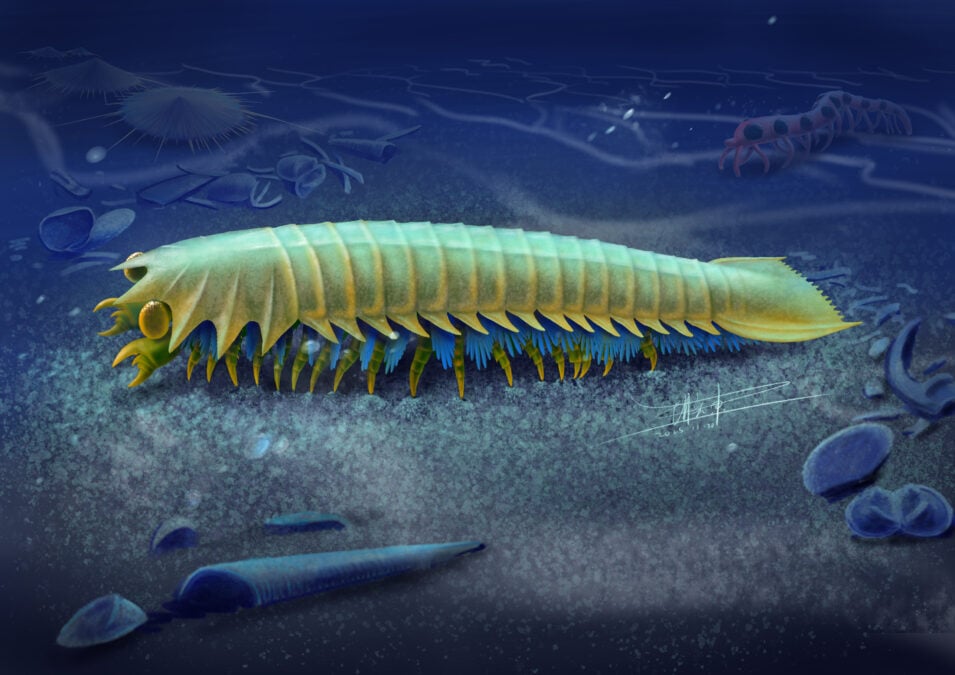
It doesn't really look like a spider yet, though. It's more of an elongated, segmented thorax supported by way too many tiny feet, with a shrimp-like tail at one end and a shielded head with creepy stalked eyes at the other.
The whole thing measures only about 2 to 3 centimeters (0.8 to 1.2 inches) long, so it should be easy to crush underfoot.
But what makes Urokodia a potential target for arachnophobic time travelers? Scientists have just discovered that its fossils contain the earliest known evidence of what would later become spider fangs. Their findings are published in Nature.
These unpleasant appendages are technically known as chelicerae, and they can be found on spiders, scorpions, mites, ticks, horseshoe crabs, and other arthropods that make up a group called chelicarates.
Now it seems Urokodia can join the ranks as a founding member, pioneering these little mouthparts that have served its descendants so well for hundreds of millions of years.
The little critter was shy about revealing them, however. Urokodia fossils have been known for decades, but their little proto-fangs had always been overlooked.
They've only now been discovered by a team of scientists from Yunnan University in China and the University of Leicester in the UK.
The researchers conducted X-ray analysis of several fossil specimens and the rock surrounding them, revealing some surprisingly well-preserved soft body parts.

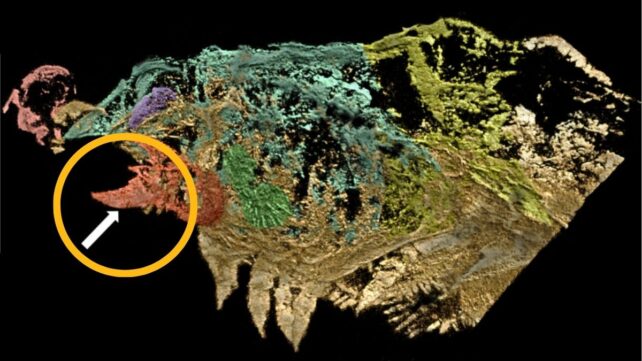
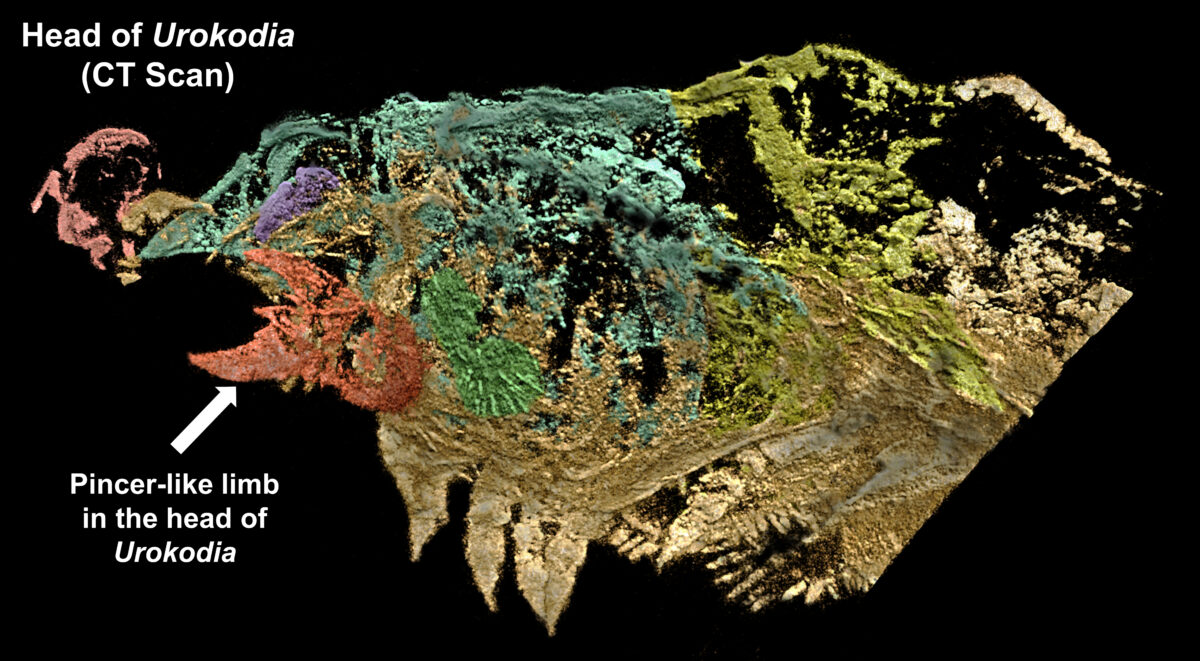
These new images showed that just behind its eyes, Urokodia sported a tiny pair of appendages that look like pincers. These, the researchers hypothesize, seem to be an early form of chelicerae.
"We were using X-ray tomography analysis of these fossils to reveal their soft anatomy buried in the rocks for hundreds of millions of years, when suddenly we noticed the pincer-like limbs at the front of the animal," says Yu Liu, paleobiologist at Yunnan University.
"We knew immediately that this was a very exciting fossil and indeed a distant ancestor of living chelicerates like scorpions and spiders."
Before this discovery, the earliest known example of chelicerae was found on a similar-looking arthropod called Megachelicerax cousteaui, but Urokodia was prowling the oceans some 14 million years earlier.
The researchers say that Urokodia "provides an unusually direct blueprint" for how small appendages near the mouth could have evolved into the fangs and pincers of later chelicerates.
In earlier species, these appendages had multiple segments, but Urokodia's mouthparts started to resemble pincers.
That general shape was preserved over eons, and today, its descendants use versions specialized to feed themselves in a range of different ways.
Horseshoe crabs and scorpions sport small pincer-like chelicerae which they use like little hands to feed themselves. Ticks use theirs to pierce the skin of hosts to drink blood.
Related: Scientists Identify The World's Biggest Known Scorpion, The Size of a Dog
And spiders, of course, have evolved fanged chelicerae that help them subdue prey or frighten off larger threats.
Without such weapons, only rudimentary ones, Urokodia will have to hide behind the integrity of the spacetime continuum to defend itself from arachnophobes.
The research was published in the journal Nature.
This article was fact-checked by Jess Cockerill and edited by Clare Watson. While we pride ourselves on our process, we are only human. If you spot a mistake, please let us know.