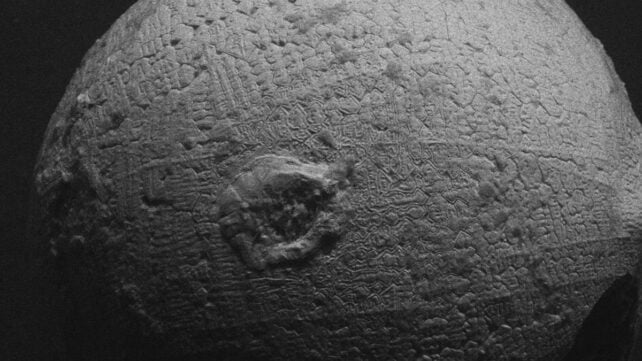
Earth is under constant bombardment.
Every year, thousands of tons of tiny micrometeorites, each smaller than a poppy seed, rain down on our planet, dusting it with cosmic snow so fine you never even notice it's there.
These particles begin as dust shed by asteroids and comets. As they plummet through Earth's atmosphere, they melt into tiny glassy spheres – and locked inside some of these microscopic particles, scientists have now found the fingerprints of a type of asteroid that's unlike any we've ever seen before.
Researchers describing the discovery refer to this asteroid parent body as "missing" because no traces of it have been found in current meteorite collections – our main window into the chemistry of space beyond Earth.

"This new research shows that micrometeorites – a field that is still in its infancy – may hold evidence that a significant part of the flux of extraterrestrial material to Earth is 'missing' from meteorite collections, showing the huge scientific potential of this cosmic dust," cosmochemist Matthias Van Ginneken of the University of Kent in the UK told ScienceAlert.
Van Ginneken is the first author of a paper describing the discovery, recently published in Science Advances.
Micrometeorites preserve a record of Earth's changing cosmic environment. Scientists use them to study everything from ancient meteor explosions to our planet's passage through streams of space debris over thousands of years.
Another thing micrometeorites can do is reveal what the rocks passing through near-Earth space are made of.
"More often than not, research is about connecting the dots."
Matthias Van Ginneken, cosmochemist
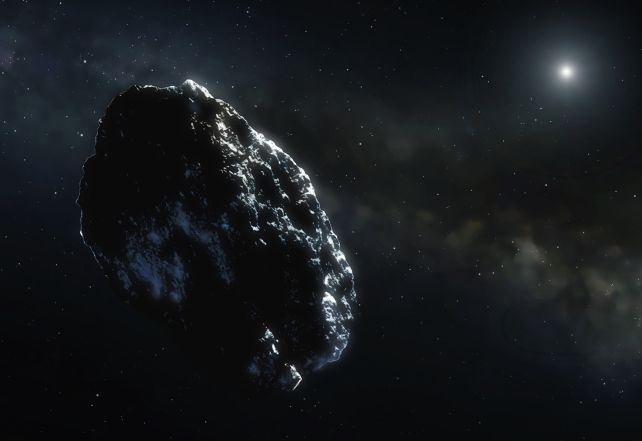
We can't easily visit asteroids or comets. However, the dust they shed that has drifted down to Earth represents an abundant, much easier-to-access resource that can give clues about their composition.
"Our study shows that at least one near-Earth asteroid (NEA) has been supplying the Earth with dust for over a million years," Van Ginneken said.
"This represents an excellent opportunity to learn more about NEAs without having to fund expensive sample-return missions."
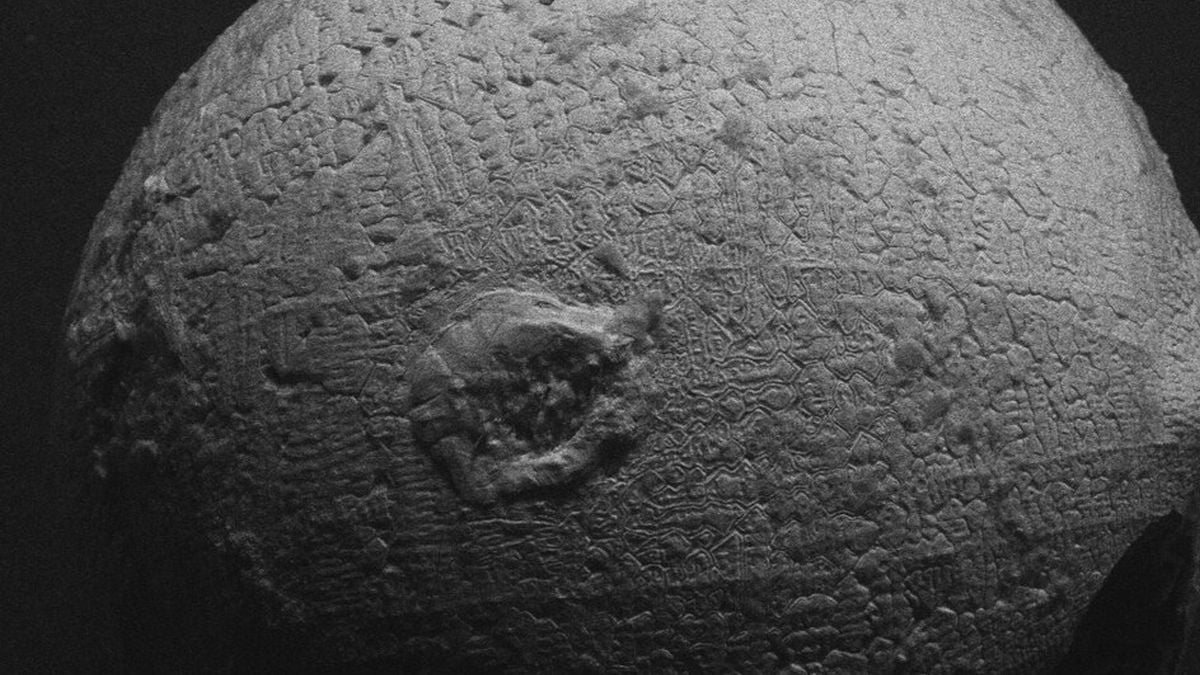
But some micrometeorites have been puzzling cosmochemists for decades.
Several studies, dating back to 2005, noted that some of the micrometeorites recovered from the Antarctic ice sheet had unusually heavy oxygen isotope ratios. Scientists classified these spherules as Group 4, and noted that they could not be assigned to any known parent body.
Then, in 2020, a team led by planetary scientist Martin Suttle of The Open University in the UK – one of the present study's co-authors – published a paper describing unmelted Group 4 micrometeorites, which still bore those heavy oxygen isotope ratios.
This changed the picture – because it meant that the peculiar oxygen isotope ratios were likely inherited from the parent body, rather than a byproduct of atmospheric melting.
Concurrently, other peculiarities were emerging in some micrometeorites.
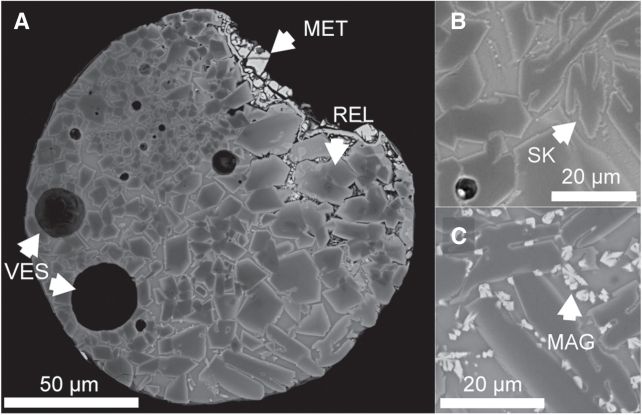
A 2016 paper led by planetary scientist Matthew Genge of Imperial College London, another co-author of the new study, described cosmic spherules in which olivine had migrated to one side of the particle during deceleration in Earth's atmosphere.
"More often than not, research is about connecting the dots," Van Ginneken said.
"Both the isotopically heavy and cumulate olivine spherules were frequently observed in micrometeorite collections, so I wondered, 'What if these unusual characteristics are shared within a single spherule type?'"
He and his colleagues decided to take a closer look at both anomalous populations.
If the results were a Venn diagram, it would almost be a circle. The overlap between the two was strikingly close, suggesting they could originate from the same unusual parent body.
"This new research shows… the huge scientific potential of this cosmic dust."
Matthias Van Ginneken, cosmochemist
That wasn't all.
The team uncovered even more oddities: These micrometeorites contained almost no magnetite – a mineral commonly found in cosmic spherules – and were unusually rich in sulfur.
The researchers have called the group SCumPo, for "sulfur-rich cumulate olivine".
All these clues point to one big, 'missing' thing.
"The total absence of magnetite, which commonly forms in cosmic spherules by the oxidation of iron during atmospheric entry, suggests that the environment was very reducing for our spherules. This indicates that something was consuming atmospheric oxygen before it could oxidize the iron, leading to the idea that the parent body was likely carbon-rich," Van Ginneken told ScienceAlert.
"The spherules are also unusually sulfur-rich, which suggests a similarity to the very rare CY chondrites that have been recently classified."
Meanwhile, the oxygen isotope ratios suggest that the parent body was altered by water with heavier oxygen isotopes than other known asteroids – suggestive of an extremely unusual asteroid that has, as Van Ginneken noted, "been silently bombarding the Earth with dust for a long time."
And this is not a small amount of dust, either. As much as 10 percent of the micrometeorite record could be from this strange asteroid, or asteroid group.

Simulations of the particles' fiery descent suggested they entered Earth's atmosphere unusually quickly, indicating they most likely came from a near-Earth asteroid rather than the main asteroid belt between Mars and Jupiter.
This means that we could already have included it in our catalogs of Near-Earth Objects, which include more than 40,000 space rocks, the majority of which are asteroids.
Related: 5,200 Tons of Extraterrestrial Dust Rain Down on Earth Every Single Year
"So it is very possible that the one producing this unusual dust has already been identified and named," Van Ginneken said.
"But to be entirely sure, we would need to sample it, which requires a lot of luck."
That could mean a sample return mission sent to just the right asteroid – but meanwhile, even more discoveries may be sitting right under our noses.
"It is therefore very possible," Van Ginneken said, "that more 'missing' parent bodies are hiding in the huge micrometeorite collections that have only been very partially studied."
The research has been published in Science Advances.
This article was fact-checked by Jess Cockerill and edited by Clare Watson. While we pride ourselves on our process, we are only human. If you spot a mistake, please let us know.