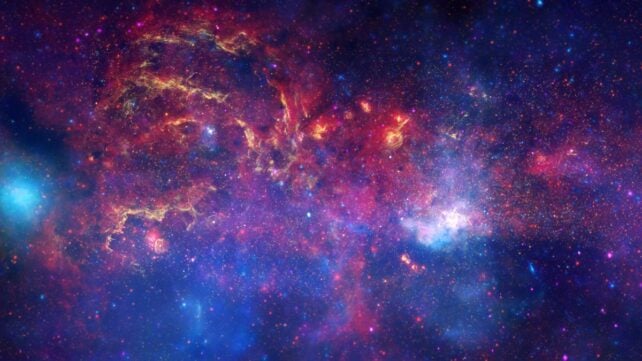
The latest discovery in the galactic center strengthens the Milky Way's resemblance to a mouth-watering treat.
Previously, scientists found an ester called ethyl formate drifting between the stars in the inner regions of the galaxy – a compound that contributes to the distinctive flavor of raspberries.
Now astronomers may have found the sugar with which to dust this cosmic comestible.
In roughly the same region of space, scientists have now identified erythrulose – the first true sugar ever found in interstellar space.
You probably wouldn't want to actually eat it. Erythrulose is edible enough, but it's mixed in with a whole bunch of space stuff that is rather less compatible with staying alive (hello, cyanide-bearing molecules).
Fortunately, what wouldn't make a very good snack may have made an excellent ingredient for life's origins.
According to a team led by cosmochemist Izaskun Jiménez-Serra of the Spanish Astrobiology Center, the discovery could help explain where the first biologically important sugars came from before life began on Earth.
"A central question in origin-of-life research is how monosaccharides formed on the primitive Earth, as laboratory experiments under prebiotic conditions yield insufficient concentrations," the team writes in a new paper published in Nature Astronomy.
"Interstellar erythrulose could have contributed to the sugar inventory available for early metabolic and replication processes."
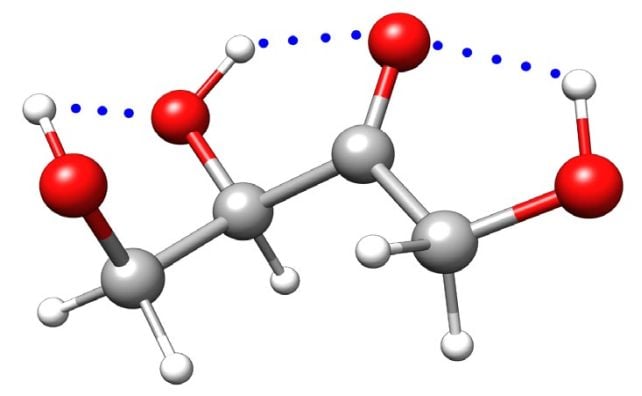
Life as we know it depends on sugars – small, carbon-based molecules that cells use for energy and as raw materials to build larger biological molecules. Sugars also form the backbone of RNA and DNA.
Sugars are also central to prebiotic chemistry – the chemical conditions that give rise to life. However, because scientists still don't know how the first sugars formed, they are often treated simply as starting ingredients in models of prebiotic chemistry.
We've had clues that sugar can form in a space environment. Sugars have been found in meteorites and samples from asteroid Bennu. Simple sugar precursors such as glycolaldehyde and (Z)-1,2-ethenediol have also been detected in space.
If we want to find true sugar, containing three or more carbon atoms, though, the researchers reasoned that the galactic center was the place to look.
The inner region of our galaxy is known as the Central Molecular Zone, and it's filled with thick clouds of gas and dust that are rich with complex organic molecules.
The team turned two radio telescopes in Spain towards a particularly promising cloud named G+0.693, which in the past has yielded other prebiotic molecules.
The search was conducted by looking for erythrulose's unique radio signature. Every molecule rotates in its own way, producing a distinctive pattern of radio frequencies that astronomers can identify even from thousands of light-years away.
G+0.693 gave the team what they were looking for – but there was a twist in the tale, and not just because erythrulose is chiral.
They were expecting that simpler sugars containing three carbon atoms would dominate.
Instead, four-carbon erythrulose appeared to be at least 8 to 17 times more abundant than the three-carbon sugars glyceraldehyde and dihydroxyacetone, which weren't detected in the cloud at all.
That could be key information that tells us how sugar forms in an interstellar environment.
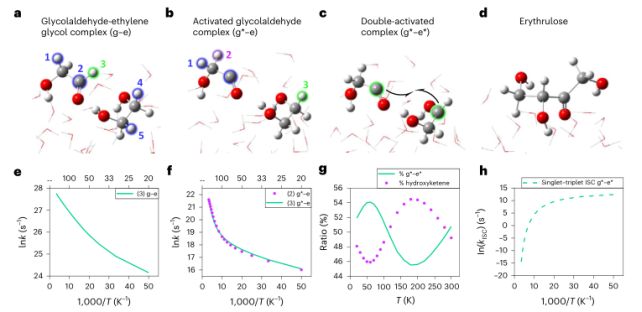
The researchers' computer models suggest the sugar forms on the icy surfaces of tiny dust grains drifting through space.
On those grains, two relatively common two-carbon molecules – glycolaldehyde and ethylene glycol – can be activated by radiation and combine to build erythrulose.
Eventually, shocks can knock these molecules off the dust grains and back into space, where telescopes can detect them.
The modeled abundances of these molecules do not quite match the observations, but there are many possible reasons for that. Future work may get to the bottom of the discrepancy.

But there's icing yet on this particular interstellar cake.
Erythrulose, at 14 atoms in size, is the largest molecule ever discovered in interstellar space that doesn't have closed rings in its structure – and only the second chiral molecule.
Related: Building Blocks of Life Can Be Forged by 'Dark Chemistry' Far From Stars or Planets
This suggests the interstellar medium – and the central molecular zone in particular – may be capable of much more complex chemistry than we realized.
In addition, the discovery could be a clue about how this chemistry may have existed in the cloud from which the Sun and all its planets were born.
The detection, the researchers write, "not only provides direct evidence that complex, chiral species can form under interstellar conditions, but it also takes us to a higher level in the ladder of interstellar chemical complexity, suggesting that other prebiotic (and potentially chiral) molecules could also form and survive under the extreme conditions of the interstellar medium."
The findings have been published in Nature Astronomy.
This article was fact-checked by Rebecca Dyer and edited by Michael Irving. While we pride ourselves on our process, we are only human. If you spot a mistake, please let us know.