
While it's also produced naturally by the body, creatine is perhaps best known as a 'muscle supplement': It helps boost supplies of the adenosine triphosphate (ATP) energy source that all cells need.
But could it have major additional health benefits?
A new study, from a team at the University of California, Los Angeles and published in iScience, builds on previous work showing how creatine can fuel more effective attacks from killer T cells against cancer – the body's frontline defense soldiers.
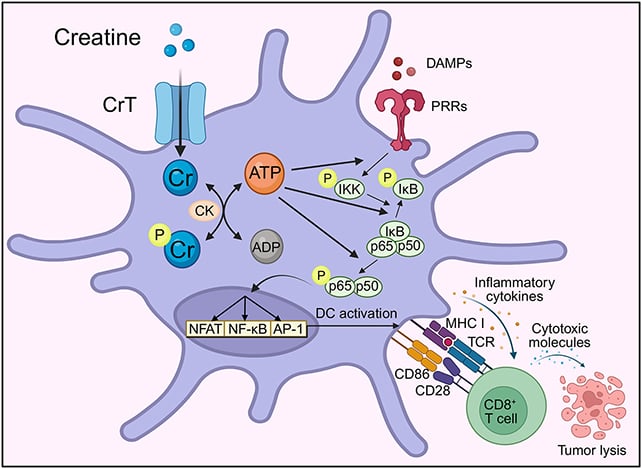
The latest discovery is that creatine can also act as a backup battery for dendritic cells, the support workers behind the T cells that direct them into the fray.
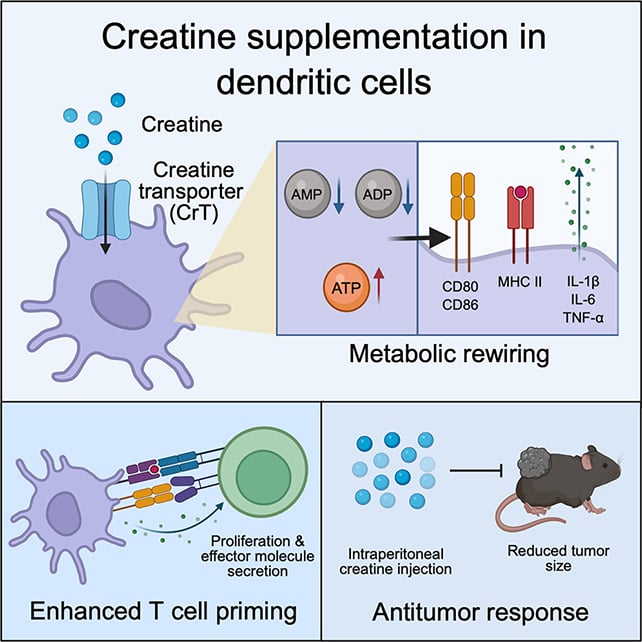
Potentially, creatine could give a significant boost to immunotherapies that train the killer T cells in the immune system to wipe out cancer. As powerful as these therapies can be, they're only effective in around 20–40 percent of patients.
"What this study shows is that creatine doesn't just help the T cells fighting cancer – it also energizes the entire infrastructure that supports and guides them," says immunologist Lili Yang.
"That makes creatine a promising supplement to holistically support the immune response that modern immunotherapies depend on."
The researchers started by examining cancer tumors in mice, identifying the nutrient-related genes most active in the dendritic cells inside those tumors.
They found the creatine transporter – tasked with pulling in creatine – was much more active in these cells compared to dendritic cells in healthy tissue.
Dendritic cells grown in the lab without this creatine transporter died out more quickly, and worked less effectively at activating and training T cells to fight cancer. The T cells relying on this support network were weakened too.
To get further proof of creatine's impact, the researchers tried the opposite approach: boosting creatine in mouse models of melanoma. This significantly slowed down tumor growth, and increased dendritic cell numbers and activity.
"Together, these findings uncover a previously unrecognized role for creatine metabolism in regulating dendritic cell function and support the use of creatine supplementation as a strategy to augment dendritic cell-based cancer immunotherapy," write the researchers in their published paper.
We only have evidence from mouse models and human cells grown in the lab so far – so there's still plenty of work to do. But there are good reasons to think that extra creatine could help sharpen the cancer-blasting skills of both killer T cells and the dendritic cells that find tumor fragments and marshal the immune system troops.
"Understanding how to metabolically support dendritic cells is about supporting the entire anti-tumor response, not just the killer T cells at the end of it," says molecular biologist Elliot Kang.

The researchers are clear that cancer patients shouldn't be taking creatine supplements – or any kind of bespoke course of medicine – without consulting a doctor.
As encouraging as these findings are, there's a lot more testing to be done yet.
While creatine is generally considered safe at recommended supplement doses, a lot depends on individual health profiles.
Next, the researchers want to add what's currently missing from this research: clinical trials. The idea is to test various levels of creatine treatment with people already undergoing immunotherapy for cancer, to see what the effects might be.
If those trials back up the findings from this research, the difference creatine might make is substantial. We already know it's cheap to produce, widely available, and is used as a supplement to treat people with rare metabolic disorders or deficiencies.
With a creatine boost, we might see that rate for successful immunotherapy treatments start to climb in the right direction.
Related: Scientists Just Unlocked an Endless Army of Cancer-Fighting Cells
"The potential we see here is that creatine could be used in two complementary ways," says microbiologist James Elsten-Brown.
"As a supplement to enhance the immune response of patients already receiving immunotherapy, and as a tool to improve the quality of dendritic cell-based vaccines before they're administered."
The research has been published in iScience.
This article was fact-checked by Clare Watson and edited by Rebecca Dyer. While we pride ourselves on our process, we are only human. If you spot a mistake, please let us know.