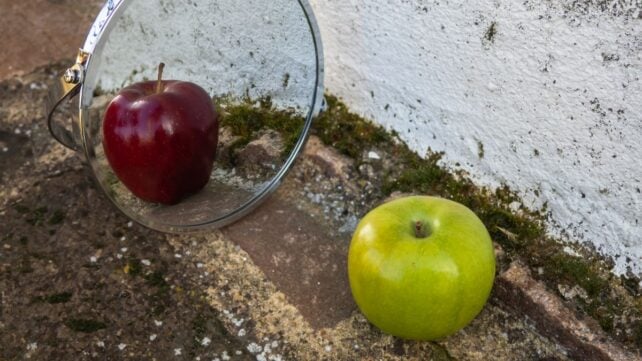
A mirror has one job: to accurately reflect the object in front of it.
Oh, sure, you might get the odd funfair mirror that reflects a deliberately distorted view of reality – but if you look at a mirror, you can be reasonably confident that what it reflects is more or less consistent with physical reality.
But what if you looked into a mirror and what it showed you was a completely different object from what it was reflecting?
That's what a team of engineers at the University of California, Los Angeles has built – a "lying mirror" that deliberately reflects a misleading image.
It's only a proof of concept at this point, producing a simple, predetermined image in response to a range of inputs – but the researchers envision a sophisticated technology that could disguise an object by replacing the optical information coming from that object with something more commonplace.
"In traditional optics, an image generator (like a projector or spatial light modulator) typically requires an active power source, digital processing, and an internal display to project a pre-programmed image," engineer and inventor Aydogan Ozcan of UCLA told ScienceAlert.
"A 'lying mirror', by contrast, is a passive optical element. It operates via reflection of incoming light from a scene, functioning like an optical transformation filter. It takes whatever incoming spatial light pattern strikes it and maps it into a deceptive output wavefront/image."
The mirror's secret is a structured surface made up of tiny features that alter the phase of light reflected from it.
During the design phase, deep learning is used to determine the pattern of structures required to guide the light into producing the desired image. The surface can then be manufactured, after which it produces one image only – let's say, a duck – so that a wide range of different input images would be transformed into the same duck decoy.
The principle has something in common with a hologram – a carefully engineered surface that manipulates the phase of incoming light so that the waves interfere to produce a desired image.
But rather than simply reconstructing a stored image, the lying mirror is designed to transform the visual information already carried by incoming light into a different, predetermined image.
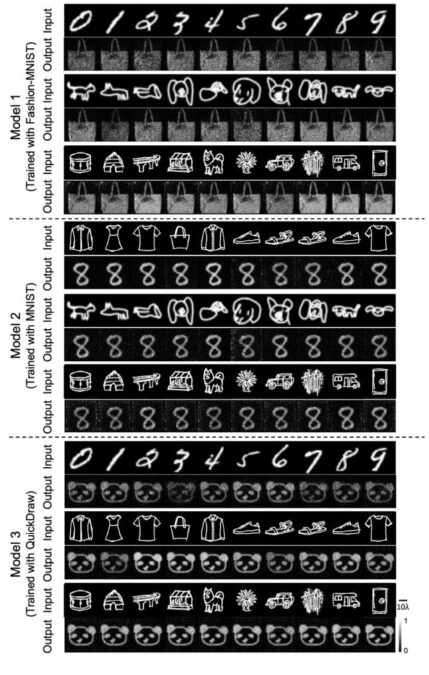
In computer simulations, the researchers trained different lying mirrors to turn images of clothes into a bag, different handwritten numerals into the number 8, and simple drawings into a panda's face.
And when the researchers tested the designs with images that were not part of this training – images the system had never seen before – it still produced a recognizable image of its decoy.
Next, the researchers built one of these mirrors – the version with the number 8.
Their experimental setup used an array of tiny mirrors to transform the handwritten numerals into the decoy. It worked with separate red, blue, and green wavelengths, as well as all three simultaneously.
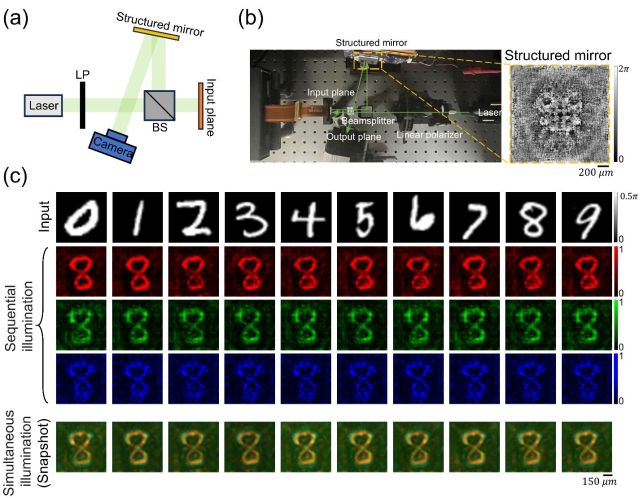
The second version worked across a continuous (broadband) range of visible wavelengths.
As a proof-of-concept, the idea is promising – but it's a long way from a practical technology. The complex interplay of real-world light is very different from a controlled laboratory environment.
"Our paper demonstrates significant results by moving beyond single-wavelength simulations to experimental validation using multi-wavelength RGB (red/green/blue) channels and a broadband design," Ozcan said.
"However, it still largely relies on a tightly controlled optical setup in a lab setting (using micro-mirror arrays and precise beam alignment) rather than a plug-and-play device you can hang on a living room wall."
The demonstration used coherent light, whereas sunlight and other forms of real-world lighting are usually incoherent. But the researchers also modeled versions for partially coherent light, showing that the underlying approach can work in simulations under less tightly controlled illumination.

Such a version would likely need multiple structure layers that could route and blend light from multiple ambient angles.
"Instead of relying on a single thin structured surface that works for well-aligned beams, the system would likely need deeper, multi-layered volumetric structures capable of routing and blending incoherent light coming from arbitrary angles," Ozcan told ScienceAlert.
Well, so then what? What would anyone even do with it?
Well, one option could be camouflage.
Related: The Awesome Physics Behind How Mirrors Work
"A lying mirror, instead of hiding a target, creates a benign, normal-looking decoy that fools the observer into thinking nothing unusual is present," Ozcan explained.
"For example: imagine protecting a sensitive tactical hardware. Instead of putting a bulky box or a protective cover over it (which signals to anyone walking by that something valuable or secret is inside), a lying mirror positioned in front of it reflects a completely mundane, uninteresting pattern."
Other potential applications include security, defense, and entertainment – and that last option definitely seems to have potential. Imagine looking into that funfair mirror and seeing a gurning ghoul leering back at you.
Step aside, wobbly mirror. Bring on the lies.
The findings have been published in Nature Communications.
This article was fact-checked by Clare Watson and edited by Clare Watson. While we pride ourselves on our process, we are only human. If you spot a mistake, please let us know.