
Out in the deep, dark depths of space, electronics and fuel can still get hot – very hot.
As plans are made for longer missions and more advanced tech systems, one of the key areas scientists want to understand better is what happens to ultra-cold, cryogenic liquids when they boil.
These liquids are used as rocket fuel and to cool electronics, for example, but at the moment, we don't know enough about their boiling behavior in microgravity.
A new study investigating just that, in a series of airborne experiments, has turned up some surprising results. The findings are published in npj Microgravity.
We know boiling liquids behave strangely in space; we've seen it happen before.
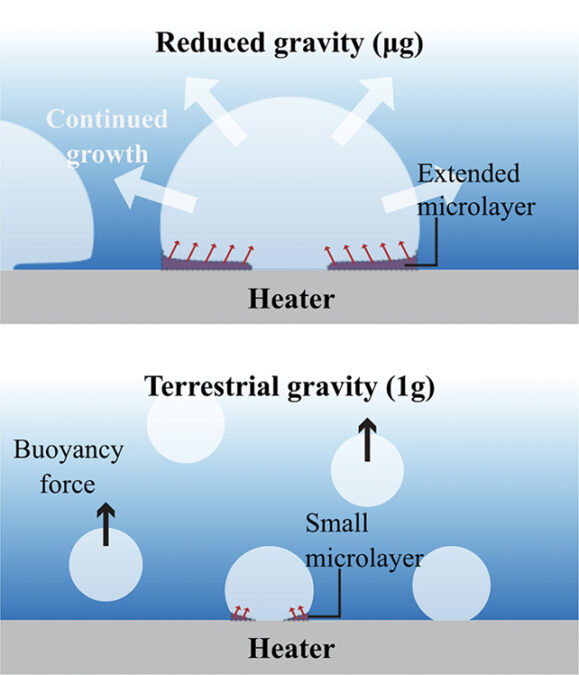
With less gravity, convection doesn't circulate heat through liquids as readily. And bubbles don't detach from surfaces as easily; they are less buoyant, so they don't float up as they do on Earth.
So it might reasonably be assumed that low gravity would also reduce the cooling capacity of those space bubbles because they can't carry heat away as fast.
But the researchers found the opposite: reduced gravity improved heat removal under certain conditions.
That is, until a heat threshold was exceeded and boiling became unstable.
"What we found is that up to a point, boiling actually got more effective, which was the opposite of what we expected," says mechanical engineer and senior author Youngsup Song, from the University of Florida.
"The catch is that the safety limit drops sharply. Both halves matter if you're designing real hardware."
Liquid nitrogen was used as a safe and reliable stand-in for all cryogenic liquids here, and experiments were carried out across parabolic flights that simulate weightlessness.

The researchers compared the data from these experiments to equivalent tests done in the lab, on solid ground under normal gravitational pull.
"Because we lose buoyancy in reduced gravity, we expected boiling would become less effective across the board," says Song.
But that's not what they found. Bubbles started forming sooner, and heat transfer was improved under near-zero-gravity conditions.
The researchers think it's because in microgravity, the bubbles stick closer to the heated surface, which improves heat removal efficiency.
"Our hypothesis is that bubbles stop floating away, so they linger on the surface," says Song.
"When bubbles are on the surface, there is a small liquid gap between the bubble and the heater, and that liquid layer is so thin that it can improve heat transfer."
While that sounds beneficial, the cooling systems reached their limit faster in the simulated space conditions.
The maximum amount of heat that the liquid nitrogen coolant could handle dropped by 65 percent in microgravity compared to the lab tests.

Essentially, the lingering bubbles begin to link together, dry out the surface faster, and cause the cooling mechanism to collapse. Reduced gravity is an advantage for heat transfer, right up until it isn't.
There are limitations to consider here: only nitrogen was tested, and on short parabolic flights.
However, the data gathered will be useful for future modeling as researchers devise equipment for more efficient, safer space travel.
Crucially, in their experiments, Song and colleagues used a silicon wafer coated with silicon dioxide as the heating surface, polished to be essentially free of microscopic flaws and cavities.
Past experiments have relied on standard metallic surfaces that have tiny imperfections, which affect bubble formation, leading to conflicting results that can't isolate the effects of gravity.
So the study here highlights the importance of material surface design when developing systems to keep fuel and electronics cool.
Related: Wild New Study Suggests Gravity Can Exist Without Mass
With fuel, for example, the further we want to explore beyond Earth, the longer propellant will need to stay below its boiling point – something surface design could help with.
"We want to engineer surfaces to see if we can delay boiling in the storage tank," says Song.
"That means [tuning] the surface features, like structures and chemistry, to suppress boiling."
The research has been published in npj Microgravity.
This article was fact-checked by Rachel Garner and edited by Clare Watson. While we pride ourselves on our process, we are only human. If you spot a mistake, please let us know.