
Entanglement is one of the best tricks in the quantum physics magic box, two particles that are inextricably linked when measured – a key component of potential advances in computing, communication, and sensing technologies.
Scientists have a variety of methods to create entangled particles, often using light particles (photons). The standard way of entangling photons is to fire a high-energy laser into a specially configured crystal.
It's a reliable and well-established method – and also one that demands energy, and of course access to an advanced laser.
Now researchers from the University of Ottawa in Canada and the Max Planck Institute for the Science of Light in Germany have done what some had considered impossible: generated entangled photons from sunlight.
Publishing their work in Optica, the team says the innovation could lead to entanglement technology cheaper and easier to deploy in "resource-restricted environments", from remote research stations to satellites in orbit.
"Our work shows that abundant natural light sources can be used for quantum entanglement, opening the possibility of more energy-efficient and accessible quantum technologies," says physicist Cheng Li, from the University of Ottawa.
The researchers were encouraged by earlier experiments showing that entangled photons could be produced by LED light, suggesting that incoherent light – light without the synchronicity and uniformity of lasers – had potential for triggering this process.
"Some world-renowned researchers in the field even questioned whether it would be possible."
– Physicist Cheng Li
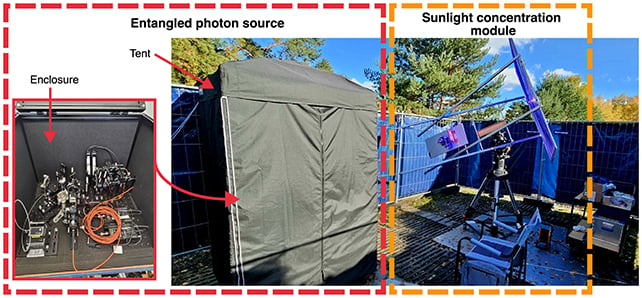
The experimental setup included a window-sized Fresnel lens and a funnel that concentrated collected sunlight into an optical fiber the width of a human hair.
The focused light was then shone on a crystal to do the actual entangling.
To address the incoherent (or 'messy') characteristics of the sunlight, including its direction and wavelength, the team focused on its polarization: the orientation of its oscillating electromagnetic field.
By entangling this characteristic in particular, the device ensured the surrounding messiness of the light didn't fundamentally prevent polarization entanglement.
"We designed our experimental setup so that differences introduced by the different colors and propagation directions didn't influence the photons' polarization," says Li.
"As our theory predicts, if the entanglement lives only in polarization, then it should only depend on the pump's orderliness in its oscillation direction and not on its direction or color.
"This allowed us to produce high-quality polarization entanglement from highly spatially and temporally incoherent sunlight."

The entangled photons the team produced passed several important quantum physics tests.
The particles were about 94 percent similar to a perfectly entangled state, and violated Bell's inequality – a standard sign that their correlations could not be explained by classical physics.
Once entangled photons are created, they can retain their intrinsic link even when separated by enormous distances. In principle, that could mean linking giant telescopes, for instance, or communications that can't be intercepted.
"This technology could one day enable satellites to create secure encryption keys using the sunlight already abundant in space, reducing the need for onboard lasers and much of the supporting hardware," says Li.
"Sunlight-driven entanglement generation could also provide the crucial ingredient needed to scale up quantum computing without adding to the energy burden."

The researchers are calling this a "proof-of-principle demonstration": We don't yet have a fully working sunlight-powered quantum entangler that can be shipped around the world or packaged into other technology.
It's a promising breakthrough, however, as a completely new kind of pump source for entangling photons. The quality of the entanglement can be further improved, the researchers say, as can the brightness – essentially the rate at which entangled photons are produced.
Related: We May Already Have The First Hints of Quantum Gravity – Hiding in Plain Sight
This is also more evidence of how important persistence can be when it comes to science in the quantum realm. Big steps forward can often be theorized a long time before the practical proof arrives.
"Some world-renowned researchers in the field even questioned whether it would be possible to detect any photons – not to mention entangled photons – from sunlight-driven nonlinear optical processes," says Li.
"We trusted our calculations, continued improving the experimental setup, and eventually showed that it was possible."
The research has been published in Optica.
This article was fact-checked by Rebecca Dyer and edited by Rebecca Dyer. While we pride ourselves on our process, we are only human. If you spot a mistake, please let us know.