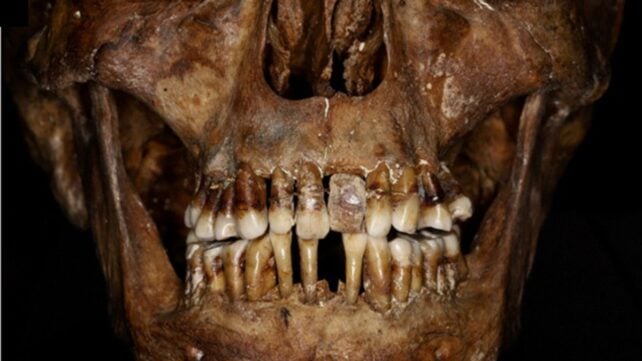
In 1988, archaeologists cracked open a lead coffin inside the Château de Laval in northwestern France and found something peculiar.
A woman who had been dead for more than 350 years, but whose teeth looked better than you would expect.
She'd been embalmed, which helped.
But something in her mouth caught the team's attention: a strange metal fixture wound around her teeth.
Nobody in 1988 had the tools to work out what it actually was, or why it was there. So the mystery went back into storage, along with the coffin.
It took another 35 years, a fresh set of dental scanners, and a very patient team of archaeologists to finally answer the question.
The skeleton belonged to Anne d'Alègre, a French aristocrat who died in 1619 at the age of 54.
And according to a 2023 study in the Journal of Archaeological Science: Reports, d'Alègre spent her final years quietly fighting to keep her own teeth in her head – using gold wire.
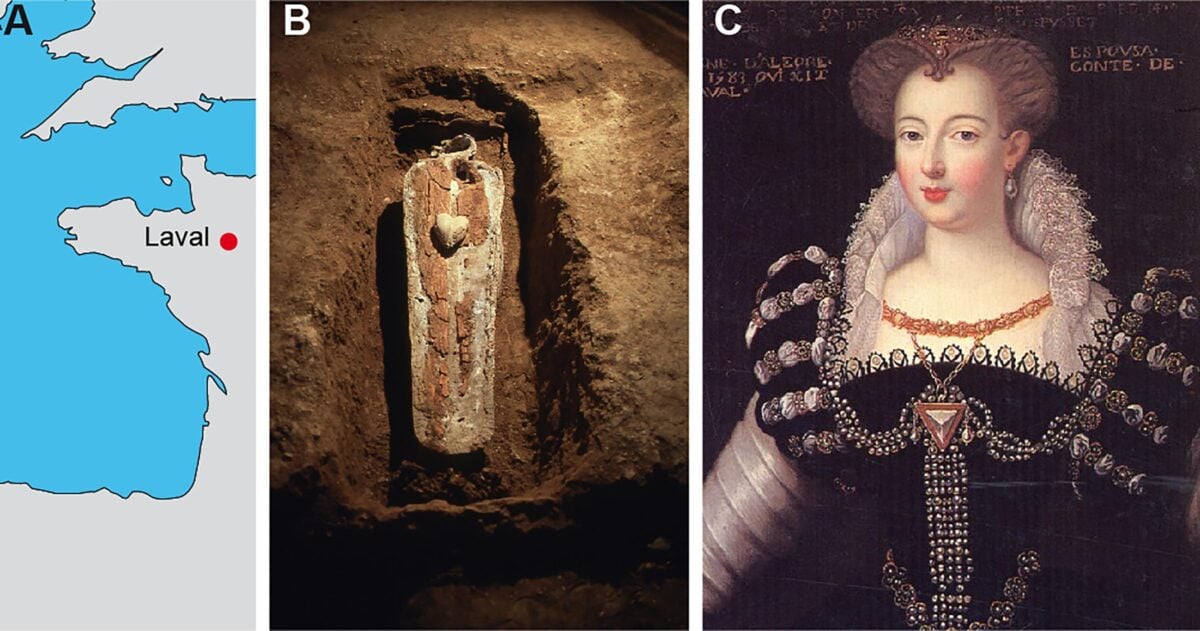
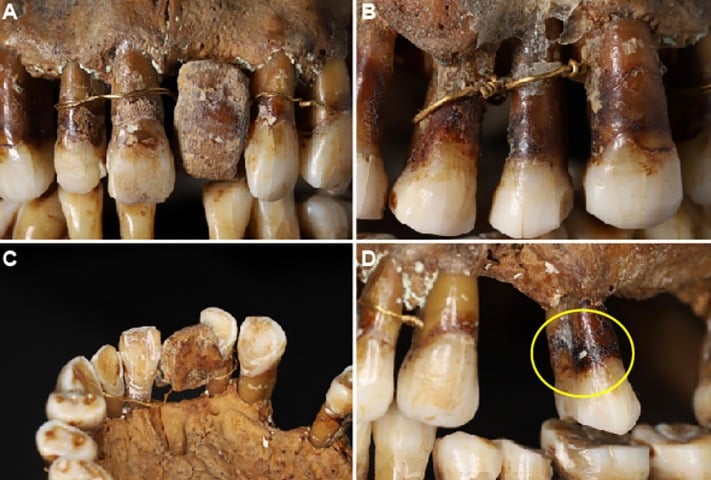
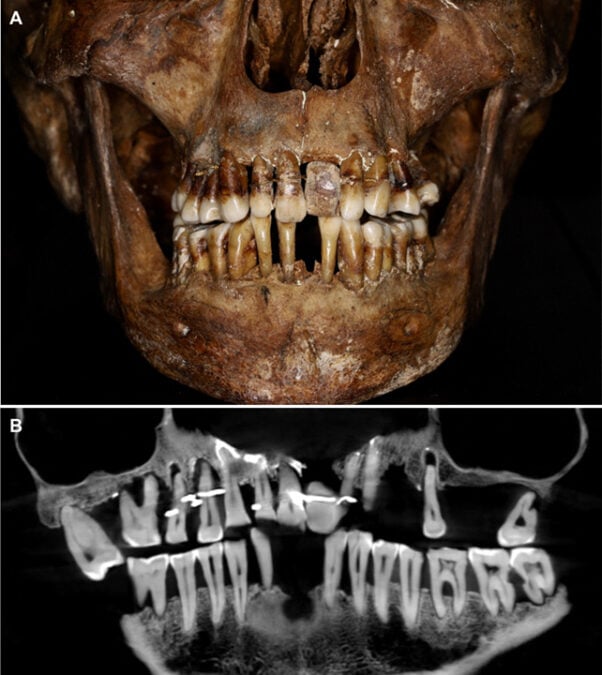
A cone beam scan – a type of 3D X-ray – found that gold wiring had been threaded through several of d'Alègre's teeth, tightening and bracing them in place.
She also had a false tooth carved from elephant ivory, not the hippopotamus ivory that was fashionable at the time.
It wasn't just a cosmetic flourish. D'Alègre had severe periodontal (gum) disease, the kind that loosens teeth in their sockets until they fall out on their own. The gold wire was there to buy her time.
"We propose that the objective of the treatment was triple: therapeutic, aesthetic, and societal," anthropologist Rozenn Colleter from INRAP, the French National Institute for Preventive Archaeological Research, and colleagues wrote in their journal article.
Alas, d'Alègre's makeshift wiring probably didn't help – at least not directly.
Wiring like this needs constant retightening, and every adjustment put more strain on the teeth next door – loosening those too.
D'Alègre would have known that. She kept doing it anyway.
At the time, a good set of teeth wasn't just about comfort. Losing your teeth didn't just change how you looked – it changed how people heard you.
"If the patient remains toothless and disfigured, his speech becomes depraved," according to 16th-century physician to French kings, Ambroise Paré.
For d'Alègre, that mattered more than most. She was a twice-widowed socialite – exactly the kind of woman whose face and voice were being judged, constantly, by a society that tied a woman's worth to how she presented herself.
"Beyond the only aesthetic aspects, the installation of a dental prosthesis, and despite the possible odontological complications known at that time, perhaps allowed Anne d'Alègre to maintain a certain social rank in front of her detractors," Colleter and colleagues wrote.
D'Alègre was a Huguenot – a French Protestant – who lived through the French Wars of Religion, fighting on the Protestant side against the Catholic crown.
By 21, she was already a widow with a young son, Guy XX de Laval. When the Eighth War of Religion broke out, mother and son were forced into hiding as the king seized their land.
Her son eventually converted to Catholicism, went off to fight in Hungary, and died in battle at 20.

D'Alègre outlived him, married again, was widowed again, and died of illness at 54 – her teeth still wired into her jaw.
But those teeth were weathered, worn down, possibly from d'Alègre grinding her teeth or clenching her jaw.
"We have noted that the bruxism observed on Anne d'Alègre could be the sign of important stress states," the researchers wrote.
"Her artificial teeth were probably not just a coquetry on her part. The various widowhoods she experienced undoubtedly contributed to her anxiety."
Related: Hidden Crotch Detail Solves a 500-Year-Old Leonardo Da Vinci Mystery
Today, severe periodontal disease affects an estimated 1 billion adults worldwide, according to the World Health Organization.
Most of us just don't have gold wire and elephant ivory on hand to fight back, but we may soon have access to experimental treatments that can repair enamel and fight tooth decay – without drilling.
The research has been published in the Journal of Archaeological Science: Reports.
This article was fact-checked by Clare Watson and edited by Clare Watson. While we pride ourselves on our process, we are only human. If you spot a mistake, please let us know.