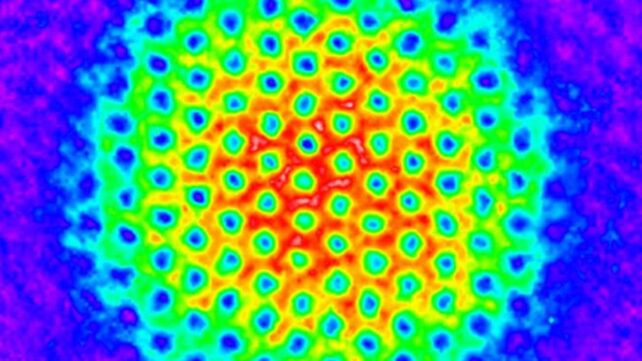
Empty space is never actually truly empty.
Even a quantum field in its lowest-energy state, the vacuum, has unavoidable fluctuations that arise from the Heisenberg uncertainty principle: Certain pairs of properties cannot both have precisely defined values at the same time.
In real-world terms, this means that a quantum field should resemble a staticky TV, and plenty of indirect evidence suggests this is the case.
Now, however, physicists led by Yansheng Zhang at the University of Cambridge in the UK have made a major breakthrough: They have directly imaged fluctuations in a lab-made quantum field.
"Observing such fluctuations in the sine-Gordon limit opens many possibilities for laboratory simulations of relativistic fields in regimes that are presently not theoretically tractable," they write in a preprint posted to arXiv.
Vacuum fluctuations aren't just theoretical jiggery-pokery – they actually have real effects on the physical Universe.
Excited atoms interacting with fluctuations in a vacuum can spontaneously decay to a lower state, emitting a photon in the process. Electrons in a hydrogen atom can have slightly different energy levels due to fluctuation interactions.
Then there's the Casimir effect. If you put two conducting plates very close together in a vacuum, they experience a measurable force that pulls them towards each other due to the difference in quantum fluctuations between the plates compared to outside the plates.
Heck, they even play a role in the theoretical Hawking radiation emitted at the boundary of a black hole.
And in cosmology, tiny primordial quantum fluctuations are thought to have been stretched to enormous scales during cosmic inflation. Those tiny variations eventually provided the seeds from which matter collected, ultimately producing the cosmic web of galaxies and clusters we see today.
Quantum field theory describes the Universe as permeated by fields, with particles emerging as excitations in those fields. Each field can be thought of as a collection of modes of different wavelengths, a little like the different ways a guitar string can vibrate.
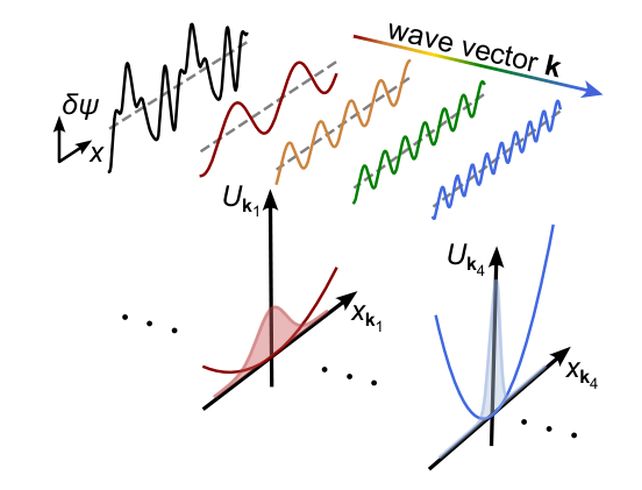
Each mode behaves a bit like a quantum harmonic oscillator – the quantum-mechanics version of a mass bouncing on a spring. And thanks to quantum uncertainty, even in its lowest possible energy state, that oscillator can never be perfectly still.
But for something that has such profound effects on the physical Universe, quantum fluctuations are extremely difficult to observe directly. They are extremely small, inherently random, and don't present a clear target that scientists can point a detector at.
Most observations of quantum fluctuations have therefore measured their consequences, not the fluctuations themselves.
This is where Bose-Einstein condensates enter the chat.
A Bose-Einstein condensate (BEC) is a cloud of ultracold atoms, chilled to just a hair above absolute zero. At these temperatures, the atoms collectively behave as a single quantum system, allowing quantum effects to be observed across the cloud.
So, instead of trying to image the vacuum of empty space, Zhang and his team built a quantum field they could observe: a two-dimensional BEC of potassium-39 atoms.
The researchers used two different internal states of the atoms of potassium-39, which they coupled using radio waves.
The quantum field they wanted to study was encoded in the atoms' spin states: Essentially, variations in spin across the cloud behaved like variations in a quantum field.
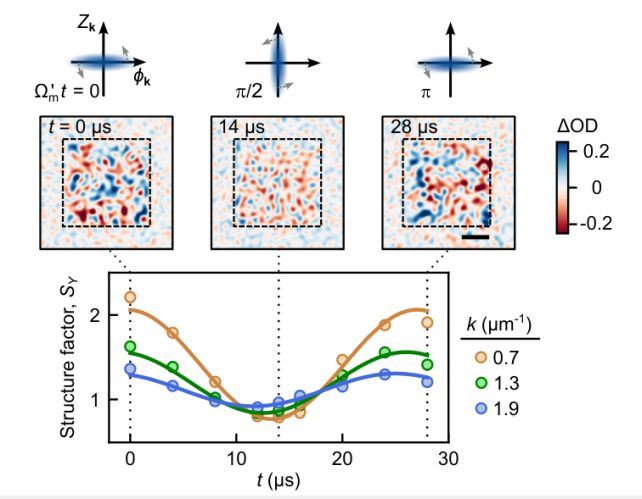
And, because the BEC is made of atoms, the researchers could image them and reconstruct the local variations – the quantum fluctuations – in the tiny flesh.
But there are other things that can make fluctuations. Temperature variations. Experimental noise. So to figure out that the staticky fuzz that emerged in the BEC was actually the result of vacuum fluctuations, the researchers exploited the properties of quantum oscillators with an amplification experiment.
First, they prepared the spin field close to its ground state. Then, they suddenly changed the strength of the coupling between the two atomic states. That change was designed to amplify the tiny fluctuations already present in the field.
An oscillator sitting at zero energy wouldn't respond to this change by suddenly starting to oscillate – but a quantum oscillator in its ground state isn't perfectly still. It retains that baseline jitter from quantum uncertainty. Changing the system causes those pre-existing fluctuations to evolve into measurable oscillations – and this is what the researchers observed.
The next bit is where it gets really fun.
They performed the same measurements without amplifying the fluctuations first, looking at how the fluctuation strength changed with frequency. Quantum vacuum fluctuations and ordinary thermal fluctuations produce distinctly different patterns.
And, once again, they got a hit. The fluctuations fell off with increasing frequency exactly as expected for vacuum fluctuations, rather than thermal noise.

This is actually really exciting.
Importantly, the BEC can be tuned to behave like a type of relativistic quantum field known as a sine-Gordon field. This gives the researchers a laboratory model in which they can potentially watch quantum fluctuations evolve into much larger, more complex phenomena.
Related: Physicists Simulated a Black Hole in The Lab, And It Then Began to Glow
There are some situations in quantum theory where the math becomes ferociously difficult. This new system means that, instead of sitting down and plugging through horrendous equations, scientists could potentially build a controllable quantum system governed by analogous physics and watch what happens.
The researchers say their system could help probe situations such as false-vacuum decay, a potentially Universe-destroying process; particle production; and the formation and decay of topological defects in quantum fields.
"The fact that we can directly observe field fluctuations in the regime where the quantum uncertainty dominates over thermal noise could offer a unique window into the microscopic mechanisms governing these phenomena," they write.
The research, which is yet to undergo peer review, is available on preprint server arXiv.
This article was fact-checked by Rebecca Dyer and edited by Rebecca Dyer. While we pride ourselves on our process, we are only human. If you spot a mistake, please let us know.