
Although our Universe appears to be stable, it might just be in a temporary state of false calm that could rupture in the blink of an eye.
We consider a vacuum to be the lowest energy state of the Universe. But it's possible that there's an even lower-energy, more stable state.
Theoretically, if a pocket of space transitioned into this state, it could expand and engulf the Universe at the speed of light, overwriting physics as it goes.
Welcome to false vacuum decay, one of the most terrifying concepts in quantum theory – and a team led by physicists at Tsinghua University in China has just found a way to simulate it in a laboratory setting.
Why would they want to do such a thing? Well, false vacuum decay only results in the destruction of the Universe as we know it in some theoretical scenarios.
More broadly, it sits at the intersection of quantum theory and relativity – making it a potentially useful tool for trying to resolve the heretofore irreconcilable differences between the two frameworks.
Here's how it works. The equations of relativity are extremely good at describing how physics works in the Universe – on large scales and at high speeds.
However, once you get into the extremely small realm – the quantum Universe that exists at atomic and subatomic scales – relativity is no longer the right tool to describe how things behave.
Currently, the best tool for that job is quantum field theory, which describes how quantum fields and particles interact.
When confined to each of their lanes, quantum field theory and relativity just chug along, doing their thing, but in extreme conditions, they overlap and things get messy. There's no framework that unifies both realms, so physicists like to probe these points of overlap to see if they can find such a theory.
One of the predictions of quantum field theory is that there is no such thing as a perfect vacuum. What we call the vacuum of space is instead the lowest-energy state of a quantum field.
If the energy landscape of a quantum field has multiple local minima, or low points, these correspond to false vacuums that can transition to a true vacuum (an even lower energy state).
Think of a landscape that has multiple lakes, some of which are deeper than others. Somewhere beneath them is an even deeper basin. If a tunnel opens up at the bottom of one of these lakes, it will drain into that deeper basin.
But if something like that happened in the vacuum of space, it wouldn't stay contained. Instead of water draining away, a tiny region of space would flip into this lower-energy state, forming a kind of bubble.
That bubble wouldn't just sit there – if it exceeded a critical size, it would expand outward at close to the speed of light, converting everything it touches into that new state.
This is why it straddles quantum theory and relativity. The initial tunneling into the lower state is a quantum process – but the consequences play out on the largest scales imaginable, expanding to change the entire Universe.
Neither quantum field theory nor relativity on their own can fully describe the process. Both are needed to understand false vacuum decay.
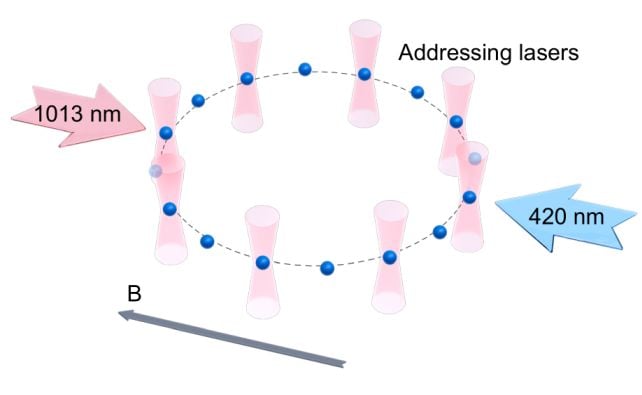
Which brings us back to the laboratory experiment. It didn't actually involve poking a pocket of vacuum to turn it inside out, don't worry. Instead, the researchers used a proxy – a ring of Rydberg atoms.

In a normal atom, you have a nucleus surrounded by its tiny swarm of electrons. If you add just a bit of energy to the atom, the electron swarm puffs out a little, making the atom just that teensy bit bigger and looser.
A Rydberg atom is what you get when you add a lot of energy under conditions that allow it to still hold onto its electrons. It puffs up quite large for an atom, many microns across, and the electrons are about as loosely bound as they can get without flying off.
Because they're so loosey-goosey, Rydberg atoms behave in an exaggerated way, which makes them useful for conducting experiments.
The researchers arranged an even number of mutually repulsive Rydberg atoms in a ring. In this arrangement, each atom falls into a spin alignment opposite to the atom on either side, so you get a symmetrical, alternating pattern of spin alignments around the ring.
Then, they excited the atoms with lasers, breaking the symmetry. This allowed the ring to exist in two different patterns with slightly different energy states, one of which represented the false vacuum and the other the true vacuum.
Related: Physicists Simulated a Black Hole in The Lab, And It Then Began to Glow
This slightly chaotic ring would then 'decay' towards a preferred ground state, at a rate that depends on the strength of the symmetry-breaking laser.
This is consistent with the most commonly accepted mechanism that is thought to drive false vacuum decay – the nucleation of a quantum bubble that contains the true vacuum. Conditions that make the bubble easier to form make the transition more likely to happen.
The experiment doesn't directly tell us anything new about false vacuum decay, but it does confirm theoretical predictions about how it would play out.
This means that the team's system of Rydberg atoms represents a new playground for probing the wild intersection where quantum physics and relativity collide.
Maybe one day it will also tell us how worried we need to be about the Universe as we know it suddenly transforming into something else entirely.
The paper has been published in Physical Review Letters.