You may think you made a decision to read this article, but did you, really?
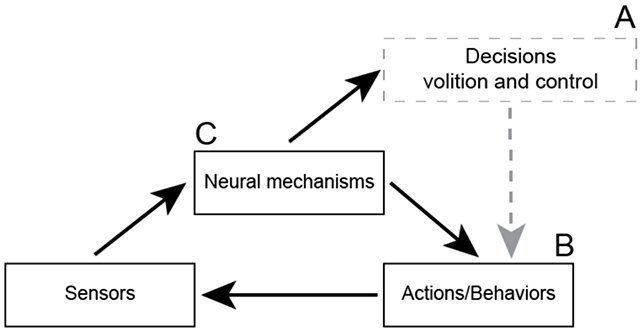
What we consider to be making a decision might in fact be a different kind of brain interaction between what we perceive, and the actions we take in response – less of a step-by-step linear process, and more of a circular feedback loop.
In a new study published in the Journal of Cognitive Neuroscience, neuroscientist Tom James from Indiana University challenges the conventional 'sense-think-act' view of how the brain makes decisions, also known as the 'sandwich model'.
The core idea is that our feeling of deliberation (which pizza topping to have, for example) and the physical choice itself (opting for ham and pineapple) are actually happening together, triggered by the same neural activity in the brain.
In other words, there's no middle step between sense and act, just the illusion of one, the argument goes.
"Explaining that the brain works by way of a central controller suggests that you haven't figured out how the brain works, because you've just put a person inside your brain," says James.
"That person inside your brain would need another person inside its brain, which would need a person inside its brain and so on, in an infinite regress. So the problem is never solved. It's just passed on."
There are several layers to the hypothesis put forward by James.
One is that while sensory and motor mechanisms are connected to physical, biological machinery – like eyes to see an apple and a hand to grab it – decision-making doesn't have a physical link.
So while we might have the sense of making decisions, and decisions are actually being made, the neuroscience behind them needs a rethink.
"The leap, I think, is to say that the brain works by having decision-making or control processes," says James. "It produces behavior that is well described in that way."
"But it doesn't need a process that does that to make it look that way."
James puts forward several analogies to make his point. One is saying "the university took certain actions."
For example, we might say "the university decided to close early." The phrase can be useful shorthand, of course, but that's an abstraction of the different meetings, calls, and other interactions that went into that decision. It does not identify the physical people and events that produced the outcome.
Similarly, the neuroscientist argues, the idea of the brain having a separate decision-making moment is also an abstraction.

Another analogy involves robots. If a robot is programmed to turn towards its targets and avoid collisions, those simple rules might lead it to follow along the walls of a room to find what it's after.
That strategy might appear to be a decision made by the robot – but actually, it's simpler than that. It's a result of more basic programming.
"It looks intentional. It looks strategic. It looks like the robot is making decisions. And yet, it is not," says James.
"The reason we know it is not is that there are no systems built into it to do that."
Clearly, all of this reasoning needs to be put to the test in actual neuroscience studies – there were no experiments or brain scans done here. What James is saying is that his framework could be a better way to understand the brain and what's going on when we decide to do one thing and not another.
One useful way forward might be to study choices and decisions in more dynamic, real-world settings rather than controlled lab tests, James suggests.
It might also be helpful in future studies to not assume that an action – such as a button press or a switch in attention – has a separate, non-physical, abstracted decision behind it.
Related: Scientists Uncover Shared Genetic Roots of OCD, Tourette Syndrome, And Autism
"Our actions feel like they are caused by decisions based on desires, beliefs, and intentions," says James.
"As mental phenomena, [decisions] are defined on too abstract a level for the goals of cognitive neuroscience."
The research has been published in the Journal of Cognitive Neuroscience.
This article was fact-checked by Rachel Garner and edited by Rebecca Dyer. While we pride ourselves on our process, we are only human. If you spot a mistake, please let us know.