Alone in a dried-up crater lake millions of miles from Earth, NASA's Curiosity rover has been tirelessly exploring for 14 years.
In that time, it's seen the good, the bad, and the ugly of what Gale Crater has to offer. Surprising minerals. Interesting rock textures. Red noons and blue sunsets. Heck, even 'eclipses' involving Mars's two moons.
The rugged terrain holds many secrets that tell scientists about the red planet's geological history, and most of the oddities discovered get an explanation sooner or later.
Even after all this time, however, the rover can still roll up to a new way Mars has found to be weird – something that defies easy explanation.
This time, it's holes.
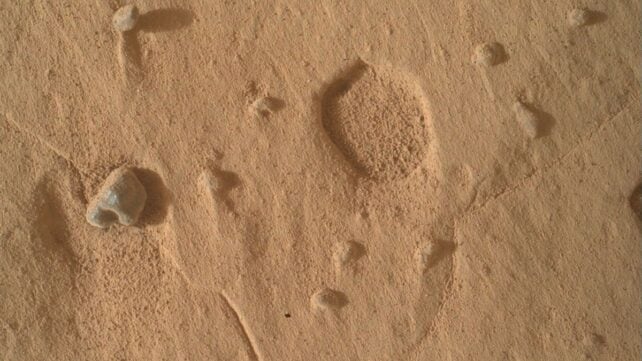
They were found dotting the ground while Curiosity climbed through Valle Grande, a broad valley cutting through the sulfate-rich layers of Mount Sharp that rises in the middle of the crater.
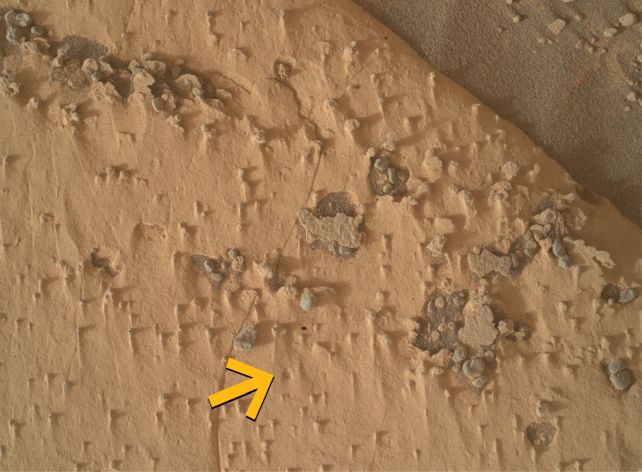
Holes and pitted ground on Mars are nothing new. Anywhere with geology and a history of getting smacked with meteorites is going to have holes. But these holes – tiny, shallow divots in the ground – are unlike anything seen before on Mars.
Usually, small pits in the bedrock can be explained fairly readily. Pebbles or mineral nodules embedded in softer rock resist erosion for longer than their surrounding substrate, before eventually weathering out and leaving little cavities behind.
The new pits are different. They're unusually broad and shallow, and there are no obvious pebbles or nodules nearby that look as though they once occupied them.
So Curiosity's science team decided to take a closer look.
The rover's Mars Hand Lens Imager, or MAHLI, photographed the pits at close range, while its Mastcam cameras captured overlapping stereo images of the surrounding terrain.
Those images can be combined to build three-dimensional models of the surface, allowing scientists to measure the pits' shapes and depths and, hopefully, work backward to how they formed.
The mystery is particularly intriguing because Curiosity is currently driving through relatively fresh territory.
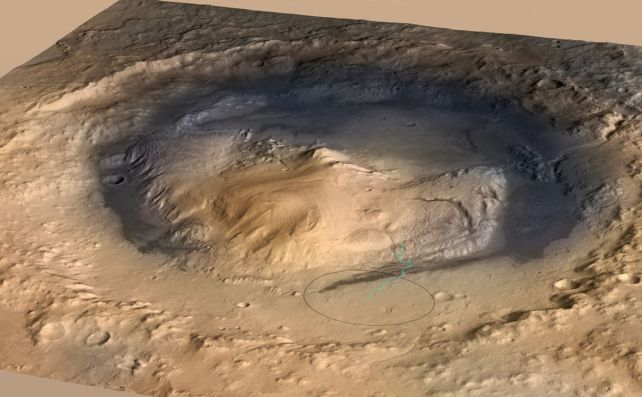
Earlier this year, the rover left behind the strange, web-like "boxwork" terrain it had spent months investigating – a landscape of resistant mineralized ridges thought to have been shaped by groundwater billions of years ago.
Now, as it climbs higher through Mount Sharp, Curiosity is working its way through the layered sulfate rocks above the boxwork.
Those layers are themselves changing as the rover ascends, with differences in texture, chemistry, and resistance to erosion that could preserve a record of changing conditions on ancient Mars.
In fact, the rover just marked a major milestone in its ascent – an elevation gain of 1,000 meters (3,280 feet), celebrated in late August 2026.
The climb isn't just for a better view of the surrounding terrain – although that's a nice perk. The peak of Mount Sharp rises 5.5 kilometers (3.4 miles) above the crater floor, and its sedimentary layers preserve records of different periods of deposition across the red planet's geological history.

By slowly working its way upwards, Curiosity can analyze those layers as it goes, looking for clues that can tell us how a once-wet environment transformed into the dry world we see today.
Related: NASA Spots a Bizarre 'Jellyfish' Floating on Mars. Here's What We Know.
The strange holes aren't the only mystery about the ground Curiosity is exploring. The researchers also noticed rapid changes in the appearance of successive rock beds, including rougher gray layers that resist erosion differently from neighboring material.
To figure out why, they directed Curiosity to sample the chemistry. Further analysis of that data will take more time.
So, too, will an investigation of the holes. They could be the result of an unfamiliar erosion process, an unusual property of the rock, or something else entirely – we'll just have to wait and see.
This article was fact-checked by Rebecca Dyer and edited by Rebecca Dyer. While we pride ourselves on our process, we are only human. If you spot a mistake, please let us know.