
The world's 'doomsday' seed banks could be a way to replant our planet after disaster, but only if their contents survive the years.
Even when they are carefully frozen, they may not last as long as we thought they would.
Scientists have now investigated which of our tropical crops last the longest in our seed banks – and it seems that mung bean stew may be a staple on the future doomsday menu.
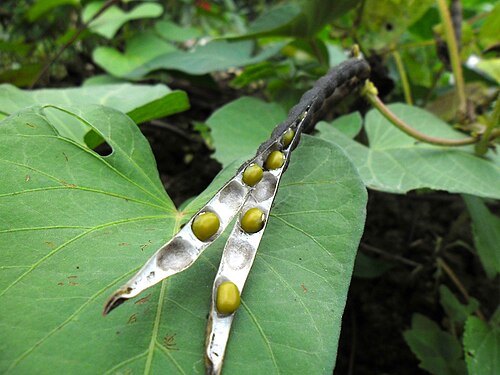
In recent germination tests, the frozen seeds of mung beans (Vigna radiata) and common beans (Phaseolus vulgaris) remained highly viable for decades.
Even after 45 years in storage, at least 90 percent of the mung bean seeds in one batch could still germinate with the potential to produce a plant.
The findings are published in Plant Genetic Resources.
_Dired_open_Pod_in_Hong_Kong.JPG)
The Australian Grains Genebank (AGG) may not be as famous as the 'Doomsday Vault' in Norway, but it contains one of the largest and most diverse crop genebanks globally.
Here, scientists have stashed away hundreds of thousands of seed types from cereals, legumes, and oilseeds.
Each is sealed in a packet at 15 percent relative humidity and -20 °C (-4 °F) to extend its natural longevity.
But how long will those little vessels of life last?
The truth is, we don't really know.
Today, experts have only predicted the longevity of about 70 plant species, and some of these estimates may not match reality.
To find out how seeds at the AGG are actually faring, researchers in Australia conducted germination tests on 3,861 stored batches at the AGG, covering six tropical crops in total.
These included a type of cereal called sorghum (Sorghum bicolor), the common bean, the mung bean, the soybean (Glycine max), the pigeon pea (Cajanus cajan), and the adzuki bean (Vigna angularis).
Some of the seeds dated to the 1960s.
When scientists tried to revive some batches, the seeds of pigeon peas had the lowest germination rates.
After an average of 36 years, only four batches exceeded 85 percent viability.
This signals to scientists that many of the seeds are in need of replenishing.

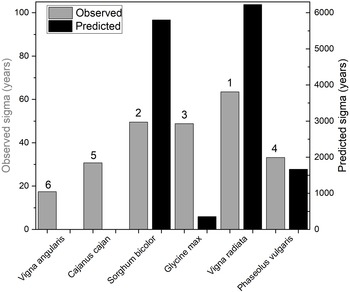
By contrast, mung beans were the longest-lived, followed by sorghum bicolor.
In fact, some seed batches of mung beans, common beans, and soy beans retained high viability for decades.
Even though these results seem promising, what's troublesome is that the longevity estimates are much, much shorter than we once assumed. Adzuki beans had the shortest average longevity estimate: just 17.4 years.
Older theoretical models predicted that frozen seeds from these species didn't need to be checked for hundreds, if not thousands, of years.
Based on the prior predicted longevity for sorghum, germination would be monitored every 2,901 years.
For mung beans, the interval would be 2,075 years.
"Given that we have shown real-time evidence of seeds showing <85 percent after as early as between 20 and 40 years under optimum, long-term storage conditions for all species; such extreme and infrequent monitoring seems risky," argue the authors, led by seed physiologist Katherine Baum at AGG.
Besides, just because a seed germinates in experiments doesn't mean it will go on to produce a viable plant.
Scientists are using this measurement as a proxy for viability. There are still many more steps in the growth to a fully-fledged plant.
Related: Scientists Analyzed Earth's Hidden Seed Vaults And Made a Disturbing Realization
"As long as genebanks continue to collect viability data and work in collaboration to share information on seed longevity, our understanding of the observed longevity of species will continue to grow," the study authors conclude.
With this trove of new information, we can then refine prediction models for how long seeds will last, "which is imperative to the global conservation of plant genetic resources," the team adds.
Crop seeds are also stored in Norway's 'Doomsday Vault' and other banks around the world.
Preserving these seeds is just a start. Now, we need to maintain the batches through the decades.
We can't just sit back and hope.
The study is published in Plant Genetic Resources.
This article was fact-checked by Rebecca Dyer and edited by Rebecca Dyer. While we pride ourselves on our process, we are only human. If you spot a mistake, please let us know.