If you think you know what DNA looks like, there may be a surprise hiding in your blood.
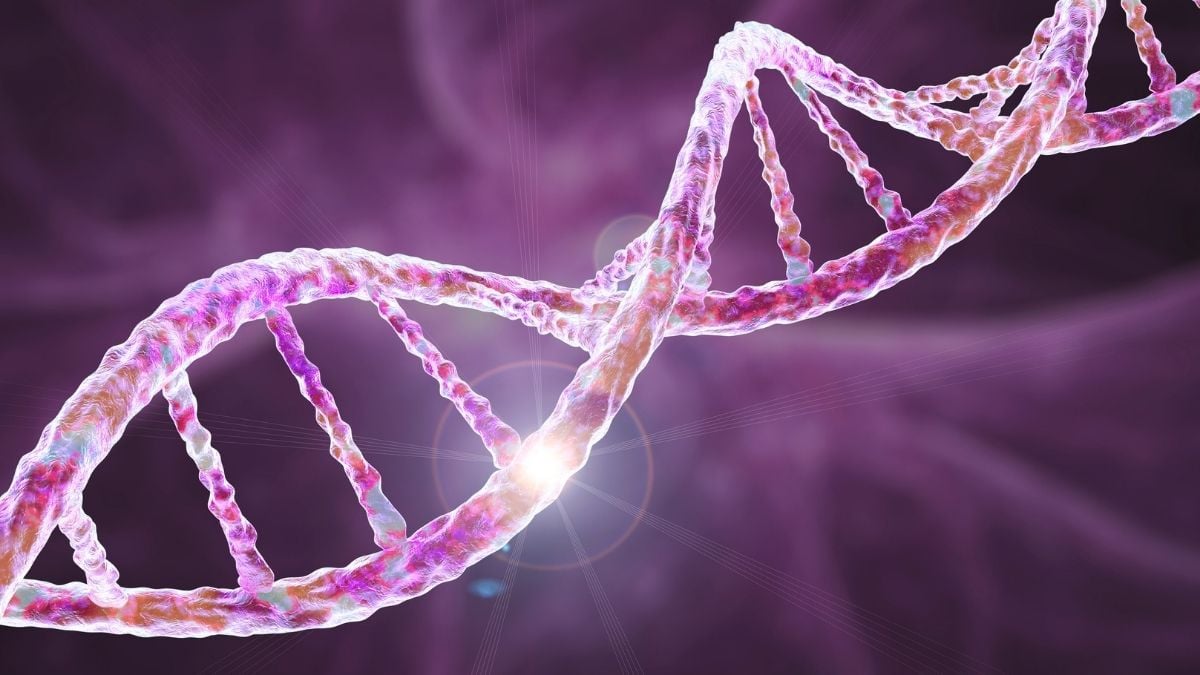
DNA instantly brings to mind its famous double helix. But genetic material does not always remain in that familiar form. Some pieces can fold into compact, four-stranded structures.
These unusual shapes have previously been seen inside cells. Now scientists say they have caught them folded in human blood plasma.
So why is DNA in our blood at all?
As cells throughout the body die, they leave behind small fragments of DNA. These enter the bloodstream like pieces of a torn message, carrying clues about what is happening inside us.
Until now, scientists have concentrated on reading the message: its genetic letters, the length of each fragment, and where in the genome it came from. A new preprint study suggests that how the message is folded could matter too.
Researchers detected four-stranded structures called G-quadruplexes, or G4s, in genetic material captured directly from human plasma.
"Our study provides, to our knowledge, the first direct biochemical evidence that folded G-quadruplex structures are present in nucleic acids captured directly from human plasma," University of Cologne molecular biologist Robert Hänsel-Hertsch told ScienceAlert.
A G4 begins when four copies of the genetic letter guanine join to form a tiny square. Several squares can stack together, creating a compact structure very different from the familiar double helix.
The mystery began when scientists noticed unusual fragments known as ultrashort cell-free DNA. At roughly 50 genetic letters long, these single strands were so small that they could slip through the nets used by standard DNA-capturing methods.
Some contained enough guanine to form G4s, and computer analyses pointed to the same possibility.
But finding a piece of string that could form a knot is not the same as finding it already knotted. The team had to catch these structures in human blood while they were still folded.
That was harder than it sounds. Harsh procedures used to extract DNA from plasma could pull delicate structures apart or allow molecules to refold during the experiment. If a G4 appeared at the end, the researchers could not know whether it had existed in the bloodstream or had been created in the laboratory.
So the team set a gentler trap. They captured genetic material directly from plasma without heating it or using extraction steps that could disturb its shape.
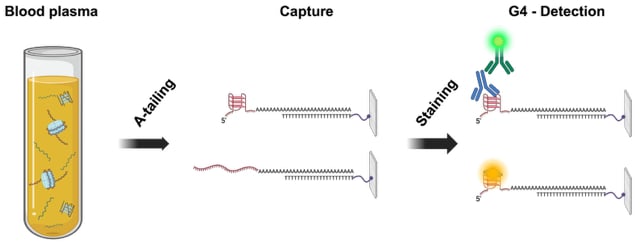
They then used two independent detectors. One was an antibody designed to recognize G4s. The other was a small molecule that lights up when it binds to one.
Both produced a signal.
A matching genetic sequence that could not fold was also captured but produced no signal. The researchers then tested the result by making the two G4-detecting agents compete for the same structures. Each reduced the signal produced by the other, indicating that both were recognizing folded G4s rather than sticking randomly to the captured material.
"Structure is a layer of information, and potentially of biology, that sequencing alone cannot see," Hänsel-Hertsch said.
But the discovery opened another mystery.
Although the investigation began with ultrashort DNA, the experiment could not reveal whether the detected G4s were made from DNA or RNA. RNA can fold into the same four-stranded shape, and the detectors recognize the structure rather than the molecule underneath it.
Hänsel-Hertsch described this as "a real limitation".
One next step will be to treat the captured material with enzymes that destroy either DNA or RNA before testing it again. Sequencing the folded molecules could then reveal their identity and genomic origin.

Scientists also do not know which tissues released them, or whether the structures folded inside cells or only after entering the bloodstream.
So what might they tell us about health?
G4s often occur in parts of the genome involved in controlling genes, and elevated G4 levels have been observed in several tumor types. This raises the possibility that G4s circulating in blood could one day provide information about cancer that cannot be found by reading DNA sequences alone.
But this is not a new cancer test.
The study was designed to establish that folded G4s are present in plasma, not to compare people with cancer against healthy participants. Before considering any diagnostic application, researchers must identify the molecules and measure them in carefully characterized groups of patients and healthy volunteers.
Only then will they know whether illness changes the number, origin, or pattern of these folded structures in a useful way.
Related: Your DNA Isn't Just a Double Helix. Scientists Just Found What Else It's Hiding
For now, the study offers a more fundamental – and surprising – message. The genetic debris in our blood may not be merely a string of letters waiting to be read. Sometimes, the way the paper is folded may be part of the message.
Scientists have only just begun learning how to read it.
The preprint study is available on bioRxiv.
This article was fact-checked by Fiona MacDonald and edited by Fiona MacDonald. While we pride ourselves on our process, we are only human. If you spot a mistake, please let us know.