Cultural warning: This article discusses the deaths of Aboriginal and Torres Strait Islander peoples, including through disease and frontier violence, and features images of deceased people.
It's difficult to comprehend the scale of what happened to Australia's Indigenous population when Britain's First Fleet invaded in 1788.
One reason for that, in the simplest terms, is we never knew how many people lived in Australia before European colonization irrevocably transformed the continent.
Now researchers have combined multiple lines of evidence to reconstruct the size of this pre-colonization Indigenous population whose true scale was lost to history.
Their figures estimate about 2.22 million Indigenous people lived in Australia before the landmass was invaded – a number that's up to seven times larger than common previous estimates, they report in Nature Human Behaviour.
By the time the first comprehensive estimate of Australia's Indigenous population was made – by anthropologist Alfred Radcliffe-Brown in the 1930s – it was more than 140 years after British colonization had begun.
"Since the white man first began to occupy the Australian continent, the aborigines have very rapidly decreased in numbers," Radcliffe-Brown wrote.
"It is, therefore, of some interest to endeavor to form as accurate an estimate as possible of the size of the original population. That is a task, however, that is beset with very great difficulties, for the data are scanty and for the most part unreliable."
Ultimately, Radcliffe-Brown suggested Australia's original Indigenous population numbered around 250,000 to 300,000 people, but while he suggested this was a minimum, his estimates came to inform and shape subsequent research on the topic.
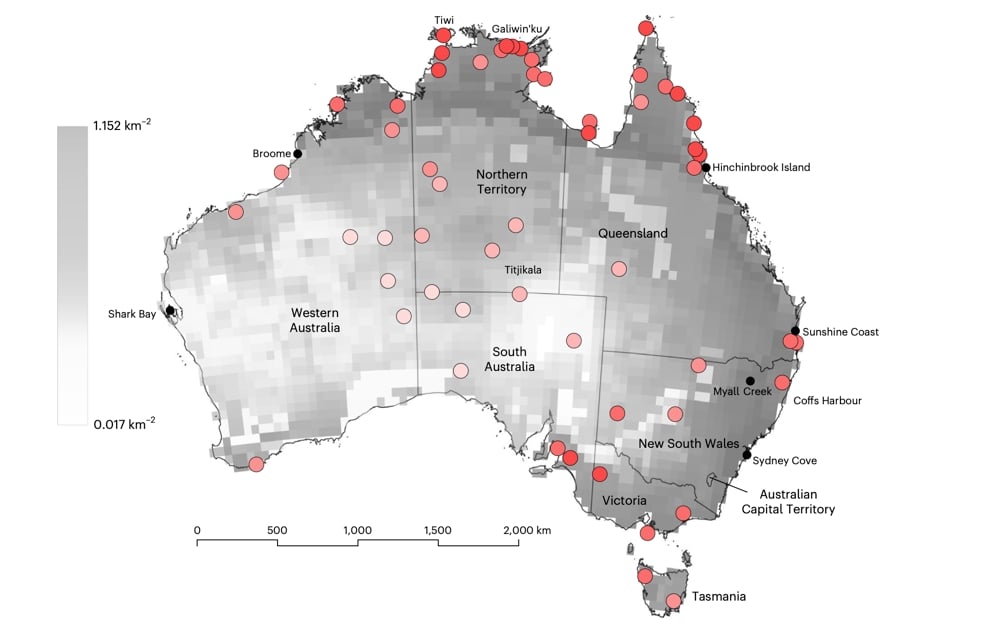
To get a clearer picture of what happened, a team led by first author and archaeological consultant Alan Williams from EMM Consulting and James Cook University used data from five different estimation methods, including two sets of computer modeling, two separate genetic reconstructions, and data from an analysis of archaeological radiocarbon records.
When the researchers combined the five different approaches, they arrived at a median estimate of 2.22 million Indigenous people living in Australia before colonization, corresponding to roughly one person for every three square kilometers of the continent.
Due to the methods involved, the researchers acknowledge there's a lot of uncertainty to their estimates, but even at the low ranges, their findings suggest pre-colonization populations of Indigenous Australians were dramatically higher than the estimates we've had before.
"The balance of evidence supports a probable population of at least >1 million, but more likely 2–3 million, and potentially >5 million at the time of colonial invasion," the researchers write in their paper.
Tragically, the pre-colonization population is only one part of the calculations.
From 1788 onwards, the researchers say Indigenous Australia experienced a "depopulation event", driven primarily by disease exposure, but also by violence – including massacres and other killings – that claimed potentially millions of Indigenous lives.
By 1847, less than six decades into the colonization, the non-Indigenous population had overtaken the dwindling and decimated Indigenous population.
By 1861, Indigenous people numbered only about 177,000 to 193,000 people – roughly 7 percent of their former population.

"Comparing our revised pre-invasion population estimates with those recorded during the colonial era exposes the scale of the catastrophe inflicted on Indigenous populations," the researchers explain.
"We estimate that a median of 2.06 million additional people might have died through disease, and directly or indirectly by frontier violence, or by structural violence in the form of assimilationist policies and racial exclusion throughout the nineteenth and early twentieth centuries."
Given the uncertainty in the estimates, the total number of excess deaths could have ranged from about 700,000 to 4.2 million Indigenous lives, the researchers say.
"These devastating findings highlight the major impacts of invasion experienced by Indigenous Australians, and demonstrate their remarkable survival, resilience and recovery over the past century," Williams says.
Even today, almost 240 years after the First Fleet landed, and with Australia's total population standing at about 28 million people, the Indigenous Australian population has not recovered, and currently is about 37 percent of its estimated pre-colonial size.
Related: DNA Analysis Reveals Two Routes Ancient Humans Used to Reach Australia
Based on current growth trends, the researchers say Indigenous Australians may reach parity with their pre-colonization population by 2047.
"These research findings challenge us to rethink the scale of what happened after 1788," says Distinguished Professor Larissa Behrendt AO, a Eualayai/Gamillaroi woman, who serves on the Australian Research Council Centre of Excellence for Indigenous and Environmental Histories and Futures (CIEHF), which funded the research.
"We are not talking about a marginal consequence of colonization but a demographic catastrophe at the heart of the Australian story.
"But the research also tells us something extraordinary. Our survival is one of Australian history's most remarkable stories."
The findings are reported in Nature Human Behaviour.
This article was fact-checked by Fiona MacDonald and edited by Fiona MacDonald. While we pride ourselves on our process, we are only human. If you spot a mistake, please let us know.