
We all know we should be eating healthy foods. The science is clear.
We know there are huge benefits if we make healthy food choices, and we've been told many times over about the serious consequences if we're not careful with our diet.
But there's a problem.
Research shows that people expect unhealthy foods to taste better than healthier alternatives, and pushy messaging that urges us towards healthier options can sometimes backfire, triggering psychological reactance.
In a new study, scientists explored a way to get around this, investigating how music can subtly affect people's food choices, both in a real-life cafeteria and in simulated restaurant environments.
The results, reported in npj Science of Food, suggest that low-arousal music can actually nudge people to make healthier food selections than music that's highly arousing.
"Background music is a particularly relevant cue: It is extrinsic to the food itself, often operates outside focal awareness, and can be readily manipulated in restaurant settings," a team led by co-first authors Shucheng Cao and Bihe Wen from the Macau University of Science and Technology in China explains.
"Even basic acoustic properties can shape food-related responses."
These food-related responses can have different kinds of effects.
In previous research, scientists found that high-volume music led to unhealthy food choices, perhaps because people had elevated excitement levels due to the loudness.
By contrast, lower-volume music led to increased sales of healthy foods, potentially because people were more relaxed than in the high-volume scenario.
According to Cao and Wen's team, these are just some of the ways background music cues can convey taste-related meanings to the listener, subtly shaping our evaluations of food options.
"When the music is perceived as matching a cuisine's characteristics, individuals are more likely to prefer, and thus to choose, those options that feel congruent with that setting," the researchers write.
"Consistent with this congruency account, 'healthy' sounds, characterized by higher pitch, slower tempo, lower volume, undistorted timbre, legato articulation, and consonant harmony, have been found to steer choices towards healthier options, relative to 'unhealthy' sounds that exhibit the opposite acoustic properties."
Another way of putting it is that people seem to associate healthy eating with low-arousal music – sounds that are relaxing and slower – whereas more highly arousing music, which is faster and perhaps more exciting, is linked to unhealthy eating.
To test their hypothesis, the researchers conducted four experiments: one in a real university cafeteria in Macau, and three experiments based around simulated restaurant scenarios.
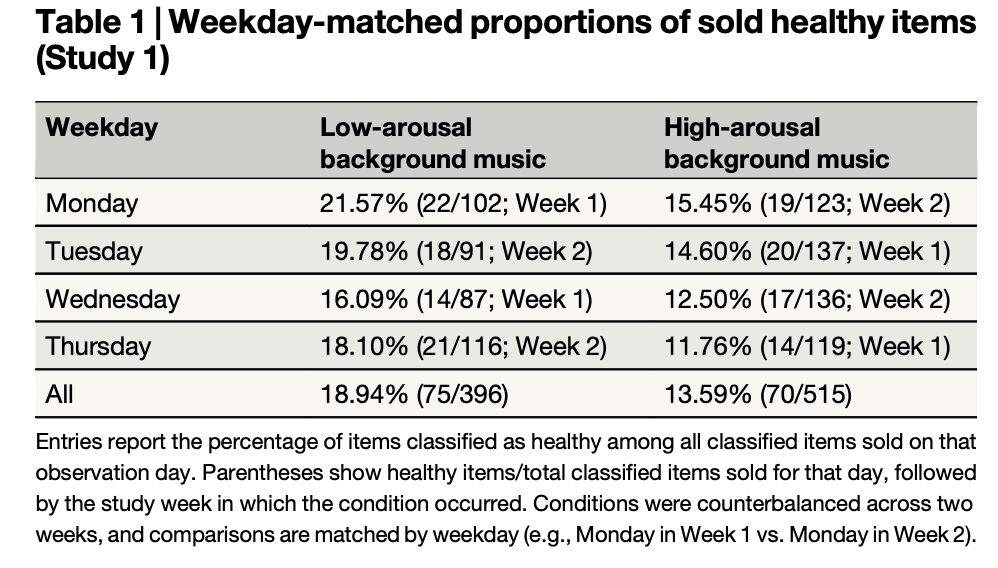
In the cafeteria experiment, which ran across eight working days, the cafeteria alternated between days where low-arousal or high-arousal music was played, with the songs' arousal levels having been rated separately in a previous test by other participants.
In total, over the eight days, 911 food items were sold, with buyers choosing more healthy items on days when low-arousal music was played: 18.94 percent of purchases on low-arousal music days were healthy foods, compared with 13.59 percent of purchases in the high-arousal condition.
In a separate experiment, participants looked at a healthy lunch menu, while listening to either low- or high-arousal hip-hop music.

Those exposed to the low-arousal music reported higher consumption intention than people who heard high arousal music (average rated scores of 6.08 vs 5.56).
In a similar experiment simulating a healthy restaurant with jazz background music, low-arousal jazz also resulted in greater consumption intention than high arousal jazz (6.02 vs 4.4).
In a final restaurant simulation, low- and high-arousal music were layered over background noise. Again, low-arousal music was linked with higher consumption intention than high-arousal music or background noise played in isolation (5.91 vs 5.59 vs 5.14).
The researchers suggest that low-arousal music may signal a calmer, more relaxing dining atmosphere to people, in which healthier food options feel more appropriate.
In all of the restaurant scenarios, participants exposed to low-arousal music also reported higher perceived comprehension – a greater sense that the situation they were presented with made sense and fit together coherently.
Related: You Can Add 10 Years to Your Life Simply by Changing Your Diet, Massive Study Finds
"Crucially, when cues are readily interpretable, individuals tend to form more favorable attitudes and stronger intentions," the researchers explain.
"Moreover, such experiences have been shown to translate into behavioral outcomes. This is because perceived comprehension can reduce cognitive resistance, strengthening the persuasive impact."
The team says their findings could have practical applications for hospitality venues, food retailers, and even online shopping, all of which could promote healthy foods by curating playlists with low-arousal music.
Whether people can tap into the same effect while doing their grocery shopping remains to be seen.
But next time you're perusing the aisles, nodding along with the beat on your headphones, perhaps a calmer playlist wouldn't hurt.
The findings are reported in npj Science of Food.
This article was fact-checked by Fiona MacDonald and edited by Fiona MacDonald. While we pride ourselves on our process, we are only human. If you spot a mistake, please let us know.