
Some days it can be downright difficult to summon the energy to exercise.
We've all been on that shuffling run before: the one where our feet are barely doing more than walking.
It might feel futile at the time, but new research suggests that even jogs that require minimal effort are still worth it in the end.
The study is the first to show that running, even at its slowest speed, is sufficient to induce a positive mood and to promote executive function in the brain's prefrontal cortex.
This region is important for both mood and cognition.
The results are published in Imaging Neuroscience.
Researchers at the University of Tsukuba in Japan conducted the experiment with 24 healthy young adults.
Each of these participants stepped on the treadmill for 10 minutes and ran at a slow pace of about 3 to 6 kilometers per hour.
During each treadmill session, the average heart rate of both male and female participants ranged from 104 to 107 beats per minute.
Their strides were very small – but it was a step in the right direction.
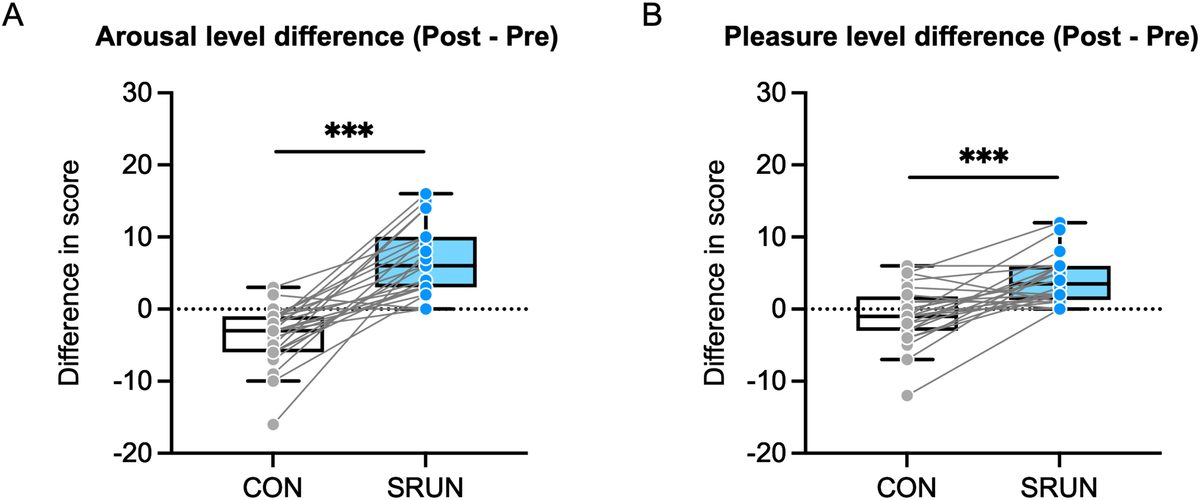
Compared to a day when participants spent 10 minutes sitting still, after a 10-minute run, they reported significant improvements in their mood, including greater alertness and feelings of pleasure.
After a run, reaction times on a test of attention and self-control also improved compared to sitting.
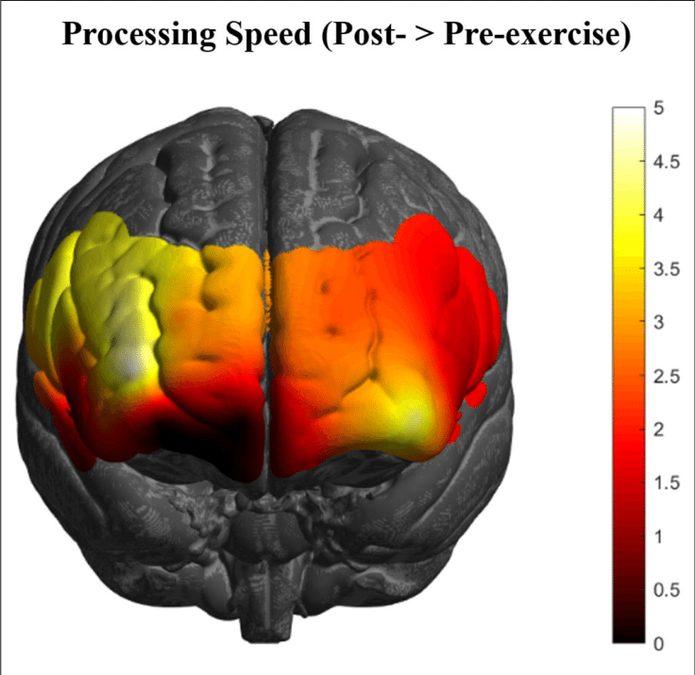
During these cognitive tests, participants wore headsets that measured changes in oxygenated hemoglobin levels at the brain's surface.
While this technique is not as accurate as an MRI, it can hint at what areas of the brain are broadly activated during certain tasks.
After a run, these headsets recorded a stronger oxygen-rich blood signal in two areas of the left prefrontal cortex while undergoing cognitive tests.
A previous study by some of the same authors found that a 10-minute run of moderate intensity can also increase activation in the prefrontal cortex.
But this new experiment suggests that the cognitive and neural benefits of running are not necessarily limited to more demanding exercises.
The findings are preliminary, and they don't compare walking to running, or explore the long-term associations.
But they do suggest that very slow running positively affects both executive function and mood in the short term.
There are a few possible mechanisms that might explain these changes.
For instance, it could be that running stimulates certain neural networks that project into the prefrontal cortex.
Or perhaps it is the movement of the head itself. In rodents, experiments suggest that when the head rhythmically bobs up and down, it can mechanically stimulate the brain.
"This is a new and challenging hypothesis, and the exact neural circuitry involved in the positive effect of head acceleration on mood has not been identified and needs further investigation," the study authors explain.
That said, the researchers in the present study found that among their small group of young participants, head acceleration, influenced by very slow running, was positively correlated with exercise-induced pleasure levels.
This factor explained about 17 percent of the variation in improved mood scores between individuals.
Previous studies on low-intensity exercise and cognition have tended to focus on cycling, as it is easier to control the intensity.
But cycling may not get the head bobbing as much as a jog, and this could make a difference.
"This discovery of the positive relationship between head acceleration and improved mood may be one of the underlying mechanisms through which very slow running promotes mental health," the authors hypothesize.
In fact, slow running may have been more important to our survival as a species than speed.
Humans have evolved to run great distances while upright on two legs. It's one of our superpowers, allowing us to hunt large prey across the savannah.
"It is interesting to hypothesize that human upright bipedal running is also strongly tied to the evolutionary expansion of the Homo sapiens' frontal lobes and higher cognitive functions," write the researchers.
"Against this background, running may be viewed not simply as another exercise modality, but as a biologically foundational form of human movement with particular relevance to brain function."
When the legs get moving, even at a slow pace, they seem to get the brain moving too.
The research has been published in Imaging Neuroscience.
This article was fact-checked by Peter Dockrill and edited by Peter Dockrill. While we pride ourselves on our process, we are only human. If you spot a mistake, please let us know.