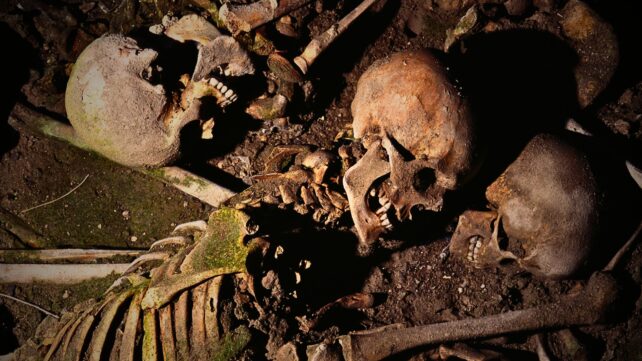
The textbooks and history lessons tend to treat the Black Death as one devastating wave of pestilence that hit Europe between 1347 and 1353. However, the full story of the disease goes on for many centuries more.
In a new study published in PNAS, researchers led by a team from the University of Tartu in Estonia reveal how the plague returned again and again in different regions, through until the 18th century.
While this second plague pandemic isn't a new discovery, we haven't seen it mapped out in quite this much detail or with dating this specific before.
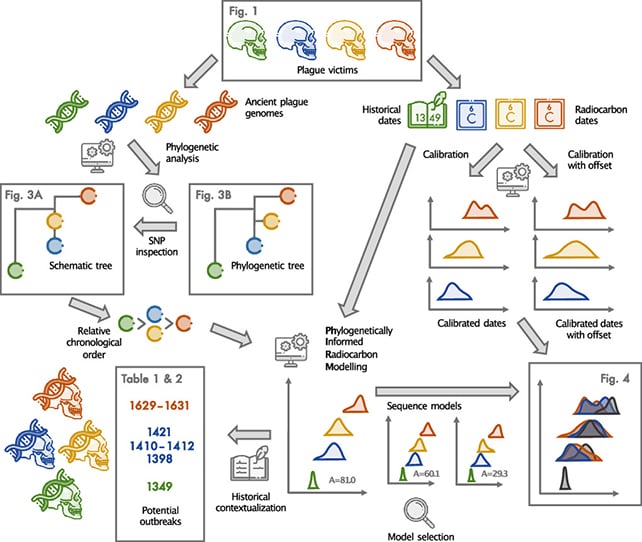
The researchers used a new method for matching plague genomes with historical outbreaks, using extra clues from the family tree of the disease bacteria Yersinia pestis to pinpoint when and where different strains appeared.
"We found evidence for repeated introductions of plague into Estonia starting already in the late 14th century and identified several previously unknown genetic lineages, both in urban and rural settings," says molecular biologist Kristiina Tambets, from the University of Tartu.
The researchers reconstructed and analyzed 26 genomes of Y. pestis, taken from 11 different archaeological digs across Estonia, Russia, England, the Netherlands, and Switzerland.
Using their new approach, they combined traditional radiocarbon dating with chronological genetic timelines, historical archives, and local fatality records.
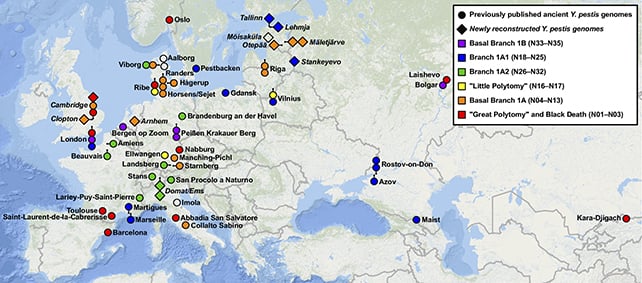
A total of 75 plague genomes were more accurately dated through this method: 11 higher-quality samples from the newly recovered 26 DNA fragments, and 64 samples previously investigated in earlier studies.
"We were able to improve dating intervals for many samples, which allowed us to connect them to specific plague waves and outbreaks that were recorded in the respective towns or regions by chroniclers," says historian Philip Slavin, from the University of Stirling in the UK.
One of the main revelations from this more detailed approach was the discovery of a major diversification in Y. pestis lineages (or family tree branches) around the 1450–1500 period, possibly establishing new reservoirs of the plague disease in rodents.
The researchers also point out a possible connection to the Great Renaissance Drought that happened around the same period, potentially drawing wild rodents to start dying in larger numbers or move closer to human settlements, spreading disease.
Further connections were made to plague outbreaks during the Thirty Years' War of 1618–1648, and the Great Northern War of 1700–1721. The suggestion is that armies, refugees, traders, and other groups moving en masse tend to take infections with them.
"We see how Yersinia pestis splits into new branches during periods of conflict and spreads along the routes traveled by troops and displaced populations," says geneticist Christiana Scheib, from the University of Tartu.
As more ancient DNA is recovered and collected, the timeline mapped out here can be made even more precise – and the connections to historical events can be established more confidently.
The Yersinia pestis bacteria still persists today, and although human cases of the plague are now only very occasional and can be successfully treated with the latest antibiotics, there are still takeaways for diseases in the modern day.
These findings give researchers more context for understanding how diseases that spread from animals to humans progress over time – over several centuries in fact. If the threat of another pandemic appears, we'll be better able to assess and model it.
So responses to the next disease threat can be informed by this study of a historical one, with all the benefits of modern medicine and analysis added on top.
"With COVID-19, scientists could reconstruct the spread of individual strains extremely well because the genomes came with precise timestamps," says geneticist Marcel Keller, from the University of Tartu.
"For historical pandemics, those timestamps are often missing or may cover more than 100 years, which limits our ability to interpret the genetic data."
The research has been published in PNAS.
This article was fact-checked by Fiona MacDonald and edited by Fiona MacDonald. While we pride ourselves on our process, we are only human. If you spot a mistake, please let us know.