
Going through menopause brings with it major shifts in biology for women, and experts have long wondered whether this could be part of the reason that Alzheimer's disease is notably more common in women than in men.
Past studies have suggested that the significant drop in estrogen that menopause brings with it could be involved somewhere: a hormone involved in everything from how brain cells connect to how they produce energy.
To take a closer look, researchers from the US tapped into health data on 2,603 women, cross-referencing menopause age against a number of markers for memory and brain function, as well as cases of Alzheimer's, for up to 18 years. The results of the study have now been published in JAMA Network Open.
While the findings don't show a direct cause-and-effect link between earlier menopause and Alzheimer's disease, there were several associations worth highlighting that are worthy of future investigation.
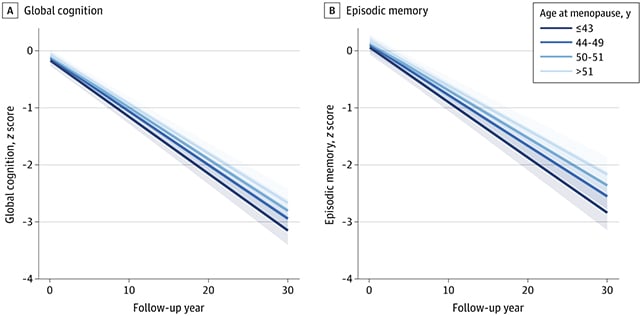
"Earlier menopause age was associated with faster cognitive decline (global and episodic), earlier Alzheimer's disease onset, and greater white matter hyperintensity accumulation, with the largest effect sizes for structural outcomes observed in spontaneous menopause," write the researchers in their published paper.
"Associations with total brain volume loss were present but modest."
The researchers highlight the link between earlier natural menopause (without surgery) and the accumulation of white matter hyperintensities as "the most striking" finding.
Essentially, these white matter hyperintensities (WMHs) are bright spots on brain scans that indicate damage to small blood vessels.
In women who went through natural menopause, menopause five years earlier was associated with roughly 15 percent greater WMH volume over the next 10 years, the researchers estimate – assuming the peak difference they saw holds steady.
It's a connection that's been spotted before, but this latest research adds the element of time, suggesting that the link between menopause timing and these brain changes plays out over decades.
"Our findings extend this literature longitudinally, demonstrating that earlier menopause age is associated with faster WMHV accumulation decades later, and specifically in women whose hormonal decline was gradual (spontaneous) rather than abrupt (surgical)," write the researchers.
For earlier Alzheimer's onset, the statistical association was 1.8 fewer years without Alzheimer's for menopause 10 years earlier – that's a relatively modest effect, but deserving of a mention. The average age of Alzheimer's diagnosis among participants who developed the disease was 88.4 years.
Add in the memory associations, which showed a relationship between earlier menopause and a slightly faster decline in overall cognition and episodic memory (memories of personal experiences and events) – and the results fit with the idea that longer exposure to the body's own hormones may help protect the brain.
"The convergence of cognitive, clinical, and imaging outcomes is consistent with a model in which prolonged endogenous hormone exposure contributes to sustained neurobiological resilience in late life," write the researchers.
Further research will be needed to determine the exact relationship between menopause, estrogen, and Alzheimer's. For example, the data here could be interpreted as showing that earlier menopause is a sign of faster aging that then also affects the brain, rather than the cause of these brain changes.
Given that several markers were pointing the same way however, and the other research we've seen on this topic, it's reasonable to think there's a meaningful link here worth pursuing.
Potentially, that link could ultimately lead to improved treatments and prevention methods, but it also suggests that brain aging isn't something that only kicks in later in life. It's possible that menopause age could be a useful earlier indicator to help healthcare professionals assess risk later in life.
"These findings suggest menopause age has lasting associations with structural and functional brain aging decades after the menopausal transition, positioning it as a midlife-identifiable marker for dementia risk stratification and early intervention," write the researchers.
Going through menopause brings with it major shifts in biology for women, and experts have long wondered whether this could be part of the reason that Alzheimer's disease is notably more common in women than in men.
Past studies have suggested that the significant drop in estrogen that menopause brings with it could be involved somewhere: a hormone involved in everything from how brain cells connect to how they produce energy.
To take a closer look, researchers from the US tapped into health data on 2,603 women, cross-referencing menopause age against a number of markers for memory and brain function, as well as cases of Alzheimer's, for up to 18 years.
The results of the study have now been published in JAMA Network Open.
While the findings don't show a direct cause-and-effect link between earlier menopause and Alzheimer's disease, there were several associations worth highlighting that are worthy of future investigation.
"Earlier menopause age was associated with faster cognitive decline (global and episodic), earlier Alzheimer's disease onset, and greater white matter hyperintensity accumulation, with the largest effect sizes for structural outcomes observed in spontaneous menopause," write the researchers in their published paper.
"Associations with total brain volume loss were present but modest."
The researchers highlight the link between earlier natural menopause (without surgery) and the accumulation of white matter hyperintensities as "the most striking" finding.
Essentially, these white matter hyperintensities (WMHs) are bright spots on brain scans that indicate damage to small blood vessels.
In women who went through natural menopause, menopause five years earlier was associated with roughly 15 percent greater WMH volume over the next 10 years, the researchers estimate – assuming the peak difference they saw holds steady.
It's a connection that's been spotted before, but this latest research adds the element of time, suggesting that the link between menopause timing and these brain changes plays out over decades.
"Our findings extend this literature longitudinally, demonstrating that earlier menopause age is associated with faster WMHV accumulation decades later, and specifically in women whose hormonal decline was gradual (spontaneous) rather than abrupt (surgical)," write the researchers.
For earlier Alzheimer's onset, the statistical association was 1.8 fewer years without Alzheimer's for menopause 10 years earlier – that's a relatively modest effect, but deserving of a mention. The average age of Alzheimer's diagnosis among participants who developed the disease was 88.4 years.
Add in the memory associations, which showed a relationship between earlier menopause and a slightly faster decline in overall cognition and episodic memory (memories of personal experiences and events) – and the results fit with the idea that longer exposure to the body's own hormones may help protect the brain.
"The convergence of cognitive, clinical, and imaging outcomes is consistent with a model in which prolonged endogenous hormone exposure contributes to sustained neurobiological resilience in late life," write the researchers.
Further research will be needed to determine the exact relationship between menopause, estrogen, and Alzheimer's. For example, the data here could be interpreted as showing that earlier menopause is a sign of faster aging that then also affects the brain, rather than the cause of these brain changes.
Given that several markers were pointing the same way however, and the other research we've seen on this topic, it's reasonable to think there's a meaningful link here worth pursuing.
Potentially, that link could ultimately lead to improved treatments and prevention methods, but it also suggests that brain aging isn't something that only kicks in later in life.
It's possible that menopause age could be a useful earlier indicator to help healthcare professionals assess risk later in life.
"These findings suggest menopause age has lasting associations with structural and functional brain aging decades after the menopausal transition, positioning it as a midlife-identifiable marker for dementia risk stratification and early intervention," write the researchers.
The research has been published in JAMA Network Open.
This article was fact-checked by Rebecca Dyer and edited by Rebecca Dyer. While we pride ourselves on our process, we are only human. If you spot a mistake, please let us know.