Can monkeys get Alzheimer's, or is the disease unique to humans?
As African green monkeys age, their brains can develop some changes that resemble those seen in Alzheimer's.
That doesn't mean they develop the full disease seen in people. But it raises a question: Could these monkeys help researchers see what happens before memory begins to fail?
In a new study published in Communications Biology, green monkeys kept performing well on a memory test after being administered small clusters of a protein linked to Alzheimer's. Yet one year later, signs of a biological response remained in the fluid surrounding their brains.
"What surprised me most was the persistence of the molecular response," co-first author Bianca Brown, a biochemist at Yale University, told ScienceAlert.
Brown and her colleagues focused on amyloid-beta, a protein closely studied in Alzheimer's research. It can gather into small clusters called oligomers. Scientists suspect these clusters may affect nerve cells before larger amyloid deposits appear.
In people, biological changes linked to Alzheimer's can begin years before symptoms appear. Studying that period is difficult. Researchers can measure signs of disease, but they can't watch every change unfold inside a living person's brain.
Previous experiments had found Alzheimer's-like changes in the brain tissue of monkeys given laboratory-made amyloid-beta clusters. This time, the researchers wanted to know whether traces of the response could still be found much later, in a sample taken from a living animal.
They examined cerebrospinal fluid, which surrounds the brain and spinal cord. Five female monkeys received synthetic amyloid-beta clusters, while three received a control solution.
The researchers delivered the treatment through a port connected to the fluid-filled space around the spinal cord. Brown confirmed that the animals received 12 administrations over four weeks, three each week.
The team also tracked the monkeys' memory.
Each animal was shown a shape on a screen and, after a short pause, had to pick it out from among other shapes. The treated monkeys showed no decline on this task during the experiment or over the following year.
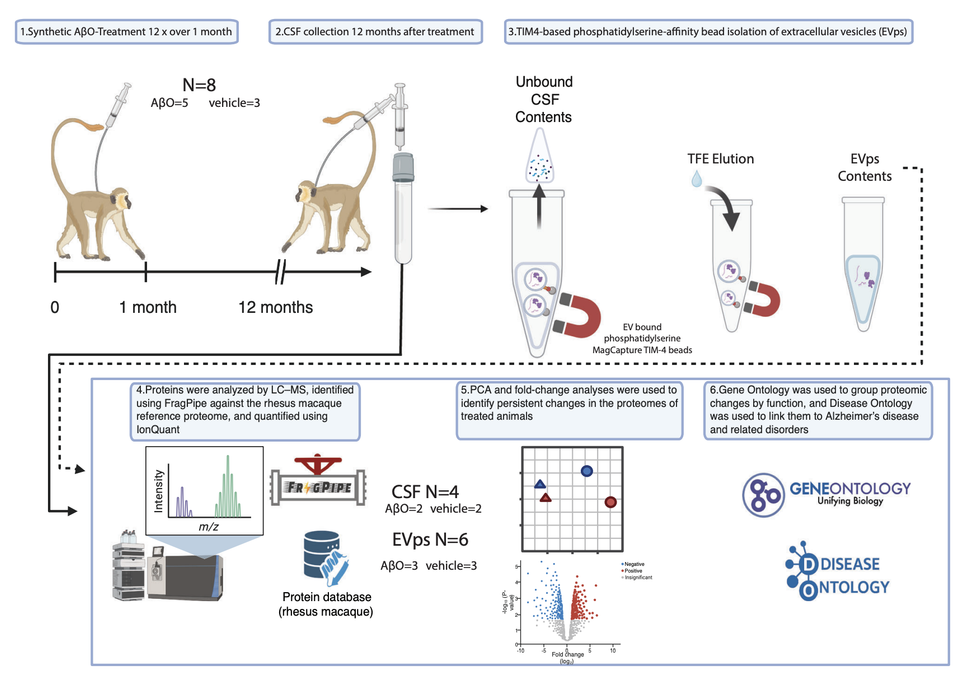
But fluid samples collected 12 months after the final treatment showed that something had changed.
Compared with the control group, the treated monkeys had higher levels of C3, a protein involved in the body's immune response. Some proteins associated with connections between nerve cells were lower. The researchers also found differences in proteins related to blood vessels and clotting.
They separately examined a portion of the fluid enriched with tiny particles, including extracellular vesicles. This revealed further protein changes that were harder to detect when they looked at the fluid as a whole.
Some of the patterns resembled findings from Alzheimer's research.
What made the result striking is that the monkeys could still remember the shapes, while samples from around their brains carried signs of a response to a treatment that had ended a year earlier.
"To me, that suggests that the nervous system can remain biologically altered long after an exposure without producing an obvious behavioral deficit," Brown said.
The proteins in the fluid may reveal changes that this memory test couldn't detect.
Those signs don't mean the monkeys had Alzheimer's disease. Nor does the experiment show whether they will develop memory problems later.
As Brown cautioned, "What would be premature is to assume that every molecular change we see in the monkeys represents early Alzheimer's disease in humans."
The researchers now plan to compare the patterns they found with samples from people. They want to see which responses occur in both species, and which may be specific to this monkey model.
Brown said the model could help identify proteins and pathways that respond early and persist, and possibly point to future treatment strategies. Comparing its results with human samples will help establish which findings are relevant to human disease.
The study was small. Although eight monkeys took part, the final analysis of proteins in the whole fluid compared only two treated animals with two controls. The particle-enriched samples included three animals from each group. All were female, and a single memory task may have missed other subtle difficulties.
Alzheimer's develops over years in people, while these monkeys received a particular protein preparation on a set schedule. The experiment offers a way to investigate an early biological response; it doesn't reproduce the entire human disease.
A year after treatment, the monkeys were still remembering the shapes. What the lingering signs in their cerebrospinal fluid can tell us about the earliest stages of Alzheimer's in people remains an open question.
The research has been published in Communications Biology.