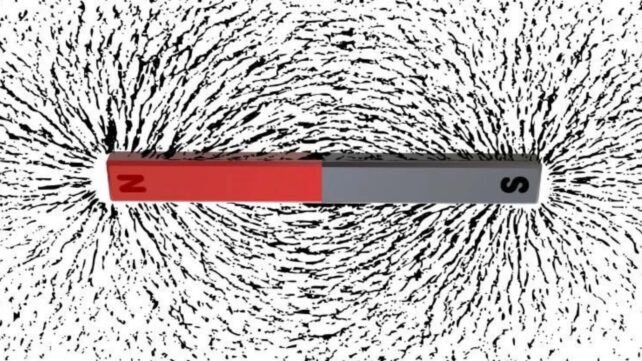
Unlike what a certain donut company suggests, the world actually runs on magnetism.
It's essential for generating power, building (electric) vehicles, and powering life-saving medical technologies like cyberpunk-style titanium hearts with levitating rotors.
Magnetism comes in multiple variations, but two are instantly relatable.
In ferromagnetism, the magnetic moments (tiny fields) of a material's constituent particles align in a certain direction to create a bigger magnetic field – the classic north-and-south-pole setup of a fridge magnet. But this generates stray fields that can interfere with computer chips and other electronics.
In antiferromagnetism, the magnetic moments point in opposite directions and cancel out, so there's no overall north or south pole at all. This squashes the stray fields but also the attractive properties that (literally and figuratively) may make a material useful.
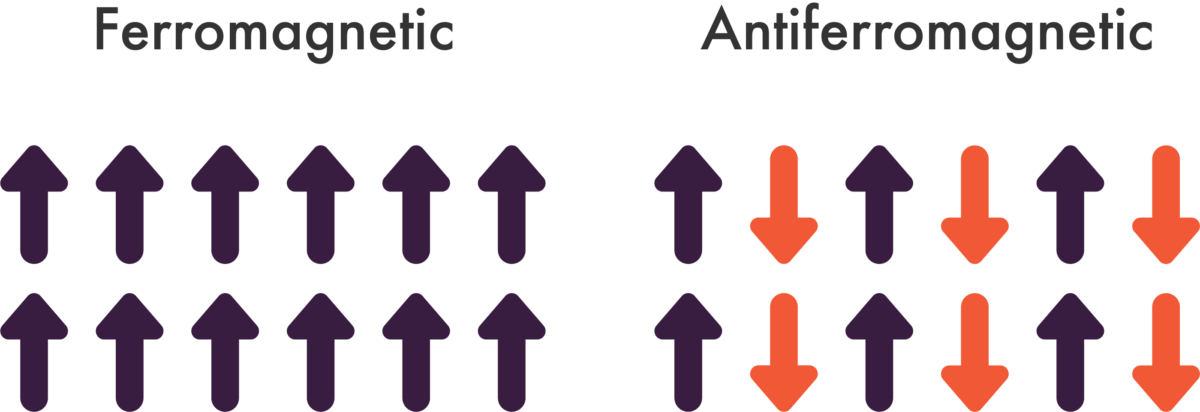
(National University of Singapore)
If one could, perhaps, combine the best of both worlds in, say, a versatile yet thin material, it could prove prominent in a world of ever-shrinking electromagnetic technologies.
Surprisingly, scientists have reported doing just that, achieving the first experimental evidence of altermagnetism – a recently confirmed type of magnetism – in a sandwich-like material with numerous future applications.
In a paper published in the journal Nature Communications, a team of physicists created crystals of a material called Co₁/₄TaSe₂. This sounds incredibly abstruse but only comprises three elements: cobalt, tantalum, and selenium (and their ratios).
Combining them in an experimentally useful way required 'baking' them at more than 900 degrees Celsius (1,700 degrees Fahrenheit) across two weeks.
"These materials are distinguished from more conventional antiferromagnets by their ability to generate and detect spin currents without the negative effect of producing stray fields," explains Madhab Neupane, a professor of physics at the University of Central Florida (UCF) and the study's corresponding author.
"This new property makes them very well positioned for use in many different applications – including spintronics, ultrafast memory devices, terahertz networks and energy-efficient electronics."
The Co₁/₄TaSe₂ material, which is not itself new to science, is made of layers that are composed of the metal tantalum and the non-metal selenium.
Between these layers, the researchers sprinkled atoms of the magnetic metal cobalt, to structurally create a quantum jungle gym that could alter the electrons as they run through it.
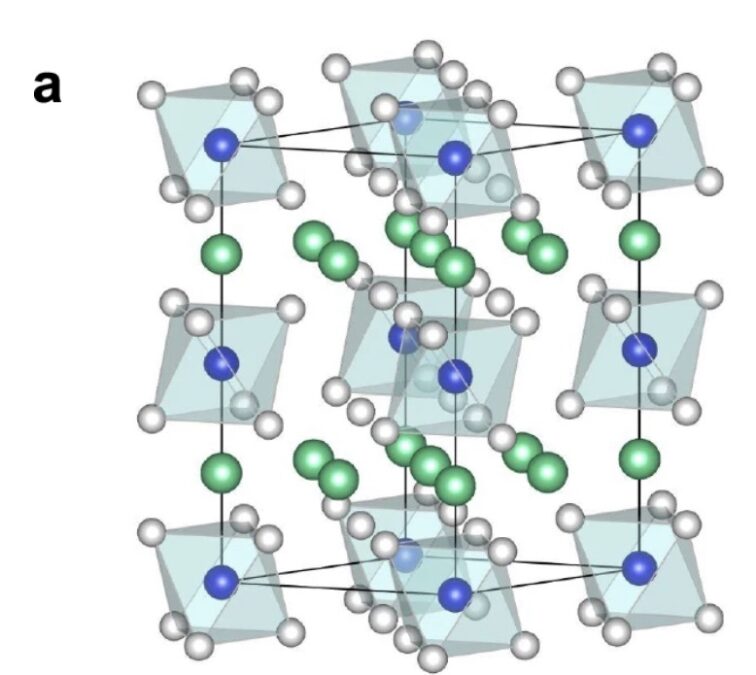
To confirm the altermagnetism, the researchers used a quantum modeling method and angle-resolved photoemission spectroscopy (ARPES).
The latter basically hits a material with a beam of light, causing it to eject an electron so scientists can determine its energy and its direction.
They thus revealed the material's energetic band structure, a map of where its electrons can and can't exist.
In doing so they noticed it was split, and that the split states carried opposite spin polarizations, which refer to how an elementary particle's spin is aligned to a certain direction – conveniently, particles can only spin "up" or "down."
Of course, the electrons don't actually spin, as Earth does on its axis or a seven-layered sandwich spins on Scooby-Doo's claw before being devoured. Instead, it's more of a mathematically defined angular momentum.
But it is an essential quantum property and, importantly, the researchers showed that the Co₁/₄TaSe₂ material splits the electrons by their spin.
This is vital in the context of the two previously mentioned magnetic types.
Ferromagnetism is good at splitting spins, because its magnetic moments point in the same direction, but it produces stray fields.
Antiferromagnetism produces no stray fields but is not a good spin splitter, because its magnetic moments point in opposite directions.
This combination of qualities may make this easily tunable material a magnificent medium to probe magnetic mysteries:
"Evidence for altermagnetism in a versatile materials platform opens a lot of new possibilities," notes Milo Sprague, an experimental quantum physicist at UCF and the study's lead author.
"There's currently a lot of debate in altermagnetic theory about how the spin-polarized electronic states interact with other magnetic phenomena. Now we have a material that we can easily modify to explore these new questions," Sprague adds.
For example, altermagnetism's origins are ostensible. Further research is required to see how they rise over other forms of magnetism, as electron interactions compete amongst one another.
Finally, in practical terms, while modern hardware may physically transport electrons to process data, emerging spintronics could manipulate data by transferring the electrons' spin states through a 'current' – like a soccer-stadium wave – to increase data storage while reducing the odds of espionage.
Thanks to the versatility and small scale of such recently described layered materials, our technological fate may be minuscule and sandwich-shaped.
But why not? Sandwiches have never failed us before.
As Neupane lays out, "If this approach proves viable, then layered altermagnets will be at the forefront of electronics development."
The research has been published in Nature Communications.
This article was fact-checked by Fiona MacDonald and edited by Fiona MacDonald. While we pride ourselves on our process, we are only human. If you spot a mistake, please let us know.