
Recognizing a familiar face across the street. Reading a distant sign without squinting. For people with myopia, a clear view often depends on glasses, contact lenses, or laser surgery.
But what if the eye's light-focusing surface could be reshaped without cutting away any tissue?
Researchers are exploring that possibility using a platinum mold resembling a contact lens and a small electrical potential. In early experiments, isolated rabbit eyeballs adopted the mold's shape in about a minute.
All 10 eyes treated with a correction intended for nearsightedness reached the targeted focusing power.
The idea is to make the cornea temporarily moldable, then allow it to retain its new shape.
Chemist Michael Hill of Occidental College and surgeon Brian Wong of the University of California, Irvine, conducted the research, which Hill presented at the American Chemical Society's fall meeting in August 2025.
The announcement describes a conference presentation and does not identify a peer-reviewed publication.
To understand the approach, start with the eye's transparent, curved front surface. The cornea bends incoming light, helping focus it onto the retina. Changing its curvature changes how light travels through the eye, potentially altering how clearly objects appear.
LASIK adjusts that curvature by removing precise amounts of corneal tissue with a laser. The experimental alternative, called electromechanical reshaping, or EMR, instead changes the chemical interactions that help the tissue hold its shape.
"LASIK is just a fancy way of doing traditional surgery. It's still carving tissue – it's just carving with a laser," Hill says.
Hill and Wong's method exploits a property of collagen-containing tissues such as the cornea. Attractions between oppositely charged components help maintain their structure. Because these tissues contain water, applying an electrical potential can alter their chemical environment.
Specifically, the researchers lower the tissue's pH, making it more acidic and loosening some interactions that keep it rigid. During this window, the cornea becomes malleable enough to conform to a mold.
When its original pH returns, those interactions are restored, holding the tissue in its new shape. The goal is to change its optical properties without removing material.
"The whole effect was discovered by accident," Wong says. "I was looking at living tissues as moldable materials and discovered this whole process of chemical modification."
To control the process, the researchers built specialized platinum "contact lenses". Each carried the curvature they wanted the cornea to adopt, serving as a template for reshaping.
Each lens also acted as an electrode, allowing the team to apply the electrical potential. The same device therefore helped initiate the chemical change and determine the resulting shape.
The researchers placed rabbit eyeballs in a saline solution intended to mimic natural tears, positioned the platinum lenses over them, and applied a small electrical potential. The controlled pH change allowed the corneas to match the lenses' curvature.
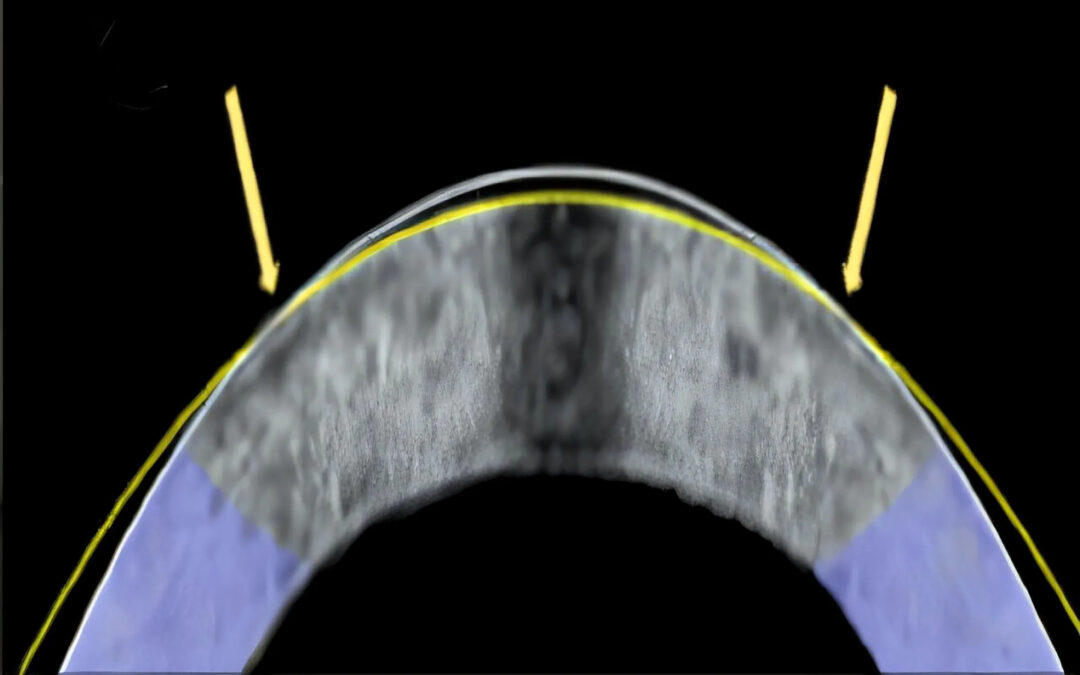
A cross-sectional image released by ACS illustrates the result: A white line marks the original corneal profile, while a yellow line shows the flatter shape achieved after treatment.
The setup was tested on 12 isolated rabbit eyeballs. Ten received a correction intended for myopia, or nearsightedness. All 10 reached the desired focusing power, indicating that their optical properties had changed as intended.
The reshaping took roughly a minute. The researchers suggest the approach could require fewer steps and less expensive equipment than LASIK, although that experimental timing does not establish how long a future clinical procedure would take.
Cell survival was another consideration. According to ACS, cells in the eyes survived because the team carefully controlled the pH gradient. That finding is encouraging, but does not establish long-term safety in a living eye.
Separate experiments also suggested the technique might reverse some chemically induced corneal cloudiness, raising another possibility for future investigation.
The team had previously explored EMR in rabbit ears and in pig skin and scars.
These reported experiments used eyes removed from animals, so they do not demonstrate improved vision in a living rabbit or person. How long the reshaping would last and how living eyes would respond remain questions beyond the findings described in the announcement.
Next, the team planned to test the technique in living rabbits and determine the range of vision corrections possible with EMR, including nearsightedness, farsightedness, and astigmatism. Funding uncertainty had put those steps on hold. The announcement does not establish whether those experiments have since begun.
"There's a long road between what we've done and the clinic," Hill says. "But, if we get there, this technique is widely applicable, vastly cheaper and potentially even reversible."
For now, reshaping the eye without removing tissue remains an intriguing possibility requiring further testing. Whether this becomes a practical alternative to LASIK will depend on what those future studies reveal.
This article was fact-checked by Rachel Garner and edited by Fiona MacDonald. While we pride ourselves on our process, we are only human. If you spot a mistake, please let us know.