
It's helpful to know how well the senses of underwater predators are working – both to better understand the ecology and biology of marine life, and to get out of their way should you come into contact with them.
How well sharks can hear has been something of a mystery until now, mainly because it's difficult to measure in a controlled way.
Hearing is crucial though, especially underwater, for locating prey, avoiding predators, and finding potential mates.
In a new study published in Integrative Organismal Biology, researchers from Florida Atlantic University have demonstrated that blacktip sharks (Carcharhinus limbatus) can hear sounds from as far away as 74 meters (243 feet).
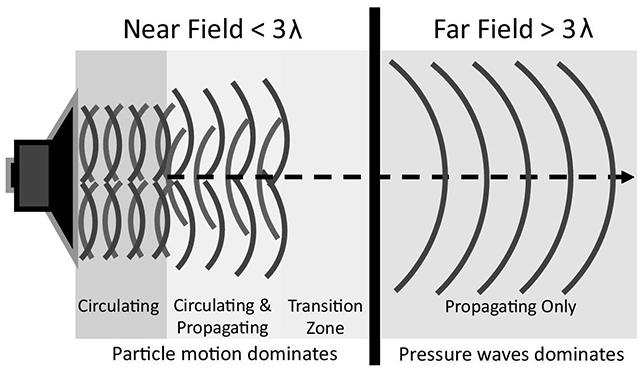
That's well beyond the limit of what's known as near-field sound, which has a more direct impact on water particles. At that range, we're talking about far-field sound, where pressure creates more subtle particle movement.
"What makes this finding particularly interesting is that the sharks were responding to sounds beyond the acoustic near field, where the sound behaves differently than it does close to the source," says zoologist Stephen Kajiura.
"This suggests that they are detecting the particle motion associated with sound even at considerable distances from the source – something we have not previously been able to demonstrate in free-swimming sharks."
The researchers used a drone and a boat off the coast of southeast Florida for their experiments: Pulsing, low-frequency sounds were played from near the team's boat, with two underwater mics used to measure how they traveled through the water.
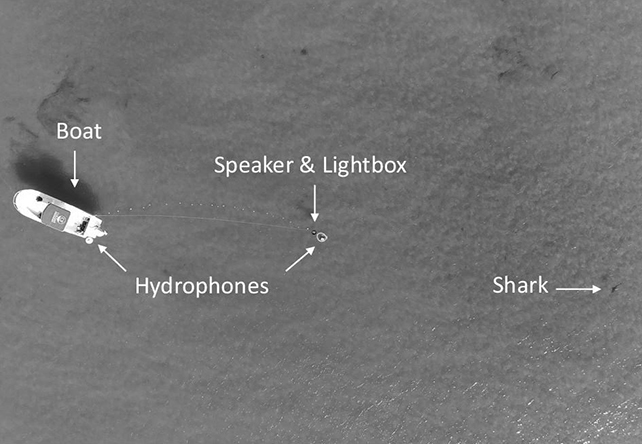
A drone flying 40–50 meters above the scene recorded how the sharks moved in relation to the sounds. Three test sounds were used at three different pitches, with a control sound beyond the hearing range of the sharks.
This species was chosen in part because it's known for congregating regularly every winter at a specific spot along the coast, in waters shallow and clear enough for drones to capture their activities.
"Their abundance and accessibility made it possible for us to observe them from above without disturbing their natural behavior, while also presenting controlled underwater sounds," says Kajiura.
The sharks ignored the control sounds as expected but responded to the test sounds between 71.1 and 87 percent of the time, depending on frequency. The farthest response from a single shark was 74 meters, while 118 of the 165 total responses came from what would be considered the far field.
For all three frequencies, sharks responded to sounds from as far as 62 meters away.
Each response also involved a sharp turn away from the source of the sound, suggesting the sharks knew where it was coming from.
"The ocean is an acoustic environment, and sharks are clearly tuned into it in ways we are only beginning to understand," says Kajiura.
"Being able to detect and respond to sounds from hundreds of feet away gives these predators an important source of information about their surroundings. The next question is how their sensory system allows them to pick up and interpret these distant sounds."
Sharks lack the gas-filled swim bladder that many bony fish use to hear, which translates pressure into vibration, so something else must be going on here. The researchers suggest that C. limbatus are instead somehow detecting water particle movements.
That can be investigated in future studies. For now, scientists have a much better idea of the hearing capabilities of sharks, observed out in a real setting.
"Trying to do hearing experiments in a tank results in the sound bouncing off the walls, which causes complex and confusing signals – it is like being in a house of mirrors," says biologist Caroline Sullivan.
"This is why it is so important to do these types of experiments in the ocean with wild sharks to get a natural response."
The research has been published in Integrative Organismal Biology.