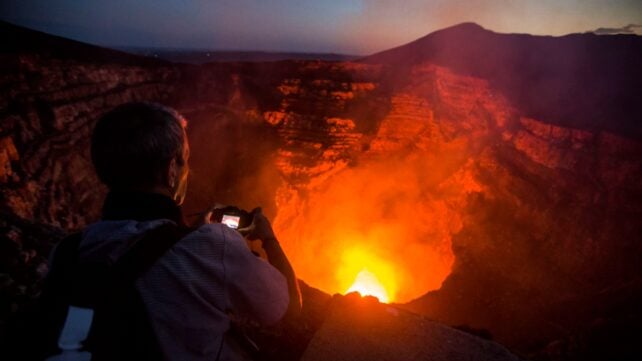
Thousands of tourists come to check out the 'Mouth of Hell', a lava lake inside Masaya Volcano, each month, and millions more people live nearby.
Given how many people are on and around this well-and-truly active volcano, scientists are keeping a very close eye on what it's up to.
Now, it appears two reservoirs of magma lurking within the volcano are active at the same time.
Those are the findings presented in Geophysical Research Letters by a team from Pennsylvania State University, based on Sentinel-1 satellite radar images taken roughly every 12 days for six years.
The volcano's famous lava lake is just a small surface feature of the much larger volcano complex, which researchers are still trying to understand, so they can better understand what risks face nearby residents and the droves of tourists that come through daily.
Around 2 million people live in close proximity to the volcano. Managua, the capital city of Nicaragua, is about 20 kilometers (12 miles) away.
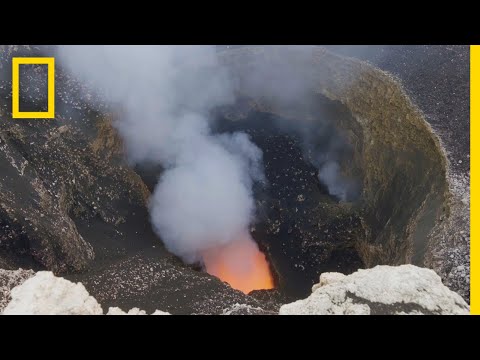
"Although Masaya last produced a major lava flow in 1772, its persistent degassing often produces dangerously high concentrations of sulfur dioxide volcanic gas," says geoscientist Lizzie Johnson, lead author of the research.
These ongoing gas emissions produce acid rain and may be harmful to human health.
The volcano has also produced several explosions over the past five decades, though luckily, very few people have been injured.
But when it comes to active magma, you can never be too careful.
"Having a thorough understanding of Masaya's volcanic activity and its related hazards is critical," Johnson says.
To do this, the team has tracked points on the volcano's surface via satellite, measuring how they change over time, to gauge what might be brewing within.
Between 2018 and mid-2022, the Masaya Central Reservoir – a magma chamber just north of the famous Santiago crater – moved about 3 centimeters (1.2 inches) away from the satellite, which the researchers interpret as the ground sinking.
That kind of deflation suggests some of the magma had moved away from the reservoir deep within the volcano.
Then, from mid-2022 to 2024, it started rising again, as if the reservoir was once again filling up with magma.
Meanwhile, the area directly surrounding the Santiago crater appeared to sink throughout the study period of 2018–2024.
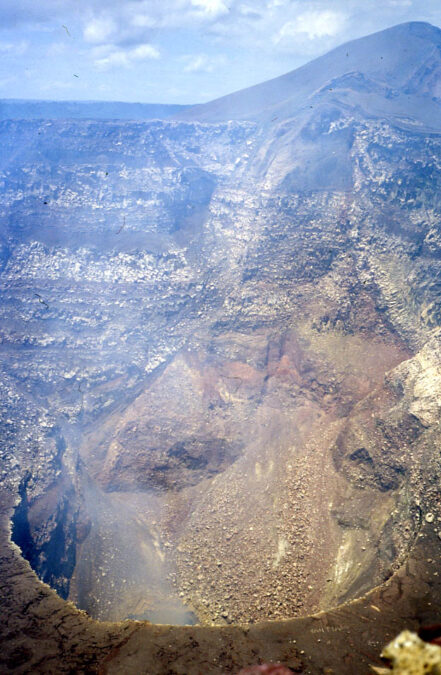

The researchers say this suggests a second, shallower reservoir, about 200 meters (656 feet) below the volcano's surface, is also active.
"When it's subsiding, that means that there's probably magma draining away from the volcano, but once the ground starts uplifting again, that can mean that there's potentially new magma moving in," Johnson says.
"At the same time, the area directly around the active Santiago crater deflated over the entire study period independently of the transition to inflation of the main reservoir.
"This indicates that the plumbing system is more complex and could be due to decreasing magma in a second, shallower reservoir."
Tracking these ground movements is an essential part of assessing potential volcanic hazards, the team says, but their results do not suggest there is any immediate danger to the surrounding community.
"Further long-term geodetic and modeling studies will provide a more thorough understanding and allow for effective hazard monitoring and mitigation at Masaya and other lava-lake hosting basaltic volcanoes," Johnson says.
The research has been published in Geophysical Research Letters.
This article was fact-checked by Rebecca Dyer and edited by Rebecca Dyer. While we pride ourselves on our process, we are only human. If you spot a mistake, please let us know.