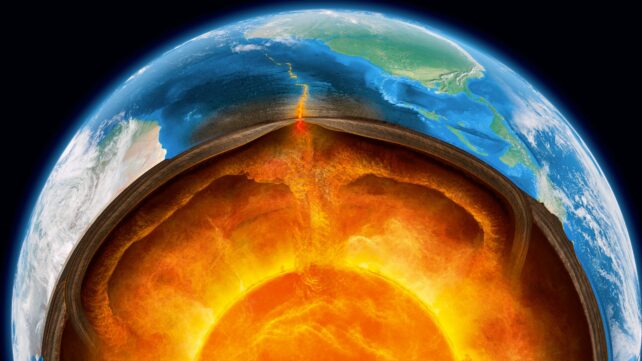
Scientists have discovered a mysterious rock in eastern Papua New Guinea that traveled to the underworld roughly 4.4 million years ago.
The story it has to tell is strange indeed.
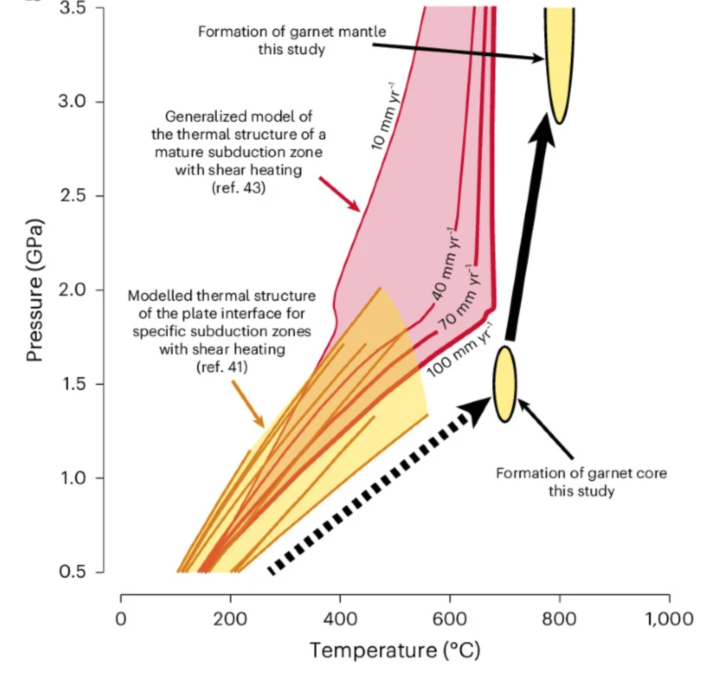
As the rock journeyed deeper into our planet's interior, pushed by the forces of a subduction zone, its temperature did not do what scientists expected.
At 45 kilometers below the surface, researchers estimate the rock became unusually warm, experiencing temperatures of about 700 °C (1,292 °F).
That's hotter than models predict subduction zones should be at that depth.
But that's not all. When the rock reached more than 90 kilometers (56 miles) deep, its temperature only rose by a further 100 °C.
"What makes this rock so interesting is that it records two very different thermal conditions at different stages of its time deep inside Earth," says geologist Axel Schmitt from Curtin University in Australia.
"At about 45 kilometers depth, the rock was surprisingly hot, but as it traveled deeper it entered an environment that was cooler than we would normally expect at that depth."
It's a small slice of evidence that has traveled a long way, and its journey could reveal important clues about what lies beneath our planet's surface.
While it is generally true that Earth gets warmer the deeper you go, the temperature gradient isn't always clean and straight.
The curious rock from Papua New Guinea is evidence of that.
It was collected from a larger exposed outcrop on Goodenough Island, which contains eclogite, a rock made under high pressure.
Based on an analysis, this rock appears to have been driven more than 90 kilometers deep at a local subduction zone.
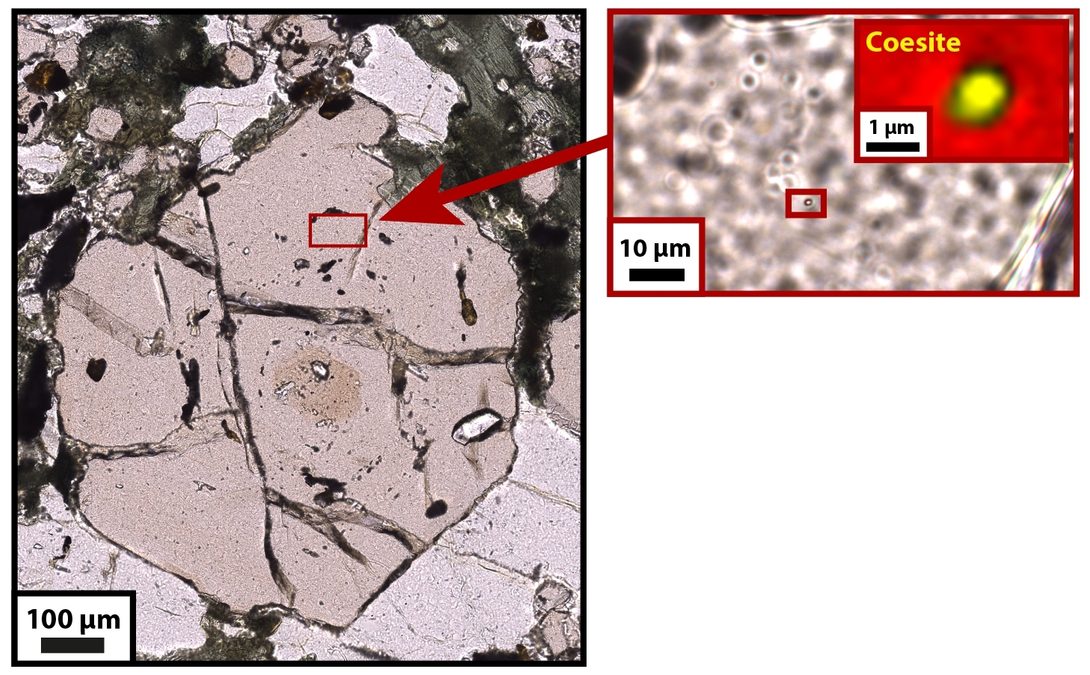
Scientists know this because the sample contains a mineral called coesite, which only forms under pressures at this depth or deeper.
Another mineral, called zircon, can help reveal when this pressure occurred.
In this case, the coesite likely formed in this rock when it was deep inside Earth, around 4.4 million years ago.
The rock was once part of a fragment of continental crust that was carried down into a subduction zone at a tectonic plate boundary.
Subduction zones are thought to push relatively cold rock downward into a hotter and more pressurized environment.
But it can take a while for that colder rock to warm up to its new surroundings.
That's why deeply buried rocks can remain relatively cold compared with their surroundings.
But not so for the rock from Papua New Guinea.
It records an unexpectedly warm beginning to its descent, followed by a colder ending phase.
First author Jan Schönig, a geoscientist at Göttingen University in Germany, says this "contradicts our current thermal models of subduction zones."
"Finding this change from relatively hot conditions at shallower depth to colder conditions deeper down was unexpected," agrees Schmitt.
"One possibility is that intense shearing where the tectonic plates meet generates additional heat at relatively shallow depths."
In other words, shearing forces where tectonic plates meet could be heating up shallow rocks more, relative to their pressure.
Another option, Schmitt explains, is that the system is young, and the subduction zone has not yet cooled to the lower temperatures scientists would expect.
"The findings suggest the thermal structure of these zones may be more complex than previously thought, helping scientists better understand how subduction operates over millions to billions of years," says Schmitt.
"Understanding these temperature changes helps us build a clearer picture of the extreme conditions deep inside Earth, where tectonic plates collide and drive processes that shape the planet's surface."
One tiny rock can reveal crucial information about the big rock we all live on.
The research has been published in Nature Geoscience.
This article was fact-checked by Rebecca Dyer and edited by Rebecca Dyer. While we pride ourselves on our process, we are only human. If you spot a mistake, please let us know.