Sound can be a tricksy beast to try to harness.
It fills the world around us, bursting from its multitudinous sources, bouncing off surfaces as echoes – a property that makes sound both incredibly useful and deeply vexing, depending on where and how its reverberations occur.
There are some circumstances where echoes can cause problems. The most obvious example is sound recording studios, but one major problem area is probably less obvious because it's far more ubiquitous – pipes.
Consider ventilation, air conditioning, industrial exhaust, or even plumbing. Sound travels through the spaces enclosed in those pipes and ducts, and when it encounters an obstruction, a change in shape, or a closed end, it can start to rattle around like nobody's business.
Now, scientists have developed an ingenious little device that can dramatically reduce those reflections by effectively 'swallowing' sound.
It's called a sonic black hole, and the new design can be 3D-printed and inserted directly into an existing pipe – a major step forward from conventional designs that require the black hole to be built into the pipe itself.
"Imagine standing in front of a duct that is closed at the far end and shouting into it. After a short delay, depending on the length of the duct, you would hear an echo coming back from the termination," acoustics engineer Oriol Guasch of La Salle, Universitat Ramon Llull in Spain told ScienceAlert.
"If the duct were terminated with a sonic black hole, you would essentially hear no echo at all. Acoustically, it would be almost as if the tube were infinitely long, with no end from which the sound could be reflected back towards you."
Black holes are best known as astrophysical objects, pockets of space so dense that their gravity warps the space-time around them into a spherical horizon from which not even light can escape.
There are many reasons why we can't study these objects up close, so physicists have devised other methods, creating laboratory analogs that reproduce aspects of black hole behavior, sometimes relying on phenomena that have little to do with gravity.
But the 'black hole' developed by Guasch and colleagues, described in a paper first authored by engineer Jie Deng of La Salle, Universitat Ramon Llull, is a different kind of beast inspired by what a black hole can do.
Rather than using sound to simulate gravitational physics, it's designed to exploit an unusual property of sound waves: under the right conditions, they can be progressively slowed until they effectively never reach the end of their journey.
It's a little like the ancient Greek philosopher Zeno's famous dichotomy paradox, in which a traveler must cover half the remaining distance to a destination, then half again, and so on, seemingly never arriving.
The difference is that, in a sonic black hole, the wave really does slow down as it travels.
"What happens to the wave as it approaches the end of a sonic black hole has a certain resemblance to what the external observer sees near an astrophysical black hole: the wave appears to take an infinite time to reach the limiting point," Guasch explained.
"In the ideal case, once a wave enters the sonic black hole, it does not come back out."
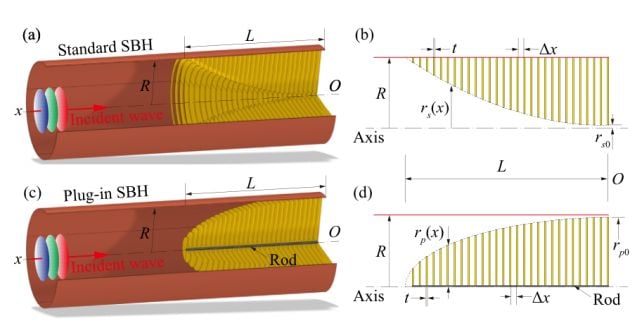
The acoustic vanishing trick lies in the design. Just as an astrophysical black hole is not actually a hole, neither is the sonic version. It's a carefully engineered structure that changes the way sound travels through a pipe.
In conventional designs, a series of rings and cavities line the inside of the pipe, arranged so that sound waves slow down progressively as they travel through it. Their wavelengths become shorter, and their energy becomes increasingly concentrated.
But there's a catch. These structures have to be built into the pipes themselves, usually manufactured together, making them difficult to retrofit into existing systems. And the black-hole effect only works across a limited range of sound frequencies.
Deng, Guasch, and their colleagues wondered whether they could solve both problems by turning the whole thing inside out – a sonic Christmas tree, rather than a funnel.
"The concept is surprisingly simple, and it works very well," Guasch said. "From a practical point of view, the sonic black hole can be manufactured independently of the duct and then simply inserted into it."
The team's design consists of a series of rings mounted on a central rod, with their diameters gradually changing along its length. The spaces between the rings form cavities that mess with the way sound travels through the pipe.
As sound enters the structure at the tip, it slows down, its wavelength becoming progressively shorter as its energy concentrates towards the far end.
And here's where that vanishing trick happens. Rather than simply bouncing back, much of the concentrated sound energy is dissipated through friction and heat exchange between the air and the device's surfaces, leaving far less to escape as an echo.
The researchers tested this with a 3D-printed prototype – a 15-centimeter-long structure consisting of 29 rings mounted on a central rod, which was then inserted into an impedance tube – a laboratory apparatus used to measure how sound waves behave when they encounter a material or structure.
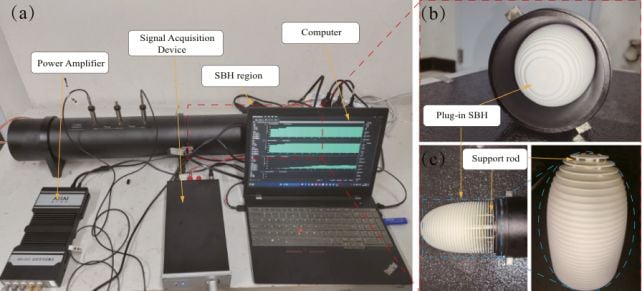
Then they yelled into the tube – not really; they used a speaker to send sound waves at different frequencies through the tube and microphones to measure how much bounced back.
And the results were pretty promising. The amount of sound reflected back out of the sonic black hole broadly matched the team's computer simulations – although it's important to note that it didn't completely eliminate echoes.
The researchers also used computer simulations to compare their plug-in design with a conventional sonic black hole.
These suggested that the new geometry could have benefits that go beyond modularity and ease of installation.
"The other important advantage is that the frequency range over which the device behaves as a sonic black hole is considerably wider than in the conventional configuration," Guasch explained.
The simulations also showed that the plug-in design reflected less sound than its conventional counterpart across a broad range of frequencies.
This is because the cavities between the rings in a sonic black hole resonate at particular sound frequencies, changing the way the device absorbs sound.
In the new design, the researchers found, those resonances occur at higher frequencies, allowing the black-hole effect to keep working over a broader range.
The most immediate applications for this technology are, obviously, in noise control, particularly in ducts and silencers where reflected sound can cause problems.
And the researchers are already looking beyond pipes, investigating whether sonic black holes could be developed in two and three dimensions, with potential applications in room acoustics.
There are still challenges to overcome before the little sound-devouring Christmas trees can be deployed in the wild. Different environments bring different problems, from particles that could clog the cavities to the effects of temperature, pressure, and flowing air.
But Guasch is excited by the possibilities of manipulating sound in ways that would once have seemed almost impossible.
"Personally, what I find most stimulating is the physics and mathematics behind all of this, and the way it brings together areas of knowledge that may initially seem quite unrelated," he told ScienceAlert.
"And, of course, the type of wave control that can now be achieved would probably have seemed almost like science fiction several years ago."
The research has been published in Applied Acoustics.
This article was fact-checked by Fiona MacDonald and edited by Fiona MacDonald. While we pride ourselves on our process, we are only human. If you spot a mistake, please let us know.