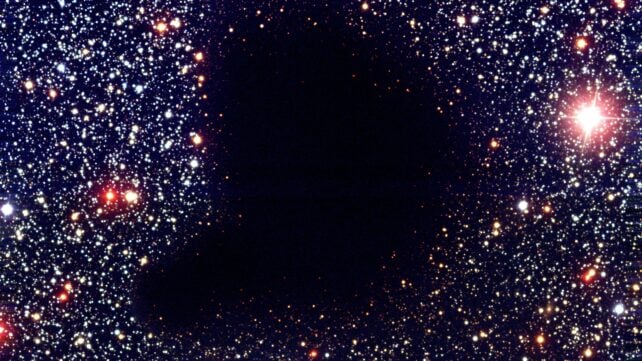
In the southern constellation of Fornax lies a tiny patch of sky just like any other. Your eyes may have brushed past it a hundred times without a thought.
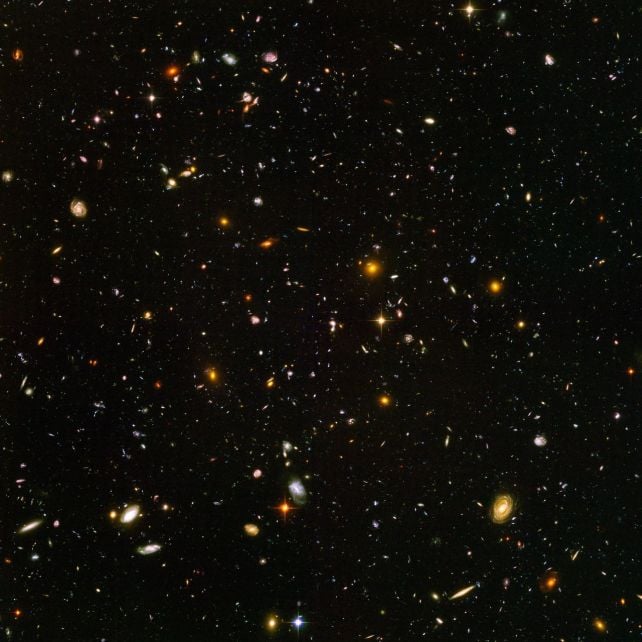
Yet this otherwise unremarkable speck of the cosmos is among the most well-cataloged in the sky. The Hubble Space Telescope stared at it for more than 270 hours to obtain its famous Ultra Deep Field (HUDF) – and contained therein are nearly 10,000 galaxies extending billions of light-years into the Universe.
When the James Webb Space Telescope (JWST) launched, it was only natural that its golden mirrors would turn to the same region of space, using its vastly more sensitive infrared capabilities to find what Hubble may have missed.
Now, it has revealed that a patch of space astronomers have been poring over for decades may yet hold some surprises.
In a tiny corner of the tiny field, JWST detected a strange signal – not once, but twice, in observations nearly three months apart.
There's just one problem. In every other prior observation from both JWST and Hubble, there's absolutely nothing there.
That doesn't mean that there is nothing there – there may be something otherwise too dim to detect that briefly unleashed a powerful flare – but it does make that signal a mystery that, currently, has no satisfying explanation.
To understand why this signal is so strange, though, first you need to know a little more about how astronomers study the Universe.
When you look into an optical telescope, you see an image formed from the light collected by its mirror. That's pretty much what you're looking at when you gaze upon the HUDF – a composite of images taken through different filters, each capturing a particular range of wavelengths.
But some telescopes can also split light into different wavelengths – think of how a prism can split white light into a rainbow, but on a much more granular scale.
This can reveal features in the light that are hard to distinguish in a multi-wavelength image. For example, if you collect all the light from the Sun, it looks white; but when split into a spectrum, you'll see dark lines where specific wavelengths have been absorbed by atoms in the solar atmosphere.
Other objects produce bright lines instead, where atoms or molecules release energy as light at specific wavelengths. These are called emission lines.
Astronomers use a technique called spectroscopy to detect these absorption and emission lines, a clever way to determine the chemical composition and other properties of astrophysical objects.
Astrophysicist Mason Huberty of the University of Minnesota and colleagues wanted to try something a little bit different.
Rather than using spectroscopy to study already known objects, they wanted to see if JWST's Near-Infrared Spectrograph (NIRSpec) could be used as a tool to find objects that hadn't been found yet.
Normally, astronomers select known targets from existing observations, and then position the instrument's tiny shutters so that light from the selected target enters the spectrograph. It's a really useful technique, with one limitation – it relies on knowing where the target is first.
Huberty and his team did sort of the complete opposite.
They opened up nearly all the shutters, closing only those covering known foreground objects identified in previous Hubble observations, whose light could contaminate the spectra they wanted to collect.
Then, they split the light collected into spectra and searched the resulting data for emission lines.
And they did it twice – two observation windows, 88 days apart in August and November 2023, and – crucially – at different observation angles. This would help eliminate artifacts and glitches.
The aim was to find faint, distant objects that conventional observations might have missed, using a technique called Multiobject Coronagraphy for Slitless Spectroscopy (MOCSS).
The HUDF was an ideal testing ground, with its wealth of existing observations allowing the researchers to check their results against known galaxies.
And it worked. After all was said and done, six detections that passed their strict criteria could be matched to distant galaxies in the HUDF.
The problem was the seventh detection.
It was a single, bright line that appeared in both near-infrared observations at about 1.6 micrometers. In isolation, that's not so weird; near-infrared emission is super normal.
It's the isolation that caused the drama. There was no other emission line accompanying it – and in prior observations from Hubble and JWST, nothing else could be seen in that patch of space.
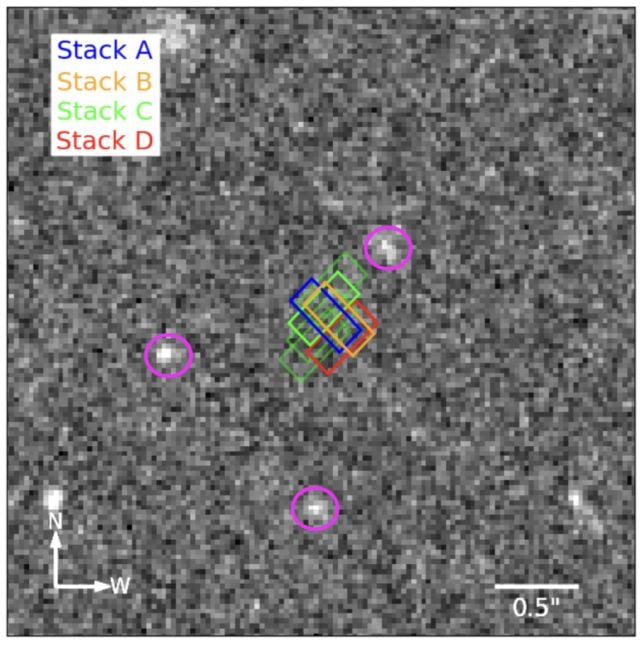
It can't easily be explained away as a glitch, either. It appeared in all four sets of combined exposures, across both observing orientations, 88 days apart, and the measurements were consistent.
Here's the real kicker. The emission line was bright enough that it should have shown up in the earlier JWST images.
Had it been present during JWST's JADES survey conducted in October 2022, there's no way the telescope could have missed it.
Which raises the possibility that maybe it wasn't present then.
But just one line is really tricky to identify, unless you know exactly how far away it is. That's because, as space expands, it stretches light into redder and redder wavelengths.
So an infrared photon could be energetic light from really far away, or less energetic light from much closer; you need more information than just its wavelength to figure out which it is – and how it was produced.
There are several different things that maybe could have produced the emission line – with four main suspects, none of which fit the bill cleanly.
A galaxy in the early Universe is the first in the lineup, with two main problems – that emission line would struggle to travel through the neutral hydrogen that filled the early Universe, and it should have appeared in the JADES observations.
A more recent galaxy could also be the culprit, but – in addition to the JADES problem – it should have other emission lines, not just the one.
It could have been a supernova, but again, it should have produced another emission line that wasn't detected.
And finally, a black hole tearing apart a star can produce a strong emission line, even without much other detectable light. But there's not enough evidence to establish that this is what happened.
Which means that there's only one thing to do.
"This object is highly unusual and probes extreme physical conditions," the researchers write.
"Follow-up observations are essential to confirm the redshift and determine the physical origin of the emission … Deeper, more sensitive spectroscopy could reveal additional emission lines and definitively establish the redshift and nature of the source."
The research has been published in The Astrophysical Journal.
This article was fact-checked by Fiona MacDonald and edited by Fiona MacDonald. While we pride ourselves on our process, we are only human. If you spot a mistake, please let us know.