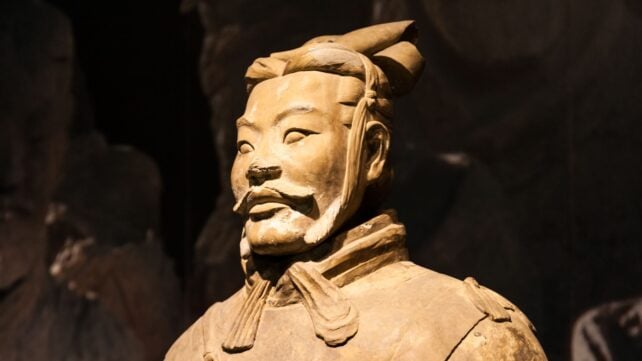
For thousands of years, a mysterious army has stood vigil – silent and impassive in the dark, never wavering from their solemn duty.
They are the warriors of the Terracotta Army, carefully crafted 2,200 years ago in China to guard the tomb of Emperor Qin Shihuang.
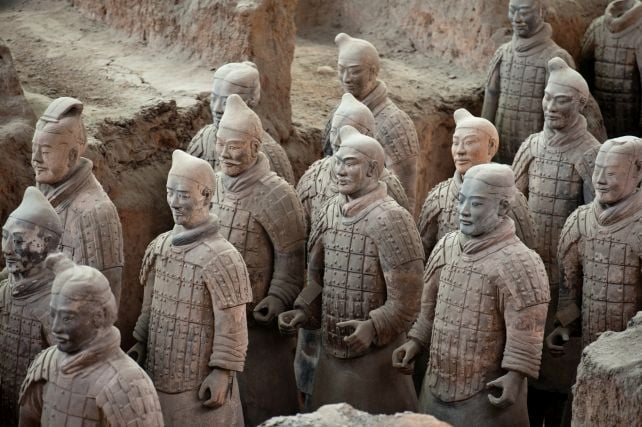
The work is exquisite – at first glance, the thousands of warriors look identical, but look closer, and you'll find an astonishing variety of faces, hairstyles, and armor, a breathtaking display of craftsmanship.
Traditionally, archaeologists have assumed that the entire army was built by adult men.
New research reveals that this assumption may be wrong.
The sculptors – whose work endures long after the emperor they served – left their fingerprints in the still-wet clay, and it's those fingerprints that suggest men, women, and children likely all collaborated in the epic undertaking of the Terracotta Army.
"These findings challenge the long-held assumption that Terracotta Army production relied exclusively on adult male labor," write researchers led by archaeologist Xiaoxi Li of Emperor Qinshihuang's Mausoleum Site Museum, "providing the first quantitative biological evidence for a diverse workforce including women and children."
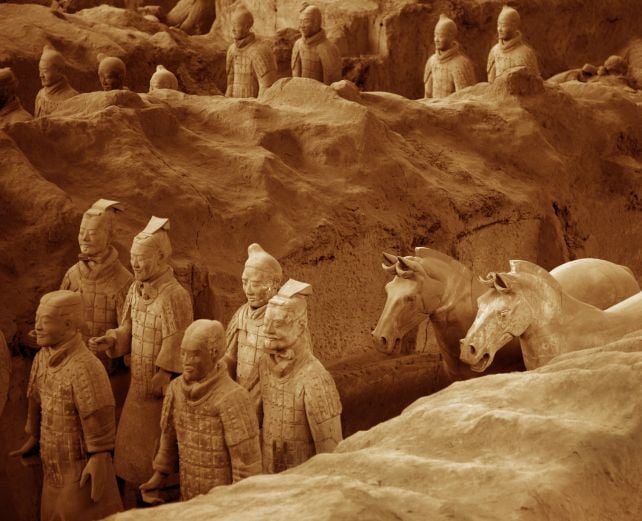
The Terracotta Army first came to light in 1974, after more than 2,000 years in darkness.
Farmers digging a well about 1.5 kilometers from the emperor's tomb site unearthed mysterious fragments of life-sized clay warriors.
What they had stumbled upon was an enormous underground army, whose full scale would take years to uncover.
The known extent of the Terracotta Army consists of thousands of life-sized statues – around 8,000 warriors, 130 chariots with 520 horses, and another 150 cavalry horses – but much of the emperor's vast necropolis remains unexcavated, and its full contents are still unknown.
Also largely unknown are the identities of the artisans who undertook this monumental work.
Relatively little research has addressed this question. Prior studies about the Terracotta Army have largely focused on how it was made, not who did the making.
So the theoretical assumption that it was men – the origin of which is unclear – was left more or less unchallenged, even though historical records show that women and children also worked in state-supervised workshops during the Qin dynasty.
A more diverse workforce was specifically documented in lacquerware production, Li and her colleagues note – but the composition of the workforce on the Terracotta Army remained an open question.
But traces of that workforce remained pressed into the clay.
Just as handprint analysis has revealed information about the artists of prehistoric times, fingerprints can shed light on who built the Terracotta Army.
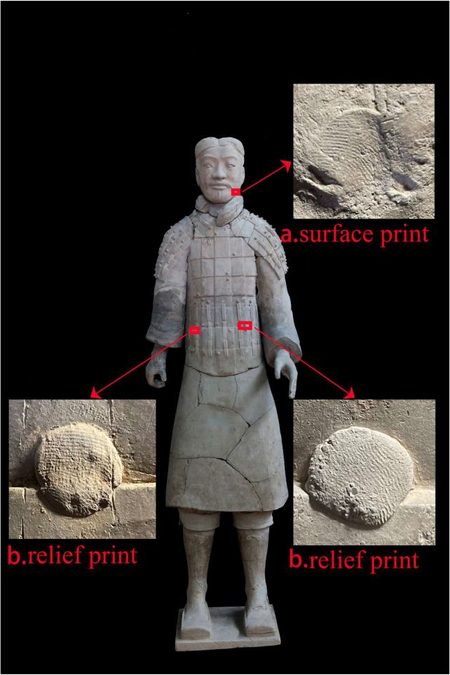
The study is based on 36 of the warriors from a single excavation pit. An initial survey documented 91 fingerprints – 12 of which were later excluded because they seemed to be from individuals who left multiple prints.
That left 79 fingerprints for the full analysis.
These prints were left all over the warriors – heads, arms, armor, hands, collars, and even a foot – and they seem to have just been a byproduct of the making process.
"Surface impressions, accounting for 73 prints, were left during molding, shaping, and assembly processes when artisans pressed their fingers directly onto wet clay surfaces; these were most commonly found on figurine heads and arms, where artisans would grip components during attachment and smoothing operations," the researchers write.
"Relief impressions, comprising the remaining 6 prints, were formed when pre-formed clay decorations – primarily armor nails and waistbands – were pressed onto the figurine surface, and these were exclusively located on armor components."
You might think a single fingerprint can't tell much about an individual, other than that they were human (or three koalas in a trench coat).
You would, however, be mistaken, and the secret lies not in fingerprint size, but in the tiny distances between the lines on the print.
As the researchers explain, as a human grows, their fingerprint ridges become more widely spaced – but there's very little difference between boys and girls.
However, once people reach skeletal maturity, their growth levels off – and men tend to have slightly wider ridge spacing than women.
That means the average distance between the ridges – a measurement called mean ridge breadth – can offer clues about a person's age and sex.
But there's a catch: the measurements overlap considerably between different groups. For example, an adolescent boy might have fingerprints almost indistinguishable from those of an adult woman.
Rather than attempting to analyze each individual fingerprint and assign it an age and a sex, the researchers used an algorithm to estimate the proportions of different demographic groups represented across all 79 prints.
The researchers also adjusted their measurements to account for differences in fingerprint size between populations and for clay shrinkage during drying and firing, although it's important to note that their reliance on modern European reference data introduces uncertainty.
Nevertheless, the demographic spread came back far more diverse than previous assumptions allowed for.
Only 45 percent of the fingerprints, according to the model, were likely made by adult men. Another 32.7 percent were attributed to adult women. And the remaining 22.3 percent were attributed to children under the age of 15.
The presence of children in the workforce may not have been unusual. Historical records from the Qin dynasty describe a formal system of apprenticeships, in which young people learned their crafts under the supervision of experienced artisans.
According to the Yuelu Academy Qin slips – ancient legal manuscripts inscribed on bamboo – "The master artisan teaches well; thus an apprentice completes training in one year, a new artisan in two years."
It's possible, the researchers suggest, that younger apprentices were assigned relatively simple tasks, such as attaching decorative details to the warriors' armor, while more experienced artisans undertook the more technically demanding work.
There are, however, some important limitations to the findings. The 79 fingerprints came from just 36 warriors in one section of the vast archaeological site, and the proportions of fingerprints don't necessarily reflect the proportions of people who made them.
Inexperienced workers, for example, may have left more fingerprints than skilled artisans, whose handling of the clay was more practiced.
Still, the findings suggest that the Terracotta Army may have been the work of a far more varied group of people than previously imagined.
Future work could focus on expanding the fingerprint database to create a larger sample set that should tell us much more about who built the enigmatic Terracotta Army of Emperor Qin Shihuang.
"This biological evidence highly corroborates numerous historical records, vividly reconstructing the production scene in the Qin Dynasty's state-run workshops where men and women served together, and adult artisans worked alongside juveniles, who may have been helpers or beginners," the researchers write.
The research was published in the Journal of Cultural Heritage.
This article was fact-checked by Peter Dockrill and edited by Peter Dockrill. While we pride ourselves on our process, we are only human. If you spot a mistake, please let us know.