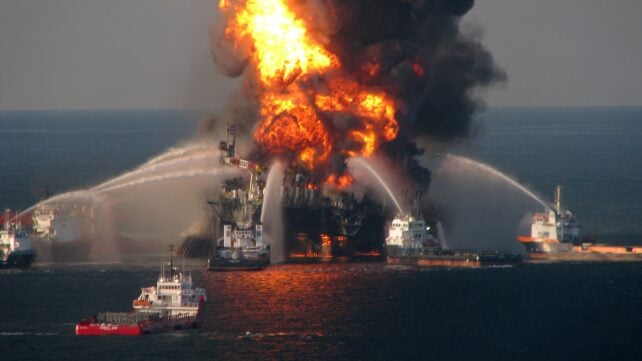
In 2010, the Deepwater Horizon oil rig failed catastrophically, leading to the largest oil spill in the history of Earth's oceans.
About 134 million gallons of crude oil entered the Gulf of Mexico during the 87 days it took to cap the oil well, as well as 7.7 billion standard cubic feet of gas.
Now, 16 years later, deep-sea ecosystems in the Gulf still show no sign of recovery from the disaster.
Scientists from institutions in the US present these grim findings in a new paper published in Proceedings of the National Academy of Sciences.
Led by oceanographer Tracey Sutton of Nova Southeastern University, the team focused on deep pelagic marine species, which are those that live deep in the water column.
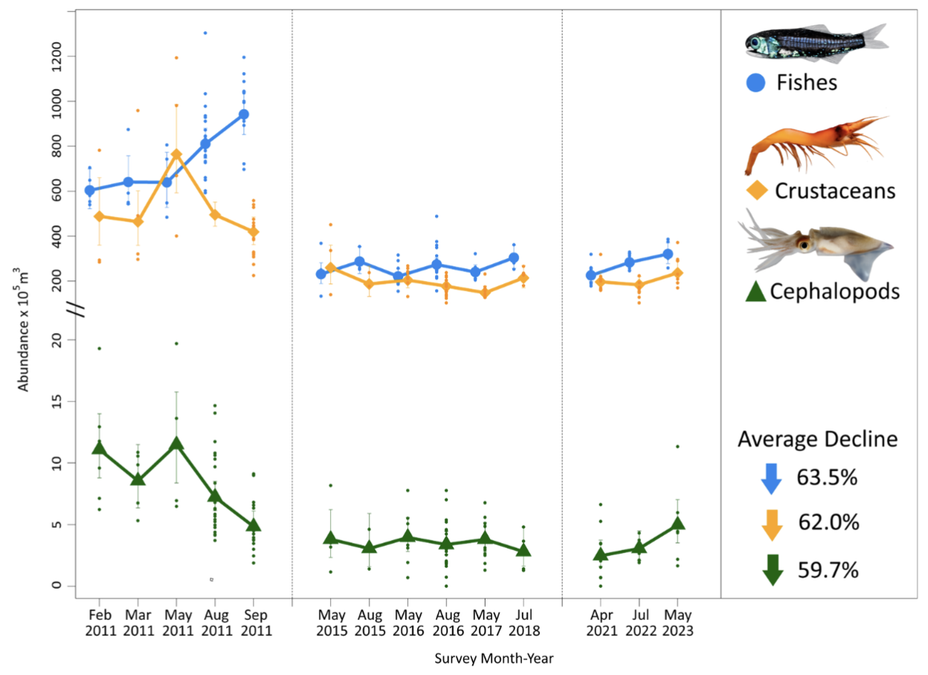
They first collected net samples in 2011, right after the oil spill. When they returned in 2015 through to 2023, their samples (now more than 2,000 nets' worth, altogether) revealed a sharp crash in the abundance of deep pelagic species.
"We saw this big decline," Sutton told Seth Borenstein at Associated Press.
"The question was then why? So we looked at all of the natural variables we thought could account for it, namely temperature, oxygen supply, and food. None of those vary with the decline. The event that did was the oil spill. So we think that's the most likely cause of the decline."
Fish numbers were down 63.5 percent; crustaceans by 62 percent; and cephalopods (mainly squid, in this context) by 59.7 percent.
"The taxa that declined the most are also considered the most ecologically important in the open ocean with respect to total numbers, biogeochemical cycling, and prey provisioning for higher trophic levels," the authors write.
Those taxa include krill, which declined by 72.8 percent; lanternfishes, which declined by 62.9 percent; and Cyclothone bristlemouth fishes, which declined by 69 percent.
All of these animals are vital prey for the ecosystem, and fuel the fishing and tourism economies people have built around it.
Many of them belong to what is known as the 'deep scattering layer', which contains fish, squid, and other creatures that rise towards the surface at night, and return to the deep at dawn, traveling hundreds of vertical meters.
This daily movement is like a 'biological pump' that drives carbon sequestration in the deep ocean.
"The community of organisms that comprise the deep scattering layer is a diverse complex of animals," marine scientist Kevin Boswell says.
"To be able to measure changes in the ecosystem across independent methodologies really drives home the point that the midwater ecosystem has undergone a significant change."
The repercussions of such a drastic collapse in the deep scattering layer may be surfacing already. Some shipboard researchers have reported sightings of 'thin whales', while once-predictable sperm whales seem to be moving erratically around the Gulf in search of food.
The researchers say the oil spill is the "most parsimonious explanation" for the drastic changes to the Gulf's deep sea ecosystem.
"Available evidence rules out natural phenomena as likely drivers, suggesting a large-scale pollution event and its associated mitigation measures most likely precipitated the declines," the authors write.
Those associated mitigation measures include around 770,000 gallons of the chemical dispersant Corexit 9500A that were injected near the wellhead.
The idea was to break up the oil and prevent massive oil slicks that could choke life on the Gulf's surface and shores, but this approach comes at a cost. The spill reached much farther than satellite images indicated, because oil residues reached all the way to the sea floor.
Both the oil and the dispersant are toxic to marine life, particularly the zooplankton that form the foundation of marine food chains. Combined, they do even more damage to zooplankton than the oil does on its own.
In 2014, scientists predicted that "the negative impact of crude oil and dispersant on microzooplankton may disrupt the transfer of energy from lower to higher trophic levels and change the structure and dynamics of marine planktonic communities."
The new research potentially shows those outcomes in action.
"Our findings are particularly concerning because these are species that are abundant, widespread, and historically might not have been considered vulnerable," says marine biologist Pedro Peres of Florida International University.
"Even species that appear abundant can experience substantial changes that may go unnoticed without monitoring."
"Collectively, these results indicate a sudden and persistent decline in the deep-pelagic fauna of a large marine ecosystem, resulting in a sustained, low-abundance state that meets the criteria for an ecological regime shift," the authors write.
They are unsure if recovery will ever be possible, let alone how long it would take.
"Given the tightly connected nature of oceanic life in the Gulf specifically… such declines are likely to reverberate through the system from top to bottom, altering ecosystem functions across multiple levels," they conclude.
The research has been published in Proceedings of the National Academy of Sciences.
This article was fact-checked by Fiona MacDonald and edited by Fiona MacDonald. While we pride ourselves on our process, we are only human. If you spot a mistake, please let us know.