
For all they seem to glisten and glint palely amid the velvet darkness of the night, stars are rarely pure white.
The cosmos is scattered with a panoply of hues – red stars and blue, yellow and orange. But some regions of the spectrum are noticeably absent from the stellar lineup.
There is, in particular, a glaring dearth of green stars.
But now astronomers have found an exception – and in an especially apposite twist, it's a white dwarf – the remnant core of a star that's already "dead".
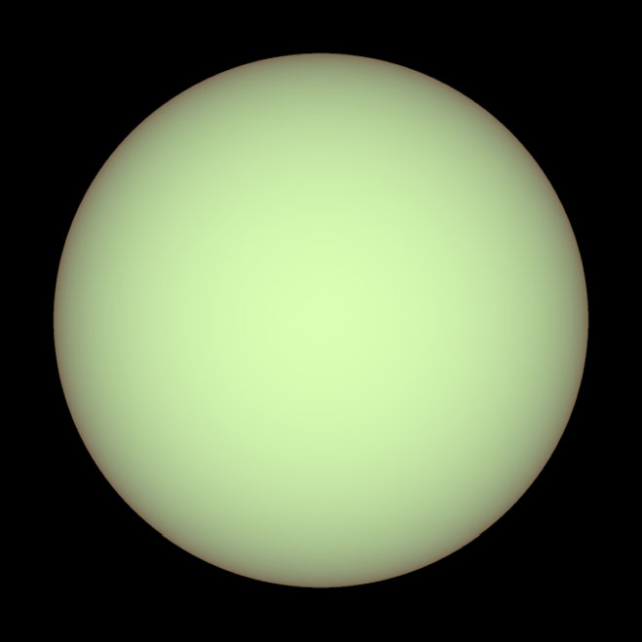
It's a star named WD J1330+6435, and according to research led by astrophysicist Mark Hollands of the University of Warwick in the UK, if we could see it up close with the naked eye (not recommended for reasons of retinal health), it would shine a ghoulish shade of chartreuse.
What's more, the researchers say, such dead stars may be the only ones capable of shining in 'forbidden' hues such as green, purple, and cyan.
"Most stars, including most white dwarfs, behave like 'perfect radiators,' so their color is set almost entirely by temperature. But nobody had really looked into what else might be possible for white dwarfs," Hollands says.
"It turns out these incredibly dense stars can produce colors nobody expected, and some of them genuinely surprised me."
Actually, the light emitted by stars is never confined to just a narrow wavelength band. These blazing objects spew light across the entire electromagnetic spectrum – not just the visible range from red to violet.
What defines the color of a star – from the red supergiants like Betelgeuse to the yellow dwarfs like the Sun to blue supergiants like Rigel – is the balance of colors in the light it emits.
That balance is set largely by temperature: hotter objects radiate proportionally more light at shorter, bluer wavelengths, while cooler objects emit proportionally more at longer, redder wavelengths.
So a star can have its strongest visible emission in the green part of the spectrum, but still look white or yellow because of all the other wavelengths present.
But white dwarfs are a different matter.
They form from the cores of stars that have ejected their outer material after running out of fuel for the fusion that sustains a living star.
No longer powered by fusion, these exposed cores – shining instead with residual heat – are extraordinarily compact, with masses up to 1.4 Suns squeezed into a body roughly the size of Earth.
Their gravity is so intense that the atmospheres of the coolest white dwarfs can reach densities comparable to liquid water – millions of times denser than the Sun's atmosphere.
At such densities, atoms are crowded together and interact with their neighbors in ways that dramatically change how they absorb light. Hollands and his team wanted to know whether that affected the light shining from these ultra-dense stellar corpses.
They selected dozens of white dwarfs that had already been identified as spectrally weird and conducted a deeper analysis of the colors their light would produce.
And among them was WD J1330+6435, the weirdest undead star of the lot.
By examining the wavelengths of light emitted by each star and calculating how the human eye would perceive them, the researchers were able to predict what colors the stars would appear if viewed up close.

The results were a riot of unexpected colors. Some white dwarfs appeared pink or purple, others vivid blue or cyan – with some displaying hues that ordinary stars simply can't produce.
But WD J1330+6435, with a surface temperature of just 4,240 Kelvin, would appear a startling shade of chartreuse green – the "most surprising color," the researchers say.
The secret to its unusual hue lies in that ultra-dense white dwarf atmosphere.
Elements such as sodium and calcium, which ordinarily absorb light at relatively narrow ranges of wavelengths in normal star atmospheres, can block out much broader swathes of the spectrum when packed cheek-by-jowl in the atmosphere of a white dwarf.
And in WD J1330+6435, that's precisely what's happening. Sodium in its atmosphere absorbs a broad swathe of orange-yellow light, while calcium suppresses violet. All that suppression lets green break free, finally claiming its moment in the starlight.
"The traces of sodium in the atmosphere of this white dwarf absorb the orange part of the spectrum, leaving behind a ghostly green glow," Hollands says. "Imagine standing on a planet and looking up at a green star. It feels like something out of science fiction."
But this tale has another macabre twist.
The elements that give the star its eerie complexion may be the remains of its own planetary system, devoured long after the star died.
In addition to sodium and calcium, astronomers have also detected lithium in WD J1330+6435 – all signs of rocky material, consistent with the dead star feasting on the debris of its former planetary system.
Like some sort of cosmic zombie, its face is stained with the evidence of its crimes.
This, however, could be good news for astronomers investigating the remains of dead planetary systems – a discipline known as necroplanetology.
Most white dwarfs are, as their name suggests, white. Of a sample of 152 nearby white dwarfs, the researchers found that just five – roughly one in 30 – had colors significantly different from those expected based on temperature alone.
Although not every unusual hue is a sign of planetary cannibalism, the findings suggest that the colors of these stellar corpses could help astronomers understand the chemistry shenanigans white dwarfs get up to – including, but not limited to, eating their families.
The research has been published in RAS Techniques and Instruments.
This article was fact-checked by Fiona MacDonald and edited by Fiona MacDonald. While we pride ourselves on our process, we are only human. If you spot a mistake, please let us know.