
US politician Benjamin Franklin famously said that death and taxes are the only two certainties of life, and while plenty of people seem to manage to evade paying what they owe to the state, no one has figured out how to live forever yet.
When it comes to extending life though, and staying healthier in old age, science and society are making progress. Now researchers from China have identified a link between longevity and a specific enzyme (a 'worker' protein).
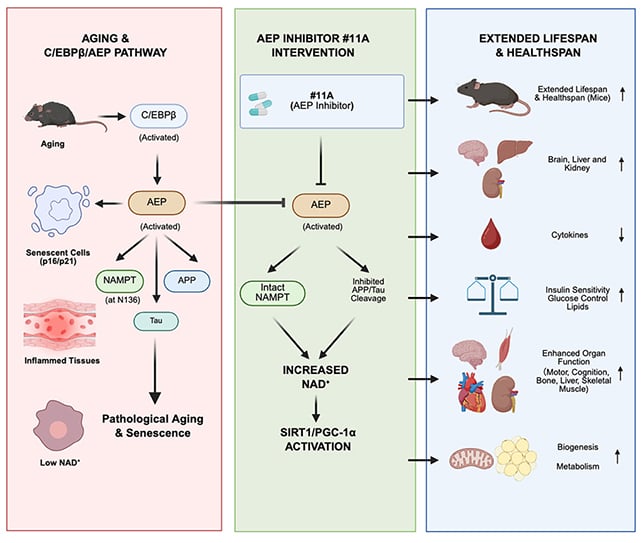
The enzyme is asparagine endopeptidase (AEP), also known as legumain. Its main job is to slice up other proteins and keep various processes in the body running smoothly, but it becomes more active as we get older, and problems can start.
Age-related overactivity of AEP, and its consequences in the body, has previously been linked to numerous health issues, including Alzheimer's disease and damage to DNA.
With that in mind, the team wanted to see if blocking the enzyme could extend lifespan and improve health later in life.
As reported in iScience, the researchers found that in tests on mice, inhibiting AEP boosted the average lifespan of the animals. What's more, the treated mice performed better on memory tests and seemed to be physically healthier, too.
"Our findings support the idea that AEP is involved in multiple aging-associated pathological processes and that pharmacological inhibition of AEP may ameliorate several age-related phenotypes," writes the team in their published paper.
The researchers put an AEP inhibitor called #11a in the food of some of the mice used in the experiments, while also keeping a control group for comparison.
All the animals involved were around 18 months old at the start of the study period, which is middle-to-old age for mice.
Untreated mice lived to an average age of 24 months, while #11a-treated mice averaged 28 months, four months longer. That translates to a 17 percent increase in lifespan.
There were lots of other positive signs too. The group given #11a showed fewer signs of age-related frailty, did better in exercise, strength, and memory tests, and showed improved metabolic health too (including better responses to insulin).
The researchers also observed fewer signs of inflammation and cell aging in the mice with inhibited AEP. It's a comprehensive set of results for the difference that dialing down the activity of the enzyme can make.

"In the current work, #11a alleviated multiple frailty indices in both male and female mice and was associated with attenuated age-related decline in physical and cognitive functions," write the researchers.
The next step in the research is to figure out why inhibiting AEP makes these differences. The study authors think overactive AEP may damage other proteins in the body that are there to protect cells from wearing out, but a closer look is needed to know for sure.
There were also some variations in how much the mice ate during the course of the study, and associated changes in calorie intake may explain some of the end results.
"Additional causal studies will be needed to determine the extent to which this pathway is required for the survival and health span phenotypes observed here," writes the team.
The study involved only a small group of mice, and we'll also need to see if the same effects show up in people to know for sure whether AEP suppression can help slow multiple aging processes.
Then there's the issue of AEP having many useful and important jobs to do in the body. While the mice in this study didn't show any major adverse effects to the treatment, long-term safety will need to be carefully evaluated.
In mice at least, blocking this enzyme shows promise for limiting and slowing some of the biological deterioration that comes with old age.
"These findings support further investigation of pharmacological AEP inhibition as a strategy to promote healthy aging," write the researchers.
The research has been published in iScience.
This article was fact-checked by Rebecca Dyer and edited by Rebecca Dyer. While we pride ourselves on our process, we are only human. If you spot a mistake, please let us know.