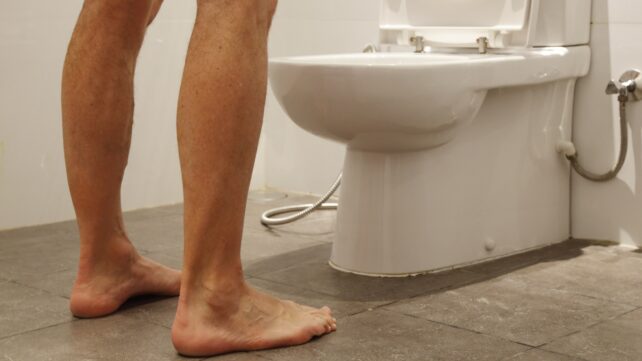
It's a question that many men may have pondered: Should they pee sitting down or standing up?
The best option may not be the same for everyone.
Past research suggests that men with enlarged prostates or other urinary issues may be better off sitting down.
Compared to standing, it's possible that sitting may relax the pelvic floor and empty the bladder more completely.
But some studies suggest the opposite.
When men aged 50 or younger urinate sitting down, evidence suggests there may be a higher risk of post-urination 'dribble'.
Now, a randomized crossover trial has put the dilemma to the test.
The research was led by scientists at the Colombian Urology Research Group, and the findings are published in Neurourology and Urodynamics.

The crossover study included 52 healthy male volunteers between the ages of 18 and 39 who had their urination monitored while sitting and standing.
Roughly half the group was randomized to sit first, then stand, while the other half tried standing, then sitting.
Between each posture, participants took a break of at least 24 hours, as a 'washout period'.
During a single pee, researchers measured the maximum urine flow rate – or how fast urine comes out at its peak – as well as the total amount of urine expelled.
Sitting or standing didn't seem to change the results.
"In healthy men, voiding posture did not significantly modify the maximum urinary flow rate or voided volume," the team concluded.
The only difference was that it took healthy men ever so slightly longer to reach their fastest urine flow when standing.
The difference was statistically significant, but it partly hinged on a single outlier, and researchers say it is unlikely to be clinically meaningful.
In the end, the results of the trial suggest that for healthy men, it doesn't really matter how they go to the bathroom.
For some, that may come as a relief.
In 2023, a global survey of more than 7,000 men found that in the United States, roughly 10 percent of men sit while they pee, though the rate is much higher in other nations.
In Germany, for instance, 40 percent of men report sitting while urinating, and yet the German word for this phenomenon is still sometimes used as an insult.
The decision to sit or stand while urinating can be heavily stigmatized in some cultures, and yet based on the literature at hand, it's one that doesn't really seem to matter that much in the end, beyond issues of hygiene.
"Regardless of the position, there seems to be no difference in the time taken to pee, the flow rate, and how completely the bladder is emptied," wrote bladder physiology researchers, Christian Moro and Charlotte Phelps, for The Conversation in 2023.
"So long as there are no urinary concerns, men are free to choose their preferred position. If you choose to stand, just be sure to aim well."
If there are urinary concerns, however, the healthiest stance may differ.
A survey from 2020, for instance, found that among nearly 200 men, those who preferred to sit while peeing were more likely to report urinary tract symptoms.
This does not mean that sitting is causing the issues. Survey respondents could be choosing to sit because they are already experiencing urinary difficulties.
But is that decision helping?
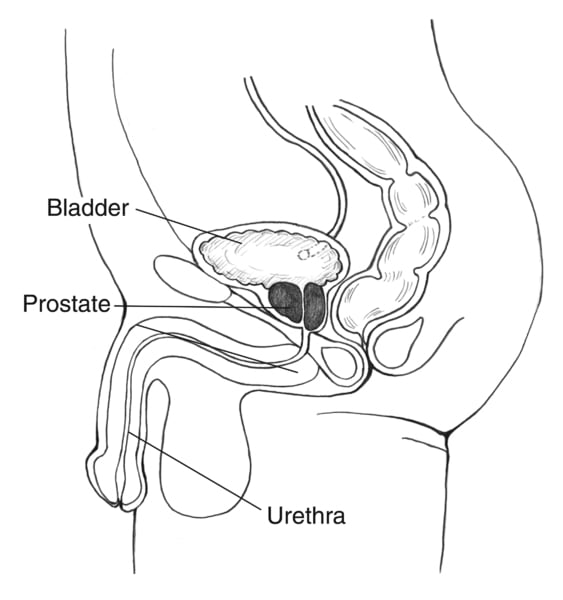
After the age of 50, many men develop enlarged prostates that may restrict their urethra and make it harder to pee.
Urologist Rena Malik explained on YouTube that this may cause some to strain when they urinate or deliver a weaker stream.
That can make it difficult to stand and aim.
"So sitting can be more convenient for hygiene purposes," Malik explained.
"But these are all theories," she admitted.
For now, the results are uncertain.
In 2014, a meta-analysis of 11 studies found that sitting while urinating was associated with greater bladder emptying, but only in men with lower urinary tract symptoms.
Among healthy men, there were no posture‐related differences.
The studies included in this review, however, tend to have small sample sizes and lack randomization of the standing-versus-sitting sequence.
"And, crucially," the authors of the most recent study add, "those reporting 'no differences' rarely perform formal equivalence analyses, which leads to claims that exceed what the data can support."
This new research addresses some of those limitations.
"From a clinical perspective," the authors conclude, the posture of urination "appears to have little practical influence on uroflowmetry in healthy men."
Healthy men, the team adds, can therefore "void in their preferred position".
Void away.
The research has been published in Neurourology and Urodynamics.
This article was fact-checked by Peter Dockrill and edited by Peter Dockrill. While we pride ourselves on our process, we are only human. If you spot a mistake, please let us know.