
The ovaries aren't the only sex organs with a biological clock.
Testicles also show signs of aging – with altered hormone levels, DNA damage, and reduced sperm function over time.
Yet despite their importance to human reproduction, it's not yet fully understood why testicles age, or what makes their biological clock tick.
Researchers in China have recently discovered a molecule that may speed up the aging process.
The team first collected testicular tissues from two young donors, aged 23 and 30, and two older donors, aged 62 and 91 – all of whom had already fathered children and had a testicle removed for medical reasons.
After analyzing more than 10,000 cell nuclei, the scientists found significant differences between young and old participants.
"With advancing age, the testis undergoes profound structural alterations," explain the authors in their published paper, led by researchers at the Chinese Academy of Sciences and the Naval Medical University of China.
The sample size is small, but in the lab, when researchers increased the expression of a single gene in cultured testicular cells, it accelerated signs of aging.
The findings are published in the Journal of Molecular Cell Biology.
Unlike the ovaries, which contain a finite supply of immature eggs, the testicle contains self-renewing stem cells associated with sperm production.
This means that a bank of sperm-producing cells can be maintained even into older age.
While it's true that men can father children past age 60, that does not mean male fertility remains constant throughout life. Cells in the testicle still show signs of aging.
After age 45, for instance, sperm quality and function tend to decline, though not quite as precipitously as egg quantity and quality in the ovaries.
In the past, research on testicular tissue has identified two cell types that decline with age: Sertoli cells, which support sperm production, and Leydig cells, which produce testosterone.
Both of these cells communicate closely with one another.
With age, however, this new research suggests their signaling may break down.
"We observed a widespread dysregulation in cell–cell interactions involving aging Sertoli cells and Leydig cells," the authors of the recent study write.
This could be detrimental to sperm development.
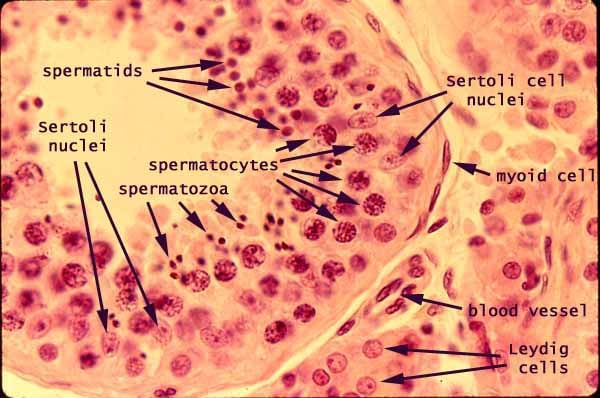
With age, researchers found that Leydig cells show significant changes in their interactions related to hormone secretion and blood vessel formation.
They also found that Sertoli cells communicate differently with immune cells.
Perhaps most strikingly, researchers noticed Sertoli cells in older testicles expressed significantly more of a protein called WLS.
In the lab, when the team increased WLS expression in cultured Sertoli cells, it accelerated signs of aging.
The findings suggest this may not just be a marker of aging; it may also be a driver of aging.
"As a Wnt transporter," the authors explain, "WLS is central to the Wnt signaling pathway that governs stem cell self-renewal, differentiation, metabolism, survival, and proliferation… Despite its established roles, the specific function of WLS in testicular aging remains unclear."
The findings are consistent with previous reports showing changes in Sertoli and Leydig cells with age and offer new avenues for future research.
But studies like these are few and far between.
"The availability of high-quality human testicular tissue samples, especially from older individuals, is limited due to ethical considerations and practical constraints," writes the research team.
"To improve the credibility and generalizability of our findings, more testis tissue samples need to be collected."
Other scientists agree we need more research on testicular tissue and its impact on male fertility.
In 2023, an international consortium of experts, led by the University of Melbourne's Moira O'Bryan, called on governments and health systems to improve research on male infertility.
The consortium recommended creating a global biobank of tissues and clinical data to help researchers understand the various causes of infertility.
"For most infertile men, the cause of their infertility is unknown. When it is known, few targeted treatments exist," explained O'Bryan in 2023.
The result is that women are often left to shoulder the burden of invasive fertility treatments like in vitro fertilization (IVF).
Knowing more about the male biological clock could help level the playing field.
The research has been published in the Journal of Molecular Cell Biology.
This article was fact-checked by Rebecca Dyer and edited by Rebecca Dyer. While we pride ourselves on our process, we are only human. If you spot a mistake, please let us know.