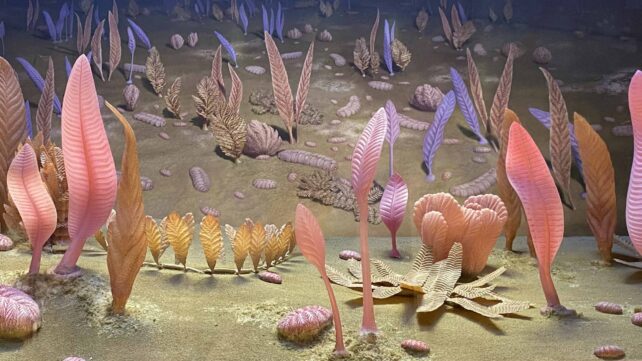
Life on Earth remained mostly tiny for the first few billion years, until bizarre giants began to appear in the Ediacaran Period, about 600 million years ago.
Long dominated by microbial life, Earth was finally getting its first animals.
In a new study, researchers look back at this pivotal time, investigating not just the animals themselves, but also how some environments preserved evidence of their soft, hard-to-fossilize bodies for us to find half a billion years later.
These were pioneering creatures, yet many looked unlike anything alive today.
Collectively known as the Ediacaran biota, they included a wide range of mainly soft, often Seussian organisms with unprecedented size and complexity – and, in some cases, question-mark butts.
They would soon disappear, however, in a mass extinction roughly 550 million years ago that set the stage for the Cambrian explosion.
As new animals proliferated, the Ediacaran biota had seemingly vanished without a trace.
In fact, it's amazing we know anything about these ancient animals, given how long ago they lived and how little hard material they left behind to fossilize.
As the new study explains, quirks of Ediacaran landscapes, coasts, and climates combined to preserve hints of their existence.
"More than half a billion years ago, the landscape of what is now South Australia looked very different," says lead author Karol Faehnrich, a geologist at Adelaide University.
The research focuses on rock formations from the Flinders Ranges in South Australia, a mountainous region famed for its rare trove of diverse, well-preserved fossils dating back to the Ediacaran Period, which lasted from about 635 million to 538.8 million years ago.
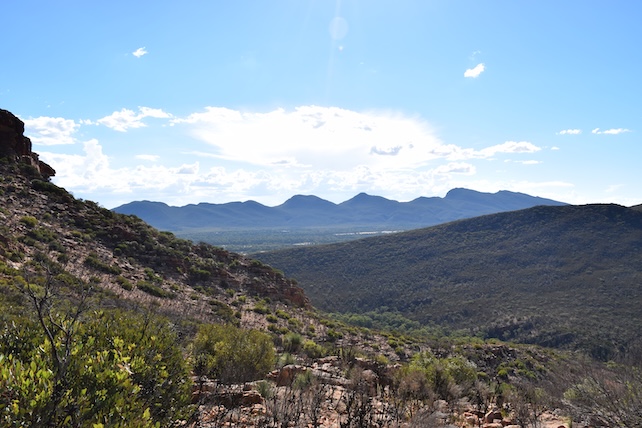

Ediacaran biota remain shrouded in mystery. It's unclear how they fit into Earth's broader family tree – i.e., to what degree they're ancestral animals or evolutionary dead ends – but also why their rapid radiation occurred in the first place, followed by their enigmatic decline.
Previous research has linked Ediacaran biota with global sea-level changes occurring at the time, Faehnrich and his colleagues note, and those changes have been cited as potential drivers of evolutionary innovation as well as factors in Ediacaran fossil preservation.
Yet this is speculative; we still don't know why these creatures evolved, why they died out, or what role sea-level change played in their fortunes.
In the new study, researchers mapped geological features across the Flinders Ranges to learn what the landscape was like about 550 million years ago – including how it changed late in the Ediacaran Period and how fossil-bearing sediments accumulated.
This revealed traces of colossal southeast-oriented canyons, plunging to depths of 280 meters (919 feet) and stretching more than 6 kilometers (3.7 miles) across in some places.
The canyons seem to have formed largely through underwater erosion, starting with a major decline in sea levels, the researchers report. When sea levels later rose, the canyons filled with sediment as the landscape flooded.
Under these conditions, a layer of Rawnsley Quartzite called the Ediacara Member preserved rare clues about the region's historic inhabitants.
"We found evidence that huge underwater canyons cut across the continental shelf before being rapidly flooded as sea levels rose again," Faehnrich says. "This flooding created the conditions that allowed one of the world's richest Ediacaran fossils to be preserved."
Based on characteristics of sediment depositions in the canyons, the region was apparently subjected to powerful water flows that could have moved large volumes of material.
With insights gleaned from modern submarine canyons, underwater erosion seems more likely to have driven this process than river dynamics alone, the researchers conclude.
"The evidence points to a combination of changing sea levels and local geological processes shaping the ancient basin," says co-author Diego Garcia-Bellido, a biologist at Adelaide University.
"This extraordinary evolution paved the way for the preservation of fossil-rich horizons. Many Ediacaran fossils are preserved as delicate impressions of soft-bodied organisms," he says.
"Those kinds of fossils only survive when environmental conditions are just right. Our work shows that the rise in sea levels played an important role in creating a window of exceptional preservation."
The research has been published in Earth and Planetary Science Letters.
This article was fact-checked by Rachel Garner and edited by Peter Dockrill. While we pride ourselves on our process, we are only human. If you spot a mistake, please let us know.