In September of 2002, a mystery emerged from the heart of the Milky Way.
Something spat out five flares of powerful radio waves, precisely timed 77 minutes apart. Then, it fell silent.
Astronomer Scott Hyman of Sweet Briar College wasn't quite sure what to make of it. He spent years looking for another, without much success, ultimately turning his attention to other work.
Twenty years later, while looking for something else, it happened again. There, in the data, every 62.2 minutes – another powerful flare of radio waves from a mysterious source.
Then it, too, fell silent.
But the new discovery offers tantalizing clues about what might be producing these strange signals, known as long-period transients (LPTs) – and whether they all come from the same kind of object.
"Are all LPTs one type of object?" Hyman told ScienceAlert. "Do they represent a new subcategory of white dwarfs or neutron stars? An entirely hitherto unknown type of object?"
The long-period transient is a newly recognized class of radio source that has only become apparent in the last few years – unidentified objects that emit long, bright pulses of radio waves with regular, lengthy pauses between each emission.
The discovery that established the category was GLEAM-X J1627-5235 – observed in 2018, and first reported in 2022.
Since then, around a dozen of the mystery pulsators have emerged in surveys of the radio sky, across the Milky Way, including – retroactively – Hyman's first, weird observation, GCRT J1745-3009.
"It is very gratifying to read about every new LPT detection after so many years coming up empty monitoring for similar objects to the GCRT," Hyman said.
But it's proven more difficult than you might think to pin an identity on these strange emitters.
There are several known types of dead stars that pulse in periodic fashion, but none can comfortably explain the full range of behavior exhibited by LPTs.
There are three leading contenders: pulsars and magnetars, which are neutron stars whose radio emissions are powered by different mechanisms; and white dwarfs, which can periodically lash out through interactions with a binary companion.
Pulsars are rapidly spinning neutron stars that sweep beams of radio emission across space like cosmic lighthouses, on short timescales that match their rotation.
Magnetars are their more intensely magnetic cousins, capable of generating powerful bursts of radiation as their magnetic fields twist and rearrange.
But LPTs pulse extraordinarily slowly by neutron star standards – sometimes taking hours between flashes.
At such leisurely rotation rates, conventional pulsars should struggle to generate the conditions needed to produce radio emission at all.
White dwarfs offer another possibility.
These stellar remnants are larger and can rotate much more slowly, and interactions with a companion star can generate powerful radio signals. Indeed, some LPTs have been linked to white dwarf binary systems.
But that doesn't mean all LPTs are white dwarfs.
Their diverse pulse patterns, polarization, and periods raise the possibility that more than one physical mechanism – and perhaps more than one kind of object – could be responsible.
It was into this mess that a strange new signal arrived in 2022, photobombing Hyman's new research focus.
By then, he had turned his attention to a search for millisecond pulsars – rapidly spinning neutron stars that might help explain an excess of gamma rays from the center of the Milky Way.
But one candidate in the data was behaving rather strangely.
"One object that we detected in archival observations of the MeerKAT telescope had pulsar-like properties, but the 'pulses' occurred many minutes apart, and at seemingly regular intervals," Hyman said.
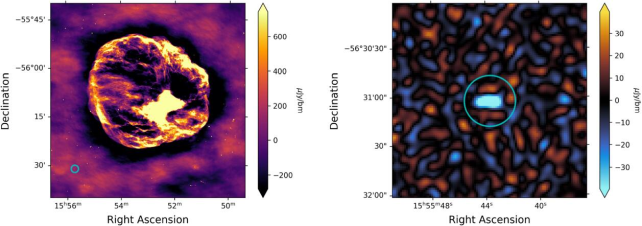
"We searched other archives, and found that the ASKAP telescope had been observing the same region of the sky on exactly the same day. This observation was 10 hours long and confirmed a 62-minute period. Together with its other properties, that's when we realized we had stumbled on an LPT."
True to its main character energy, however, it had a few surprises up its polarized sleeve.
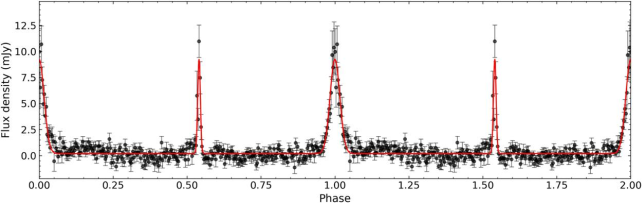
Rather than emitting just one burst every 62 minutes, LPT J1555-5631 produced two distinct pulses during each cycle – one longer, one shorter.
Even stranger, the two pulses showed opposite circular polarization: the radio waves from one pulse twisted in one direction, while those from the other twisted in the opposite direction.
That gave the researchers a tantalizing clue about the object's magnetic field.
"These properties indicate that the emission arises from regions near both magnetic poles, and that the rotation and magnetic axes of the object are nearly perpendicular to each other," Hyman explained.
This means there's something rather hinky going on with LPT J1555-5631 – because the pulses aren't quite evenly spaced. Instead of appearing 180 degrees apart, as might be expected from a simple dipolar magnetic field, they're separated by just 165.4 degrees.
"A 180-degree separation would more easily be explained by emission from a standard dipolar magnetosphere environment," Hyman said. "The observed deviation is an important clue pointing to a more complicated magnetic field structure."
And there's one other big, glaring mystery in the room: why LPTs erupt with such clockwork regularity, only to fall silent – and whether any of them can get restless again later.
LPT J1555-5631, like most of the LPT catalog, has not yet been detected again. GCRT J1745-3009, on the other hand, has shown repeat activity – as have two others.
Hyman said that such dramatic changes in activity likely have something to do with the object's magnetosphere – the region around it dominated by its magnetic field – but a larger catalog of LPTs might be needed for patterns to emerge in the data, giving astronomers something to start pulling apart.
"After many more LPTs are discovered, we hopefully will uncover more trends between them that allow us to make targeted searches of suspected LPTs," Hyman said.
"That would be exciting, although so are continued discoveries from blind searches of the archives and serendipity."
The research has been published in The Astrophysical Journal.