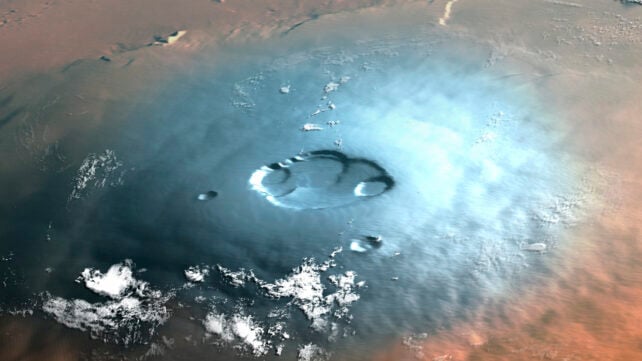
Mars is a long way away – almost 600 times farther away than the Moon – but scientists continue to make intriguing new discoveries about the red planet across the empty vastness of space.
In a new study published in Earth and Planetary Science Letters, an international team of researchers has identified a series of strange, cliff-faced geological features on the Martian surface that they suspect are hiding vast, ancient glaciers of ice.
Mars has a complicated history with ice and water. While the atmosphere is now too thin and cold for liquid water to survive, there's still a lot of surface ice on the planet – especially around the poles.
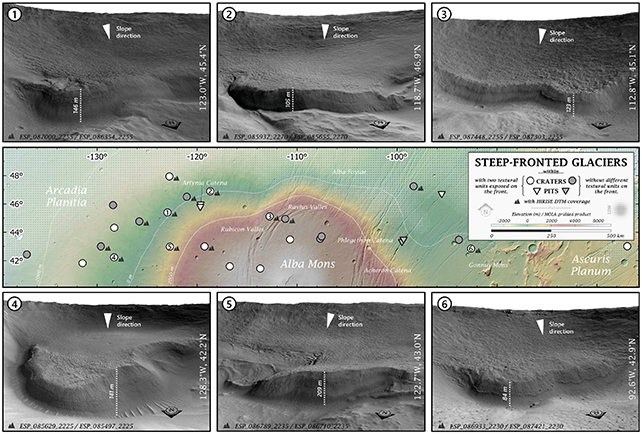
There's also thought to be plenty of ice underneath the crust, and that's what the study team believes has been spotted here, around the Alba Mons volcano in the northern hemisphere of the planet.
If the steep escarpments – 29 in all – do turn out to be glaciers, researchers are hopeful that they can teach us more about past ice ages on Mars, as well as point us towards water reserves that astronauts can tap into on future missions.
"Martian ice-rich landforms, generically referred to as Viscous Flow Features (VFFs), are key to understanding the Late Amazonian climate history of Mars, as its evolution may be recorded in the internal structure and dynamics of these deposits," write the researchers in their published paper.
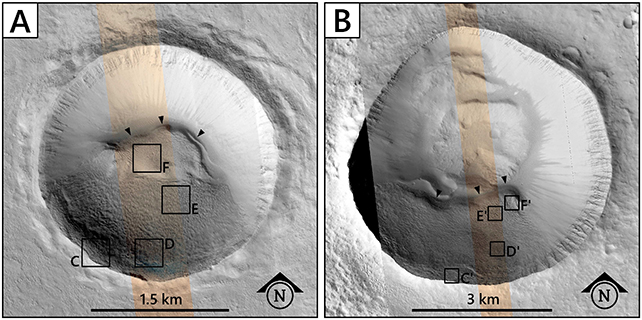
"We report the occurrence of lobate, pole-facing, steep-fronted ice-rich deposits within kilometer-scale fresh impact craters in the Alba Mons region, representing a previously undescribed glacial landform on Mars."
The geological features were picked out by studying imagery from the NASA Mars Reconnaissance Orbiter and the ESA ExoMars Trace Gas Orbiter. A total of 738 craters were examined, with pairs of satellite images used to build 3D maps.
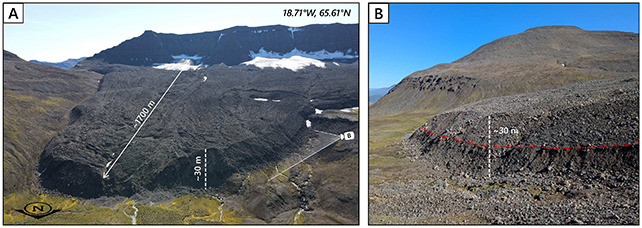
Computer modeling was then used to figure out how these glaciers may have formed, and how the geology should be interpreted. The researchers also looked at similarly shaped features in Iceland as a comparison point.
"This morphology has not been previously described for Martian debris-covered glaciers, but resembles the steep termini of some debris-covered or rock glaciers on Earth," write the researchers.
According to the analysis, we're looking at 29 deposits of glacier ice, currently covered by rocks, dust, and other debris, with the covering acting as protection against the atmosphere. They possibly formed during a relatively recent colder period on Mars.
These are large structures too: The downward slopes of these glaciers extend as far as 3 kilometers (1.9 miles) in some cases, ending abruptly in sheer cliffs that are as high as 209 meters (686 feet).
"Combined with glacial flow model and climate model outputs, our results suggest that these deposits represent the remnants of ice deposits formed during a recent colder, high-obliquity period and preserved under favorable topographic conditions on pole-facing crater slopes," write the researchers.
Some cliffs show evidence of rocks falling from the rim of the crater, traveling down the slope, and then collecting at the bottom.
That's going to matter for any future attempts to get at the water reserves on Mars. We need to know where the ice is located and how well covered it is by other material, and the new study is a significant help here.
With some further analysis, these newly discovered formation types might also be useful in working out when this part of Mars was most recently covered in ice, and how the climate shifted. The planet's tilt has changed over history, which in turn has shifted its temperature patterns, and the movement of water and ice.
Next steps for studying these Alba Mons craters could involve collecting more detailed imagery of the area, looking for similar formations elsewhere on the planet, and perhaps taking another trip to Iceland to examine the equivalent formations on Earth.
"These findings underscore the critical roles of local topography and debris-ice interactions in governing the preservation, evolution, and geomorphic expression of ice-rich deposits on Mars," write the researchers.
The research has been published in Earth and Planetary Science Letters.
This article was fact-checked by Fiona MacDonald and edited by Fiona MacDonald. While we pride ourselves on our process, we are only human. If you spot a mistake, please let us know.