There's a satisfying rhythm to life on this Earth.
Day turns into night, and into day again. Spring rolls into summer, then fall, then winter, before flowers tentatively emerge from the thawing soil once more, while the Moon in the sky cycles from full to dark and back to full.
But these are merely some of Earth's pulses, the ones we can measure in the spans of our own lives. The planet itself is vastly more ancient, and some of its cycles are longer than the entire history of humanity.
And one, written in the geological record, may have a link to our planet's long, slow dance with the Sun.
In ancient layers of rock, deposits left by powerful storms appear to rise and fall in abundance on a cycle of roughly 405,000 years.
That pattern, according to a paper led by geologist Shuyuan Shi of China's Research Institute of Petroleum Exploration and Development, could be driven by periodic changes in Earth's orbit called Milankovitch cycles, as our planet is gently tugged by other planets in the Solar System.
This would mean that, instead of entirely random spates of increased activity, our planet's storms may have followed a surprisingly predictable ebb and flow.
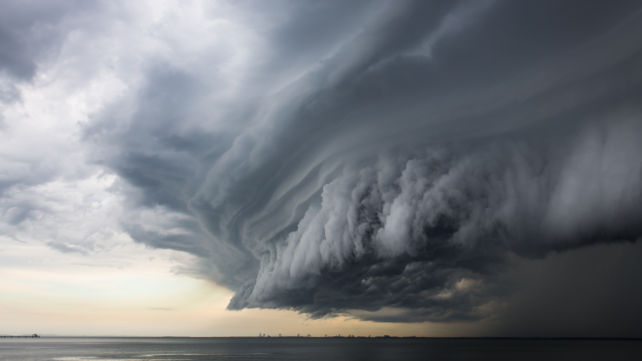
Storms are among the wildest weather events our atmosphere can create, including torrential rains and howling winds, a veritable frenzy of activity.
You might think that this would scour the planet of all traces as it went, but all the material swept up in a storm has to go somewhere – and that somewhere can be the floor of the ocean.
Powerful waves and currents can churn up sand, silt, and mud from the seafloor, carry it away, and deposit it in new layers that are eventually buried beneath subsequent sediments.
Over time, these layers harden and turn to stone, bearing a recognizable signature of the storm that put them there. Geologists call them tempestites, and here's the fun part: they can preserve evidence of a storm for hundreds of millions of years after its fury has blown itself into nothing.
But it's far easier to identify a tempestite than it is to reconstruct a timeline of the storm activity they signify.
You might be able to establish the age of a deposit here or there – there are a number of tools to help do so – but the trick is linking those dates together and making sense of the pattern.
Nevertheless, this is what Shi and colleagues have done, focusing their efforts on China's Sichuan Basin, where rocks dating back roughly half a billion years preserve the remains of an ancient tropical sea.
The researchers used a technique called cyclostratigraphy, which looks for repeating patterns in sedimentary rocks that can be matched to known cycles in Earth's orbit.
Combined with chemical clues preserved in the rock, this allowed them to reconstruct around 24 million years of geological history.
Within that record, they identified 59 cycles of roughly 405,000 years each. And when the researchers examined where the tempestites occurred within those cycles, an intriguing pattern emerged.
The tempestites tended to cluster during the rising and peak phases of each 405,000-year cycle.
These intervals contained thicker, coarser deposits, often stacked closely together, suggesting more intense storm activity. During the opposite phases, the deposits were thinner, finer, and more isolated.
And they didn't have to look far for a possible explanation. There's one specific orbital cycle with a suspiciously similar period, one that previous studies had already linked to tempestites: a Milankovitch cycle driven mainly by the gravitational influence of Venus and Jupiter.
Earth's orbit around the Sun isn't perfectly circular. It's slightly elliptical, and the degree to which it deviates from a circle changes over time, a characteristic called eccentricity.
The gravitational influence of the other planets causes this eccentricity to fluctuate in several overlapping cycles, including one that takes around 405,000 years to complete.
These changes don't substantially alter the total amount of sunlight Earth receives over a year.
Instead, they influence how that sunlight is distributed throughout the seasons, particularly through their interaction with another orbital cycle called precession, which changes the orientation of Earth's rotational axis over time.
Shi and colleagues propose that, in the warm climate of the Cambrian, these variations could have periodically intensified the heating of tropical oceans, increasing the exchange of energy between the sea and atmosphere and creating conditions favorable for more powerful storms.
The researchers caution that the relationship is not yet definitive. Changes in sea level, sediment supply, and the conditions under which tempestites are preserved could also influence the patterns they observed.
It's also unclear whether this pattern of storm activity persists today. Earth's current climate is different from the Cambrian climate, and may not provide the conditions for storms to proliferate in quite the same way.
Nevertheless, the findings suggest that tempestites could offer scientists another way to reconstruct the climate of Earth's distant past, revealing changes in storm activity and sea level that might otherwise be difficult to trace.
And what once looked like the scattered remains of random ancient storms may turn out to be another record of Earth's inextricable place within the stately motions of a vast cosmic ecosystem.
The research has been published in Palaeogeography, Palaeoclimatology, Palaeoecology.
This article was fact-checked by Rebecca Dyer and edited by Rebecca Dyer. While we pride ourselves on our process, we are only human. If you spot a mistake, please let us know.