
Superconducting materials can carry electricity with zero heat loss, which is potentially revolutionary for power grids, computer systems, and more – and which makes them of great interest to scientists.
To use them widely and practically, however, we need to know more about how superconductors work, and get them operating at normal temperatures and pressures.
Even superconductors classed as 'high temperature' need to be cooled to well below freezing to behave properly.
Researchers from the University of Warwick in the UK and the European Synchrotron Radiation Facility in France have now published a study in Physical Review Letters that overturns a 40-year-old assumption about a group of high-temperature superconductors called cuprates (copper-based ceramics).
Since their discovery in 1986, cuprates have been thought to have a uniform crystal structure internally.
This latest research suggests they're actually made up of a patchwork of different structures.

"For forty years, the working assumption has been that these materials are the same all the way through, and nearly all the theory is built on that picture," says chemist Mark Senn, from the University of Warwick.
"We've shown it doesn't hold."
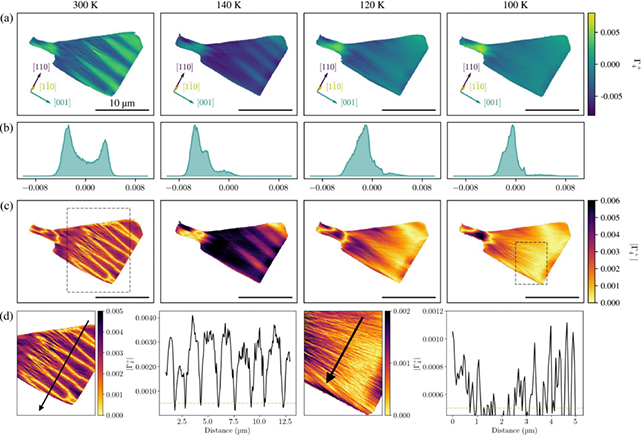
To make the discovery, the researchers used a technique called 3D X-ray diffraction (3DXRD), which can pick out crystal structures throughout a material's interior by measuring the strain at different points.
The material analyzed was a type of cuprate known as LESCO (lanthanum-europium-strontium copper oxide), which was tested at temperatures between 300 kelvin (26.9 °C / 80.3 °F) and 100 kelvin (-173.2 °C / -279.7 °F).
It's the first time that the interior of a cuprate has been examined to this depth and detail, and the scan turned up a surprise: two different atomic arrangements, separated by boundaries much wider than is typical for materials like this.
"The crystal is fundamentally patchworked and textured, with unusually wide boundary regions that likely work against superconductivity rather than just sitting alongside it," says Senn.
The discovery gives scientists a much better understanding of the superconducting qualities of LESCO, and quite possibly other cuprates. What was previously assumed about these materials was actually an oversimplification.
Electron movement is crucial for carrying electricity through a material, and the structures and boundaries identified in this research could affect how electrons pair up and arrange themselves into patterns – something which can be analyzed in future studies.
"This might explain why some materials perform better than others and means some existing bulk measurements will need to be reinterpreted and future theoretical models built that incorporate this structural complexity," says Senn.
Next, the researchers want to use the same technique to look inside other materials, including other cuprates, to see how their internal structures shape their behavior.
The discovery shows we've still got a lot to learn about superconductors, even those that were first identified four decades ago.
Already this year we've seen researchers set new temperature records for superconductors, break the conventional rules of these materials, and identify new superconducting states.
It all gets us closer to being able to use superconductivity outside of the lab and very specialist use cases (such as MRI scanners).
One question that needs further investigation is whether scientists should treat these superconductors as single materials going forward – or whether the different structures and large boundaries found inside LESCO mean it makes more sense to think of superconductors like this as several materials in one.
"New experimental techniques, such as scanning 3DXRD demonstrated here, will be instrumental in capturing the high-resolution structural data necessary to confront this challenge, enabling a more nuanced understanding of complex materials," write the researchers in their published paper.
The research has been published in Physical Review Letters.
This article was fact-checked by Rebecca Dyer and edited by Rebecca Dyer. While we pride ourselves on our process, we are only human. If you spot a mistake, please let us know.