If anything is forever in this Universe, it's black holes – or so their physics suggests.
These ultra-dense objects are possessed of inexorable gravitational fields. Matter goes in. Very little ever comes out. They punctuate the cosmos like full stops, steadily growing ever bigger, with next to nothing that can undermine their inevitability.
But that doesn't mean black holes are inviolable. And theoretical physicists have just found a method of black hole decay that's even wackier than the objects themselves.
It's possible, according to José Ferreira, Carlos Herdeiro, Eugen Radu, and Miguel Zilhão of the University of Aveiro in Portugal, that a black hole can squirt itself out of its own hair – leaving a fully functional boson star in its wake.
"Perhaps the most remarkable result is that we found a new way in which a hairy black hole can decay," the researchers told ScienceAlert.
"In one of the scenarios we call ' fission', neither the black hole nor its surrounding scalar structure is destroyed. Instead, the composite object separates into two independently viable objects: a black hole without hair and a self-gravitating lump of scalar matter: a boson star."
OK, so there's a lot going on here.
Let's start with the black holes. Although they're some of the most extreme objects in physics, under standard general relativity, black holes are actually fairly straightforward – once they're settled and doing their thing, remarkably few parameters are required to describe their behavior – spin and mass, for example.
But that doesn't mean those parameters are all there is. Actually, we don't know what other parameters might be lurking in black-hole space – but math allows physicists to explore some really weird possibilities.
These additional features are referred to as "hair", and one type of this hair can take the form of a scalar field.
Physicists have good reasons for conjuring up such strange configurations. Black holes offer some of the most extreme laboratories in the Universe, potentially allowing researchers to probe forms of matter and fields that are difficult to detect by other means.
If a black hole could support some kind of exotic "hair", studying it could therefore offer clues about particles or fields beyond those we currently know.
A scalar field can be thought of as an invisible medium that permeates space. In particle terms, it can also be described as a collection of particles with no spin.
Under some models, that field can coalesce into something like a cloud around a black hole – although not necessarily a wispy one. It can account for a substantial fraction of the entire system's mass, producing a powerful gravitational field of its own.
"Normally one might expect such matter simply to fall into the black hole. In these solutions, however, there is a particular resonance mechanism that allows the scalar field and the black-hole horizon to remain in equilibrium," the researchers said.
"The important open question was whether that equilibrium was actually stable once general perturbations were allowed. Our simulations show that, for the configurations we studied, it is not."
Initial simulations suggested that these hairy black holes could be stable – but those simulations had imposed spherical symmetry.
Although the black hole existed in three dimensions, anything that happened in one direction was required to happen identically in every other direction. This makes the calculations much simpler, but prevents the system from becoming lopsided.
Later work that allowed non-spherical dynamics revealed an instability in one model. Ferreira and his colleagues wanted to find out whether that instability was a quirk of the particular model, or a more widespread feature of these hairy black holes – and what ultimately happened as the instability grew.
They used numerical simulations to track several different configurations of hairy black holes over time, allowing the systems to evolve differently in different directions.
But there's one more piece of the puzzle. Under the right conditions, the scalar field around the black hole can hold itself together via its own gravity, forming a hypothetical, horizonless, transparent object known as a boson star.
So you can think of the system as two components bound together, but capable of existing independently.
Their results split into two possible outcomes.
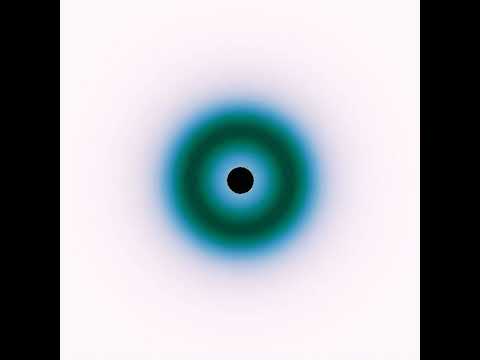
The first, which the researchers call "absorption", is probably what you'd expect. The instability causes the delicate equilibrium maintaining the hairy black hole to collapse. The black hole devours the surrounding scalar field, leaving behind a hairless – or "bald" – black hole.
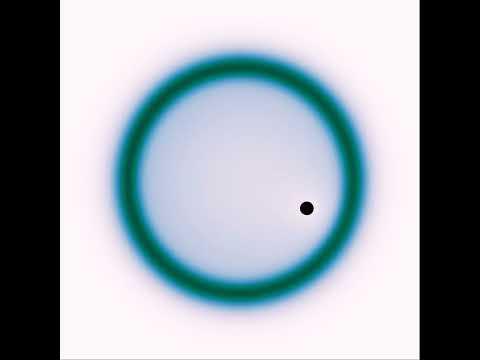
The second scenario, which the researchers called "fission", is where things got super weird.
"The black hole and the scalar configuration are held together by a competition between gravitational attraction and electromagnetic repulsion. In the fission regime, the symmetric configuration in which the black hole sits exactly at the center of the boson star is an unstable equilibrium," the researchers explained.
"A useful analogy is a ball balanced at the very top of a mountain. It can remain there if it is placed in exactly the right position, but the slightest push makes it move away."
And this is what they observed. A tiny disturbance was enough to nudge the black hole off-center. Rather than returning to equilibrium, it moved progressively farther away – eventually popping out of the scalar field like a comedone.
The field stayed together, living on as a boson star, while the black hole, now bald, went its own way.
Which fate awaited a hairy black hole seemed to depend, at least partly, on how compact its scalar hair was. More compact configurations tended towards absorption, while looser ones were more susceptible to fission.
This tendency held across two different scalar potentials.
That doesn't mean that black holes are currently popping out of boson stars willy-nilly across the Universe right now. For one thing, boson stars are still very much filed under "hypothetical".
For another, the researchers caution that this particular setup is primarily a toy model, rather than a realistic model of astrophysical black holes.
"The mechanism relies on ordinary electric charge, whereas astrophysical black holes are expected to carry very little net electric charge," they told ScienceAlert.
"So we would not claim that the particular objects simulated here are likely astrophysical objects. Rather, the mechanism we uncovered may point towards a broader phenomenon that could also occur in more realistic models."
One possibility the researchers want to investigate is whether rotation could play a similar role to electric charge in other models of hairy black holes.
And if an astrophysically plausible version of this instability does exist, it may not be entirely invisible.
"A violent symmetry-breaking process of this type should generate a characteristic gravitational-wave signal. In the fission case in particular, the dynamics are very different from familiar processes such as the merger of two black holes, so one would expect the waveform to carry distinctive features," the researchers explained.
"Determining exactly what those waveforms look like, and whether they could realistically be detected and distinguished from other sources, requires further dedicated study. We regard that as a particularly interesting direction for future work."
The research has been published in Physical Review D.
This article was fact-checked by Fiona MacDonald and edited by Fiona MacDonald. While we pride ourselves on our process, we are only human. If you spot a mistake, please let us know.