
The deep sea may seem very far away, but it's more connected to our world than you might think.
In the South China Sea, for instance, nutrient-rich waters well up from the deep, sustaining coastal fisheries that support the livelihoods of about 3.7 million people each year.
Mining companies also have their eyes on the deep sea, where they can see riches in polymetallic nodules, cobalt-rich rocks, and other mineral deposits.
A new paper from scientists at the Chinese Academy of Sciences gives a preview of how deep-sea mining can rapidly disrupt the microbes central to nutrient cycling on the South China Sea floor.
The results are reported in the scientific journal Total Environment Microbiology.
In 2020, samples of cobalt-rich rock were collected during a mining trial in the South China Sea, at around 1,300 meters below sea level.
As is typical of deep-sea mining, the rocks were crushed into small pieces first, and then transported to the surface.
"A large amount of sediment and other particulate matter were stirred up during mining, and this process had several direct and indirect effects on the in
situ microbial ecosystem," the authors note.
Meanwhile, a crewed submersible collected water samples before and during mining at 0 meters, 30 meters, and 50 meters above the seafloor where the rocks were being retrieved.
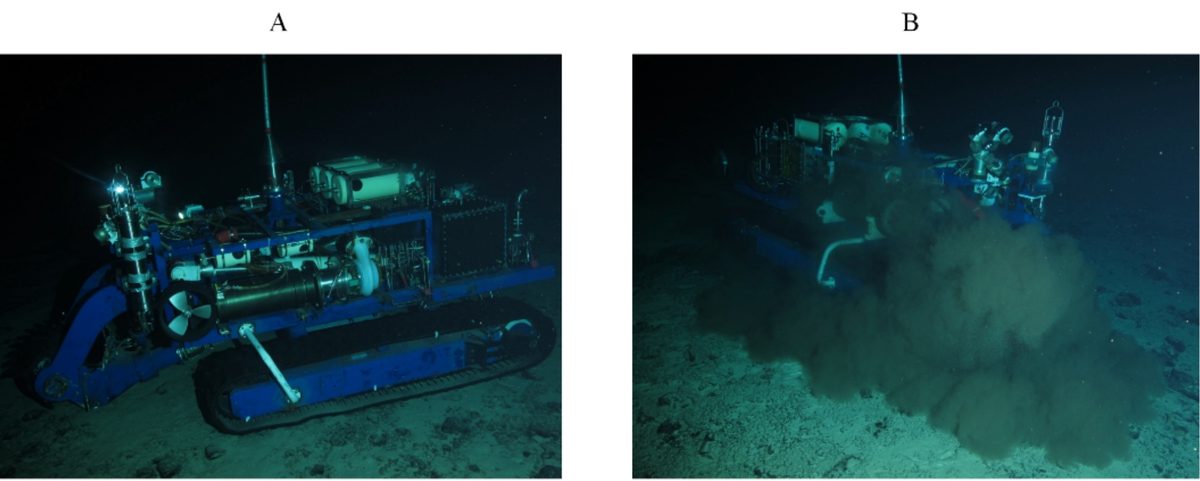
"The mining process had a significant impact on the distribution of inorganic nutrients within 50 m above the seafloor… [and] altered nutrient availability in the near-bottom water column, particularly for nitrogen and silicate," the team reports.
The researchers also sampled DNA scraped from the surface and bottom layers of the rocks and from within the water samples, particularly looking for genes involved in nutrient cycling, to understand how microbes were responding to the nutrient disturbance.
"These microorganisms were involved in nutrient cycling and energy flow to regulate and maintain the dynamic equilibrium of the marine ecosystem," the researchers explain.
The DNA results suggest that deep-sea mining can significantly disrupt the chemical processes that microbes perform.
In the water samples taken during mining, the abundance of genes involved in converting nitrogen into something living things can use decreased significantly compared to those in the samples collected previously. This effect was strongest in samples taken closest to the seafloor.
Meanwhile, genes involved in denitrification (a process in which microbes convert nitrogen compounds into gaseous forms of nitrogen) significantly increased during mining, both on the seafloor and on the surface of the rocks.
Genes involved in dissimilatory sulfate reduction, which is another kind of anaerobic process, also increased during mining.
Together, these results suggest the mining immediately disrupted nutrient cycling within the seafloor's microbial ecosystem.
"The suppression of nitrogen fixation and nitrite reduction pathways could be attributed to the increased turbidity and sedimentation caused by mining operations," the authors suggest.
"Conversely, the increase in denitrification genes in waters reflected… more anoxic conditions possibly due to the increased organic matter and reduced oxygen levels resulting from the disturbance of the seafloor."
The researchers also noted that sediment plumes can reduce light penetration, although sunlight doesn't reach the depths examined in this study.
The paper doesn't specify how much time passed between the 'before mining' samples and 'during mining' samples, so it's unclear exactly how rapidly these changes occurred, which is a major limitation of the paper.
The researchers describe the effects as "short-term" in relation to prior studies of deep-sea mining's potential long-term impacts.
Full-scale commercial deep-sea mining has not started yet, but the International Seabed Authority has granted 31 exploration contracts, five of which are held by China.
In the US, the National Oceanic and Atmospheric Administration is currently undertaking a review process to allow The Metals Company to begin deep-sea mineral resource exploration in the Clarion-Clipperton Zone, with public comment open until October 19.
Meanwhile, biologists and economists are questioning whether the risks are worth it.
A recent independent economic analysis conducted by Koinon Consulting found the industry could lose investors billions, even without considering the environmental impacts.
"Deep-sea mining doesn't stand up as an attractive investment. The returns are too low for the technical, operational, environmental, price, demand and social risks involved," Koinon Consulting director Johnny West said in an interview with Oceanographic.
The new paper's authors warn that the detrimental impact of human-induced disturbances on deep-sea ecosystems, even within a short time period, highlights just how urgent research into the consequences of deep-sea mining is.
The research has been published in Total Environment Microbiology.
This article was fact-checked by Peter Dockrill and edited by Peter Dockrill. While we pride ourselves on our process, we are only human. If you spot a mistake, please let us know.