
Sometimes in quantum physics, theory arrives long before practical observation: 40 years early, in fact, in the case of two theories that an international team led by researchers from the California Institute of Technology has now experimentally tested.
These theories are known as conformal field theories (CFTs), and deal with the math underlying what physicists call universality. Universality happens when different materials start behaving in similar ways near crucial tipping points – like water boiling, or a magnet losing its pull.
Back in 1984, physicist John Cardy used CFT math to predict that systems at critical tipping points would absorb energy in specific, fixed patterns. The researchers compare these energy patterns to rungs on a ladder.
Before now, the ladder had been theorized, but never actually observed or measured. In their study published in Nature, the researchers can now report on these energy patterns as seen in a quantum simulator.
"The energy levels predicted by these theories are important because they encode profound information about the theories themselves," says theoretical physicist Jason Alicea, from the California Institute of Technology.
"Even though we believed these theories to be true, it's important to have an experimental realization, something you can poke and prod. To see those predictions borne out is a beautiful thing."

Within the simulator, which works like a simplified, bespoke quantum computer, the researchers used strontium atoms trapped and arranged by laser light.
Separate lasers were then used to excite the atoms into high-energy states called Rydberg states, which increase atom-to-atom interaction.
Having got the chain of atoms behaving as a single entity through these strengthened interactions, it was tuned to get close to a tipping point.
At that point, the atoms were shaken by modulating the lasers at different frequencies, which revealed the 'rungs' of the energy ladder.


The energy patterns matched predictions for both the Ising point and the tricritical point, two tipping points the team wanted to investigate.
"We repeated the experiment on chains of up to 35 atoms, and the rungs came out as predicted by the Ising conformal field theory: the spectra collapsed onto a single universal curve once rescaled for size," says physicist Xiangkai Sun, from Caltech.
"We then tuned to the tricritical point and measured the lowest levels of its distinct spectrum, which came out in the different ratios theory predicts."
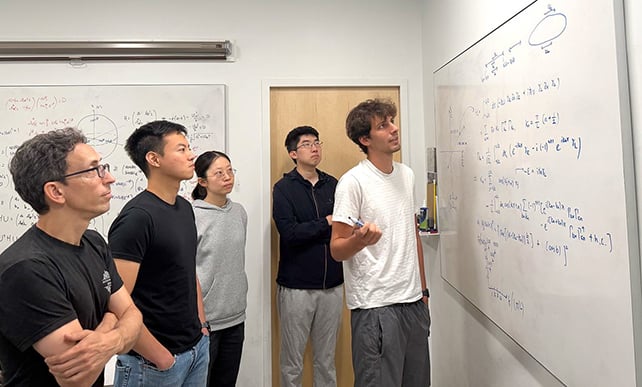
This gives scientists something to experiment on as they carry out more research into CFTs. It will help in the study of how materials behave at quantum tipping points, at temperatures close to absolute zero.
The researchers think the same approach could be useful in many other quantum tipping points, perhaps where CFTs aren't so precise about what to expect.
"What excites me is that the technique doesn't require knowing the answer in advance," says physicist Manuel Endres, from Caltech. "Here we could check our measurements against exact predictions."
"The next step is to point this at systems where nobody knows the response of the system quantitatively – including regimes that classical computers can't reach."
Besides verifying what we thought we knew about CFTs and the work of John Cardy, the study demonstrates that components of quantum computers can be useful for scientific research even before full quantum computers arrive.
A related quantum platform in the same lab was recently able to trap 6,100 atoms in an array, way beyond the 35 needed here.
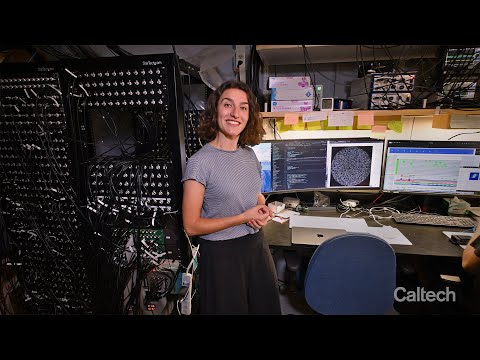
Future research could look at not just a single line of atoms, but also atoms in grids.
"Our new tools borrow from quantum computing platforms," says Sun.
"Over the past 10 years, people have been learning to control these systems, and now we are at the point where we can use them to do fundamental physics research."
The research has been published in Nature.
This article was fact-checked by Rebecca Dyer and edited by Rebecca Dyer. While we pride ourselves on our process, we are only human. If you spot a mistake, please let us know.