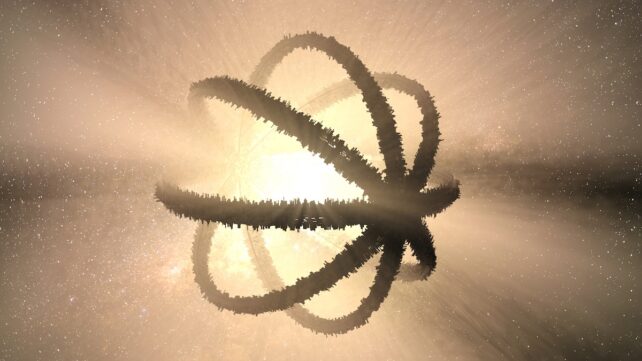
Alien megastructures built to harvest stellar energy or alter the orbits of stars may be physically feasible, according to a new analysis – satisfying both our sci-fi fancies and our innate yearning to not feel so alone in a large, cold Universe.
What's more, these immense extraterrestrial constructions could remain stable for untold eons in the right configuration.
They might even radiate distinctive technosignatures, allowing astronomers to search for civilizations that have survived long enough to approach the upper echelons of the Kardashev Scale (which ranks civilizations based on their ability to harness energy).
The mind-boggling math underlying the idea is detailed in a recent study by Colin McInnes, an engineering scientist at the University of Glasgow who has previously modeled the feasibility of super-scale astronomical projects aiming to modify planetary orbits, for example.
Now, McInnes presents a simplified blueprint for engineering passively stable megastructures such as stellar engines and Dyson bubbles.
Scientists and science fictionists envision stellar engines as immense, reflective structures gravitationally coupled to a host star. In its simplest form, the concept is a flat disc, although McInnes finds that a ring-supported version may be more stable.
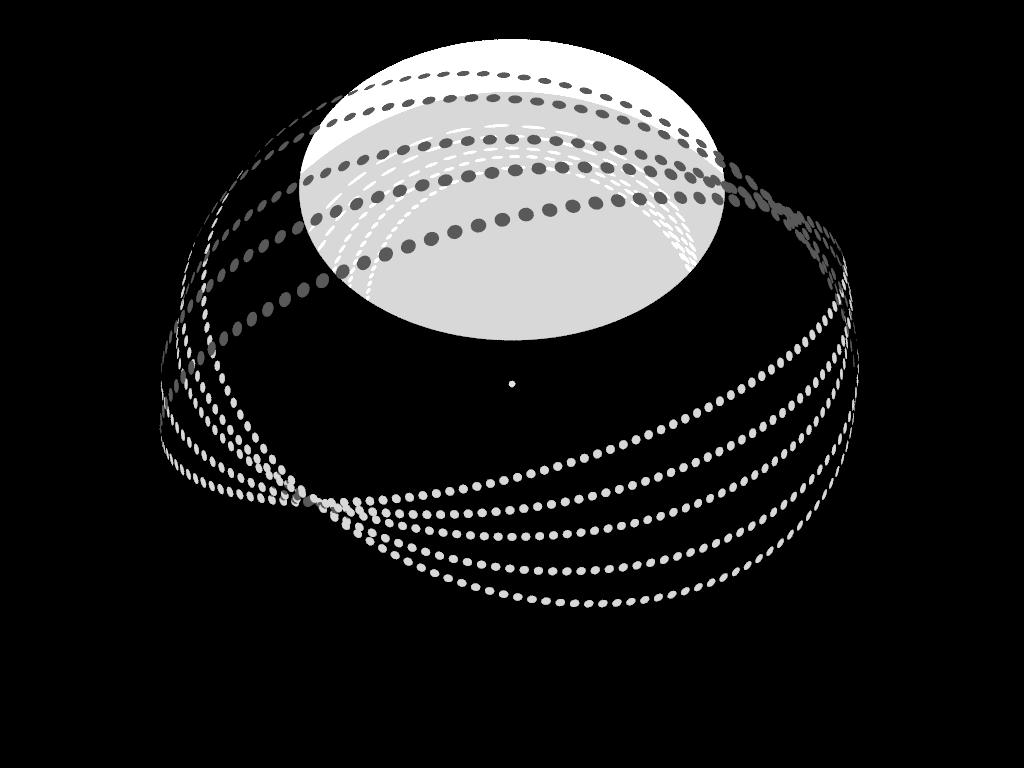

These engines use the pressure exerted by stellar radiation to shift that star's orbit and move entire solar systems across space – perhaps to avoid a civilization-killing cosmic catastrophe.
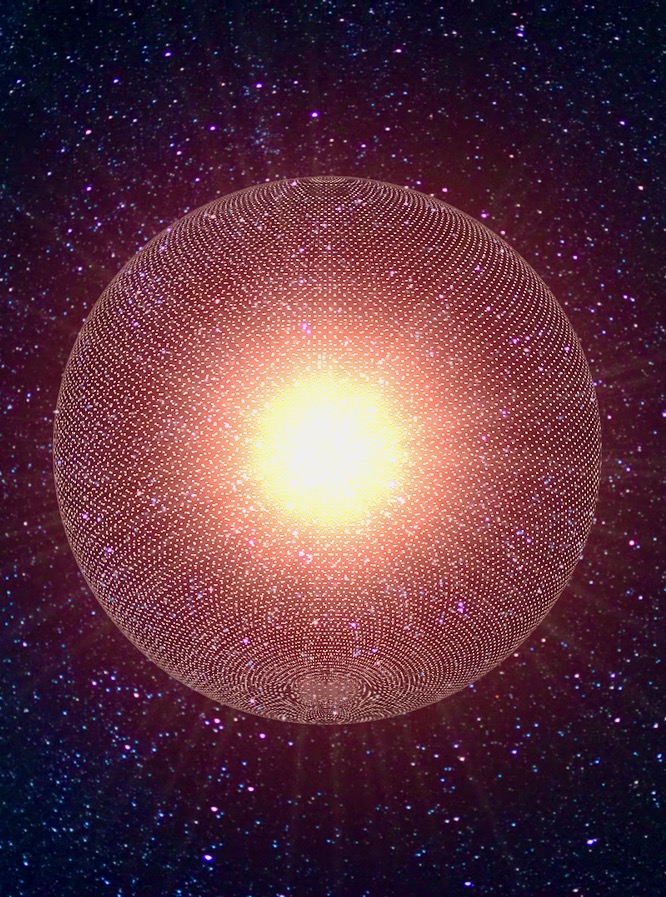
A Dyson bubble, on the other hand, surrounds a star with a dense swarm of reflectors to harvest its light and provide vastly more energy than any planetary process can provide.

Any civilization that lives long enough will presumably run out of resources or time. As an inconvenient reminder, the Sun will gradually grow brighter and eventually make Earth uninhabitable.
So advanced civilizations will invariably need incomprehensible amounts of energy to terraform other planets, alter the orbits of celestial bodies, or power interstellar travel.
But can the imagined astro-scale megastructures – which astronomers have speculated could be ways advanced civilizations may harness energy – remain stable on their own, without requiring active control measures to keep from plummeting into their stars?
To find out, McInnes developed calculations that treat the megastructures as 3D objects, rather than point masses without dimensions.
These calculations suggest that stellar engines with a uniform mass distribution are always unstable. However, they may remain passively stable if they're made of a reflector supported by a ring that contains most of the structure's mass – picture a tambourine instead of a dinner plate.

Similarly, static Dyson bubbles may be inherently unstable. Yet a Dyson bubble – potentially built from a dismantled planetary system – may achieve passive stability if it's composed of a vast number of low-mass reflectors, forming a cloud that's tenuous yet dense enough to balance its own gravity with the forces exerted by the host star.
"A stellar engine can in principle be stabilized using a ring configuration while a Dyson bubble can in principle be stabilized if a vast number of reflectors are deployed in a dense cloud," McInnes writes.
Long-term stability also suggests the possibility of long-abandoned relic megastructures. The Universe is old and unpredictable, so even advanced beings may be outlived by their creations, which have survived unmaintained as symbols of their creator's ability (or folly).
Though these space ventures may seem otherwordly, McInnes' calculations are based on physical laws, so they offer hints of what to look for in the search for extraterrestrial civilizations.
Related: Giant Star's Mysterious X-Rays Finally Explained After 50 Years
Stellar megastructures would produce an infrared excess, or unexpected output in infrared wavelengths based on their star's properties, McInnes speculates.
Or, they could cause other types of odd alterations in their host star's spectral fingerprint.
"While such ventures are clearly speculative, understanding the orbital dynamics of ultra-large structures, and in particular the conditions for passive stability, can provide insights into the properties of potential technosignatures in SETI [search for extraterrestrial intelligence] studies," McInnes concludes.
This research was published in the Monthly Notices of the Royal Astronomical Society.