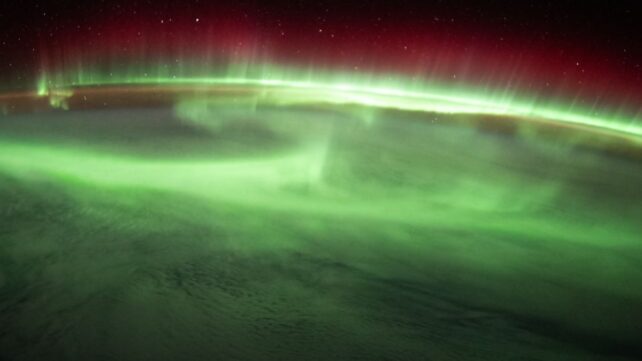
Earth is currently under bombardment from one of the most powerful geomagnetic storm categories the Sun can unleash.
Thanks to a giant eruption on the Sun and a large opening in its atmosphere, we're currently experiencing G4 conditions – a severe geomagnetic storm strong enough to disrupt power grids as energy from space weather disturbances drives electric currents through Earth's magnetic field and the ground.
Experts say the storm could even reach G5 levels, the extreme category responsible for the spectacular auroral activity seen in May 2024.
Related: The May Solar Storm Was So Intense We Felt It Even at The Bottom of The Ocean
In fact, space weather bureaus around the world are forecasting powerful aurora conditions, with some suggesting aurora could be visible at unusually low latitudes, potentially rivaling the reach of 2024's historic superstorm.
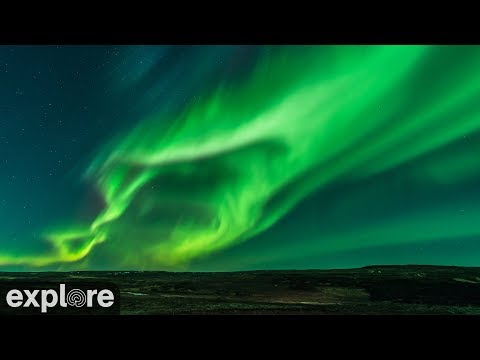
You can check it out on the livestream embedded below.
A geomagnetic storm is the result of activity on the Sun. On January 18, our star unleashed a giant X1.9-class flare – the most powerful class of flares it can emit. Flares on their own don't cause a geomagnetic storm. That requires a coronal mass ejection (CME) – the expulsion of billions of tons of solar particles bound together by ejected magnetic fields.
Think of it like a solar sneeze. When directed at Earth, as the CME that accompanied the X1.9 flare was, the energy carried by the CME slams into our planet's magnetosphere.
This accelerates charged particles already trapped there along magnetic field lines, dumping them into the upper atmosphere, primarily around the poles. Their interactions with particles in the atmosphere cause the colorful glow of the aurora.
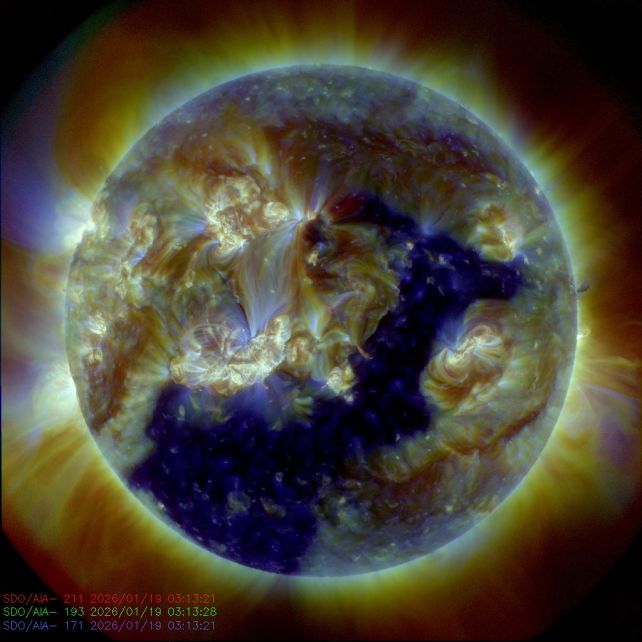
When a CME is reinforced by fast-moving solar wind, the result can be a particularly sassy storm. In this case, the CME is being followed by a huge coronal hole. That's a region where the magnetic fields on the surface of the Sun weaken and open up. This allows the wind of charged particles that constantly gusts from the Sun to escape more freely into the Solar System.
At time of writing, the solar wind was recorded at 1,069.9 kilometers (665 miles) per second, nearly three times the average speed of around 400 kilometers per second.
On its own, a high-speed solar wind stream can produce auroral displays; when combined with a CME, that display can be much more pronounced.
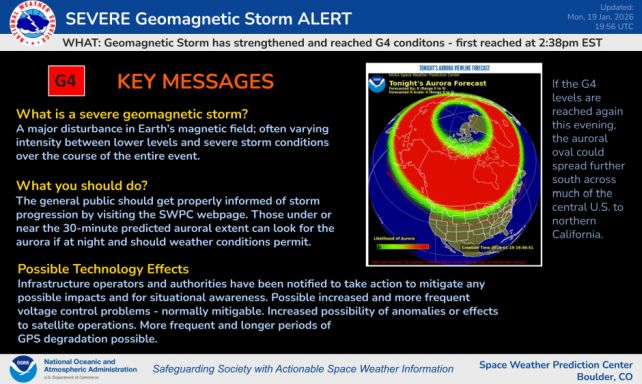
There are a few hazards associated with this kind of wild space weather. The X-radiation from a flare usually causes temporary radio blackouts. Geomagnetic disturbances driven by a CME can also interfere with radio communications and spacecraft operations, as well as the aforementioned power grids.
Another component is a radiation storm. This occurs when a powerful solar eruption accelerates a huge cloud of energetic particles – mostly protons – which stream outward from the Sun ahead of the CME.

These particles reach Earth much more quickly than the CME itself and mainly pose hazards for astronauts, spacecraft electronics, and high-latitude aviation, since most are blocked by Earth's atmosphere
Radiation storms are graded on the S-scale. The one from this solar event reached S4, the strongest radiation storm seen since 2003, according to NOAA's Space Weather Prediction Center. At time of writing, it had subsided to S2.
An S4 severe solar radiation storm is now in progress - this is the largest solar radiation storm in over 20 years. The last time S4 levels were observed was in October, 2003. Potential effects are mainly limited to space launch, aviation, and satellite operations. pic.twitter.com/kCjHj4XYzB
— NOAA Space Weather Prediction Center (@NWSSWPC) January 19, 2026
While the most intense phase of the radiation storm has passed, geomagnetic activity from the CME may continue as Earth's magnetic field responds to ongoing solar wind conditions.
Now all you have to do is head outside, look up at the night sky, and – if conditions cooperate – enjoy the show.