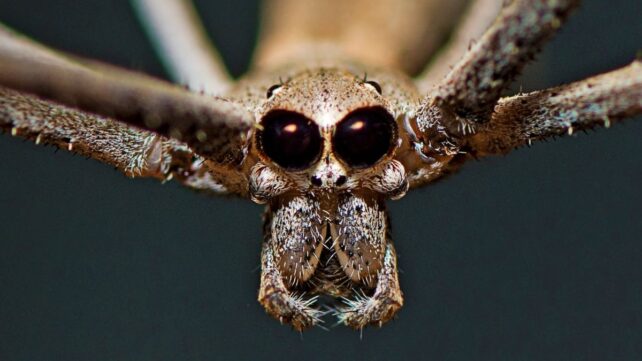
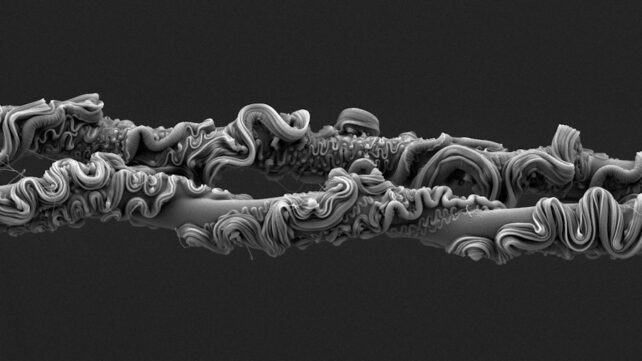
An extreme close-up of the Australian rufous net-casting spider's unique silk, captured by biologist Martín Ramírez and his colleagues, reveals in intricate detail the material qualities that make this spider's net so effective.
The image is the winner of this year's Royal Society Publishing Photography Competition, and it's a delightful reminder of all the wonders our planet has to offer, if you take a moment – and a microscope – to look.
Just a few microns thick, the two ropey, frilly strands of spider silk were photographed with the aid of an electron microscope.
The rufous net-casting spider, Asianopis subrufa (formerly classed in the genus Deinopis), has an extraordinary method of catching prey. Unlike the broad webs cast by orb-weavers, which trap unsuspecting prey with droplets of sticky, poisonous oil dotted along the silk, the net-casting spider relies on silk with an entirely different property: elasticity.
Related: Arachnid Megacity Discovered in Cave May Be World's Largest Spider Web
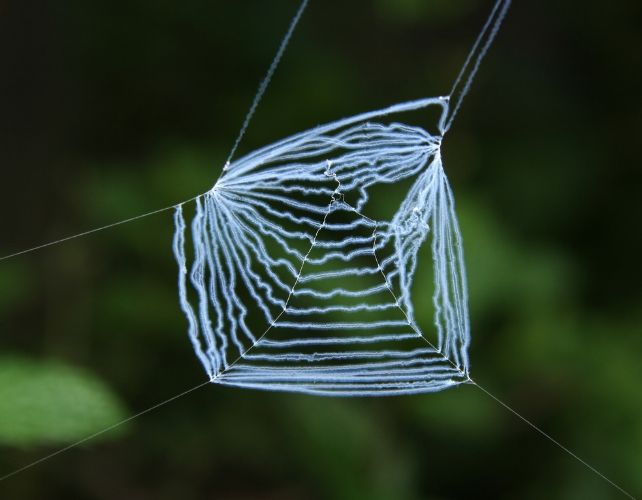
At night, the Australian net-casting spider prepares a seemingly small web, about the size of a postage stamp. It's made of what is referred to as cribellate silk, which is produced by an organ called a cribellum.
This organ is dotted with thousands of tiny holes from which the spider pulls individual silk fibers, each one with a nano-scale thickness, but which together form a strong woolly-looking silk.
Like a hair scrunchy, cribellate silk is comprised of a stretchy, elastic core that can expand to the limit of its coat of stronger, harder fibers (and which give the silk its beautiful 'ruffles,' as seen in Ramírez's picture).
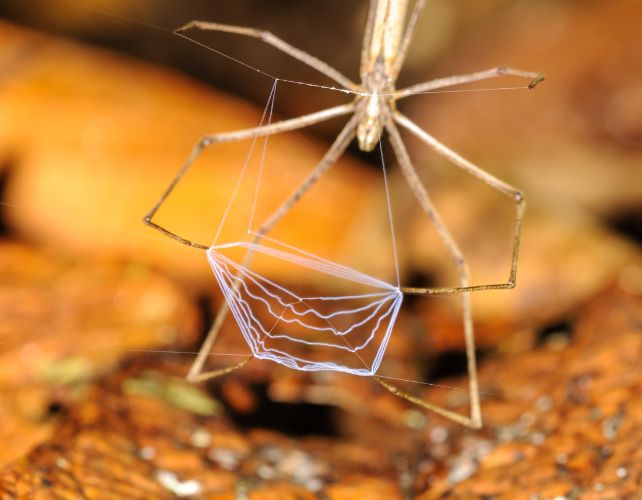
This combination of elasticity and strength is essential to the net-casting spider's nocturnal hunting style. The spider hangs head-down, holding the tiny (but highly elastic) net with its four front legs, one for each corner of the net.
The net-caster has eight eyes, two of which are significantly larger than the others and face forward like our own. This gives them excellent forward vision and motion-sensing abilities in low light, which is crucial to the success of their nocturnal hunts.

The spider dots the ground below its 'trap' with white spots of its own poop, which is much easier to see than any other colors in the dark.
If an unlucky insect should cast a shadow upon these dots, even for a second, the spider launches its attack. Its web stretches up to three times its original size, allowing it to be cast over the prey before retracting, essentially shrink-wrapping the unfortunate bug.
All finalists in the 2025 Royal Society Publishing Photography Competition were announced here.