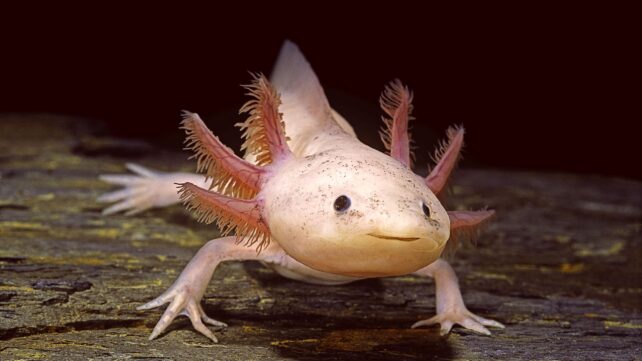
You might think axolotls don't have a lot going on.
These strange amphibians seem to spend their days languidly lolling around muddy waters, only stirring when it's time for snacks – simple creatures with simple needs and simple lives.
But there may be more going on in their little heads than their serene smiles suggest.
In a unique test of the cognitive abilities of the Mexican axolotl (Ambystoma mexicanum), researchers have found that these enigmatic creatures can accurately assess the sizes of passage openings – an indicator of basic quantitative reasoning.
But that's not all. Somehow, they retain this skill, even when shrouded in darkness.
"It was initially surprising that they could distinguish between openings in complete darkness," animal behaviorists Oxána Bánszegi of the National Autonomous University of Mexico and Péter Szenczi of the National Institute of Psychiatry Ramón de la Fuente Muñiz told ScienceAlert.
"This shows that vision is not always essential for such tasks, especially when it is limited for taxonomic or environmental reasons."
Axolotls are something of a rockstar in certain scientific circles, admired and studied for their incredible ability to regenerate lost or damaged body parts – including entire limbs.
By comparison, not much at all is known about what goes on in their frilly little noggins.
But there's reason to believe that axolotls may have some quite interesting cognitive abilities. Other amphibians, for example, have shown the ability to discriminate between numerical quantities – numbers in groups of prey or other members of their own species, for example.
Bánszegi, Szenczi, and their colleagues wondered if the same might be true for axolotls.
"Since it has been documented that some amphibians, such as salamanders, frogs, and even tadpoles, can discriminate among quantities, we expected that axolotls would exhibit similar abilities," they said.
But there's a problem when it comes to axolotls.
"Previous studies with other species have almost all relied on the animals' vision," the researchers explained.
"Those studies were developed for species with relatively good vision that actively search for their food and sometimes encounter situations in which they must choose between prey or social groups."
Axolotls, living in their natural habitat in the mud at the bottom of the murky Xochimilco Canals, have very poor eyesight; they rely on other senses to evade predators and ambush prey.
So the researchers came up with another way to test quantitative discrimination in axolotls – doorways.
The research involved 24 juvenile axolotls, around seven months old, housed in clean, comfortable tanks.
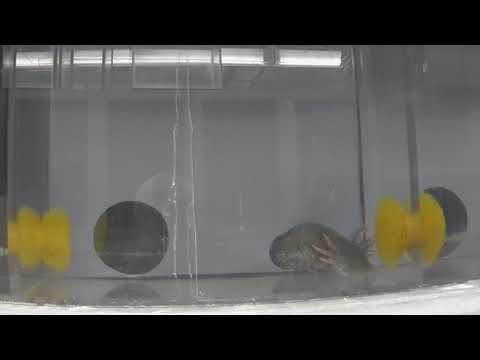
The experiment was incredibly simple. A grey plastic divider with two circular holes was placed in the tank, creating a wall that separated the tank into two chambers.
The axolotl could access the other half of the tank through either hole – each was large enough to comfortably accommodate passage – but one was larger than the other.
This was because, the researchers said, axolotls need to be able to squeeze through gaps in their natural environment.
But they're also soft and squishy, so they need to be able to assess the size of the gap to avoid getting stuck or injured. Sure, they can regrow bits, but no one wants to have to regrow a paw when they have a perfectly good one already.
Over 18 days, the researchers presented the axolotls with six different doorway combinations, each for three days – from a small difference between the hole sizes to a larger difference – and recorded their movements to see which openings they preferred.
They also turned the divider around midway through each three-day test to reverse the positions of the holes, as a control against habit or side preference.
And an exceptionally clear pattern emerged.
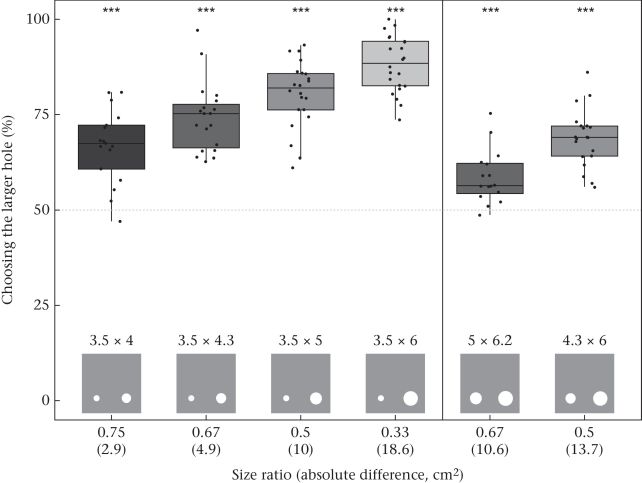
Even though both holes were large enough for the axolotl, the animals tended to choose the larger one with greater frequency – no matter the difference in hole size.
In fact, every single one of the 22 axolotls active enough to be included in the analysis showed a statistically significant preference for the larger doorway.
"We quickly saw that they preferred larger openings for crossing," Bánszegi and Szenczi said.
"We counted a surprising number of crossings in several individuals. This showed that these animals are not boring at all, and in fact, there is much more to their behavior than we previously thought."
The openings' size difference mattered, too.
The greater the difference between the two openings, the more strongly the axolotls preferred the larger one.
But when both openings were larger overall, the axolotls' preference became less pronounced, suggesting their decisions were influenced by more than just the relative sizes of the holes – although exactly how the animals make these judgments remains unclear.
More intriguingly, perhaps, the preference didn't disappear in the dark.
Overall, the axolotls were less active at night, making fewer crossings through the divider. But when they did move about at night, their preference for the larger opening was just as strong as it was during the day.
Now, it makes sense that an animal with poor vision that lives in muddy waters has other ways of navigating its environment – but poor vision doesn't mean no vision. So how the heck do they manage this trick?
"Axolotls possess a lateral line system that detects water movement and slight pressure changes," the researchers explained.
It's possible that this sensory system helps the axolotls assess the openings without seeing them, although the experiment wasn't designed to determine exactly how they do it – that could be an avenue for future research, Bánszegi and Szenczi noted.
Now, the research doesn't demonstrate that axolotls are able to count, or that they have some secret capacity for mathematical reasoning.
What it does show is that they can discriminate between spatial quantities in a way that is useful for navigating their habitat – and that understanding their cognitive abilities needs to take into account the way they perceive the world.
"The term 'intelligence' can be controversial when discussing animal behavior. It should always be evaluated in light of the animal's ecological needs. However, our study suggests that there is still much to learn about this species and its behavior," Bánszegi and Szenczi said.
"Understanding its behavior and cognitive abilities could be important for conservation, improving its welfare in captivity, and even supporting research on regeneration."
The research has been published in Animal Behaviour.
This article was fact-checked by Fiona MacDonald and edited by Fiona MacDonald. While we pride ourselves on our process, we are only human. If you spot a mistake, please let us know.