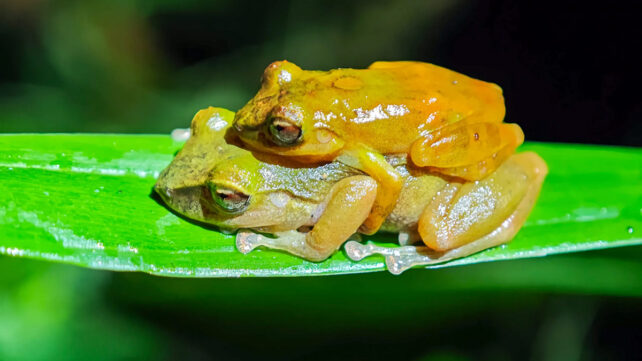
The discovery of a new species is always cause for celebration, but the arrival of Pristimantis milpe (or the Milpe Rain Frog) into the scientific textbooks comes with a more unusual story than most.
What makes the discovery of this amphibian special is that it was confused with another kind of frog – Pristimantis subsigillatus, the Salidero Robber Frog – for decades.
And it was only after a re-examination of frog specimens collected in the Ecuadorian Chocó rainforest and identified in 1902, now stored at the Natural History Museum in London, UK, that the taxonomic confusion was brought to light and put right.
Evolutionary biologist Santiago Ron and colleagues at the Pontifical Catholic University of Ecuador have published their findings in ZooKeys.

"That such a common species has gone unnoticed under the wrong name for decades highlights the importance of correctly connecting scientific names with living populations in nature," says biologist Jhael Ortega.
There were several stages to the discovery, including the close examination of the holotype – the official reference specimen – of what had previously been presumed to be P. subsigillatus at the Natural History Museum.
Through a comparison with other frog holotypes as well as modern populations, the researchers determined that the original holotype of P. subsigillatus differed noticeably from the frogs that have since been assigned to the species.
In other words, the museum specimen was not the impostor. The frogs carrying its name were.
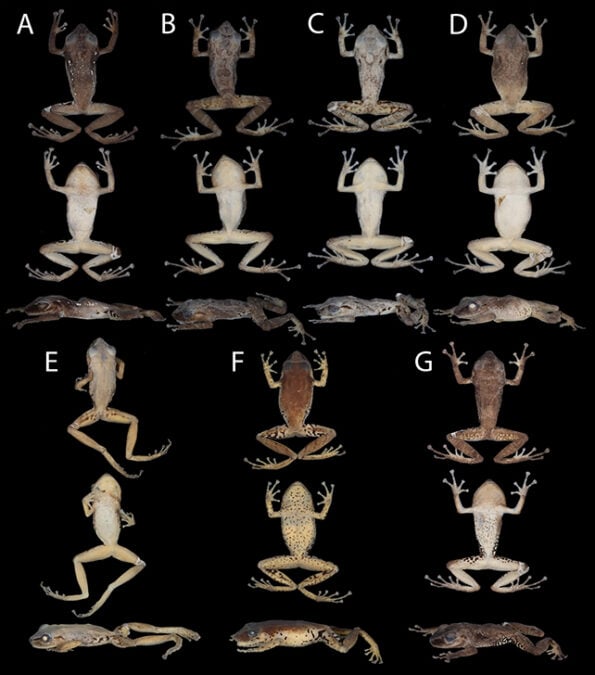
"Upon re-examination of the holotype of P. subsigillatus, we conclude that the populations currently ascribed to P. subsigillatus are not conspecific with the holotype," write the researchers.
"Instead, the holotype is conspecific with one of the syntypes of P. latidiscus, a species described four years before from a nearby locality."
The discovery effectively left a population of frogs – historically labeled as P. subsigillatus – without a correct scientific identity.
After a series of field expeditions, specimen collections, and DNA tests, the team established they were looking at a new species, which they called the Milpe Rain Frog (Pristimantis milpe).

While P. milpe is a brand new species as far as classifications go, we already know a lot about this frog.
It's widely distributed in the rainforests of Ecuador and southern Colombia, and has also been known to inhabit banana plantations and urban areas such as parks. The frog also has a distinctive nocturnal call similar to a clicking sound.
Males and females are fairly easy to tell apart: Females have a distinct colored pattern on their groin and thighs, with orange or light blue mixed with black spots, while males have a more uniform coloring.
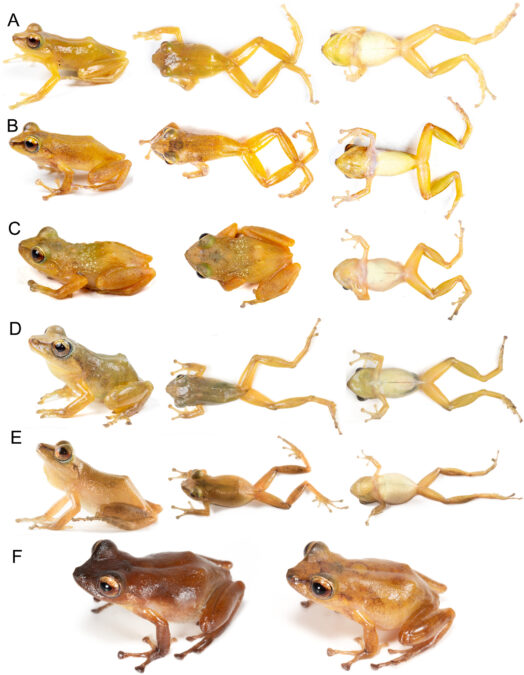
These are relatively small frogs too, with males growing to an average of 25.8 millimeters (1 inch) in length based on observations, and females growing to an average of 33.9 millimeters (1.3 inches).
"With ~67,000 km2 of extent of occurrence, Pristimantis milpe is one of the most widespread species of Pristimantis in the Pacific basin," write the researchers in their published paper.
"Moreover, it can be locally abundant and conspicuous due to its loud advertisement call.
"Therefore, it is astounding that such a common species remained undescribed until now."
The researchers note that the original naming mistake then became accepted fact in subsequent studies across the decades, without anyone going back to the initial holotype – the key source material.
This isn't the first time that mistakes like these have been spotted in the same frog genus, with more than 600 species collected together under Pristimantis, and the researchers suggest that it may be worthwhile to audit other classifications too.
Related: Fossil Kept in a Museum For Decades Turns Out to Be a Fearsome New Predator
Ultimately, being able to correctly identify the wonderful variety of wildlife around us helps in understanding the natural order of the world, how it's evolving over time, and how we can protect it across future generations.
"These historical oversights serve as a reminder that even common and conspicuous species can remain effectively 'invisible' to taxonomy until the fundamental link between name-bearing types and natural populations is correctly established," write the researchers.
The research has been published in ZooKeys.
This article was fact-checked by Rebecca Dyer and edited by Rebecca Dyer. While we pride ourselves on our process, we are only human. If you spot a mistake, please let us know.