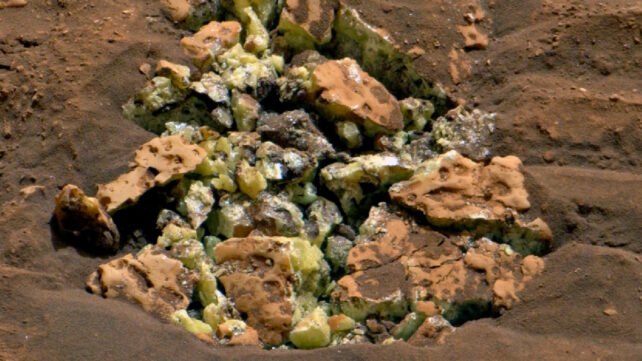
A rock on Mars spilled a surprising yellow treasure after Curiosity accidentally cracked through its unremarkable exterior.
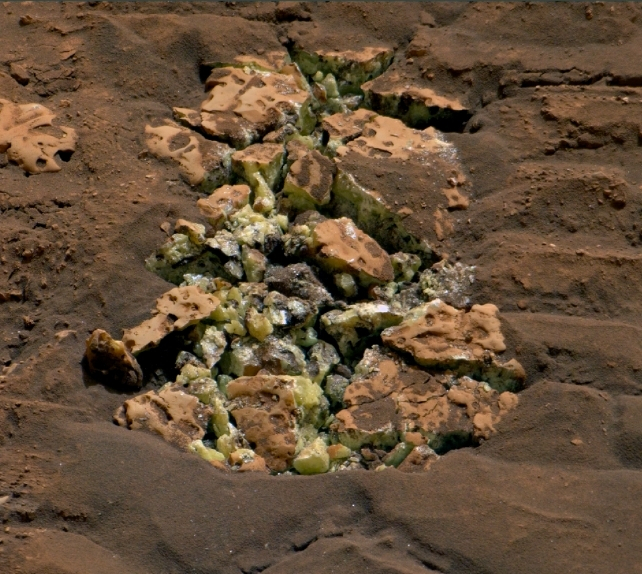
When the rover rolled its 899-kilogram (1,982-pound) body over the fragile lump of mineral in May of last year, the deposit broke open, revealing yellow crystals of elemental sulfur, known as brimstone.
Although sulfates are fairly common on Mars, this represented the first sulfur in its pure elemental form found on the red planet.
Related: Curiosity Finds First In Situ Evidence of Carbon Cycle on Ancient Mars
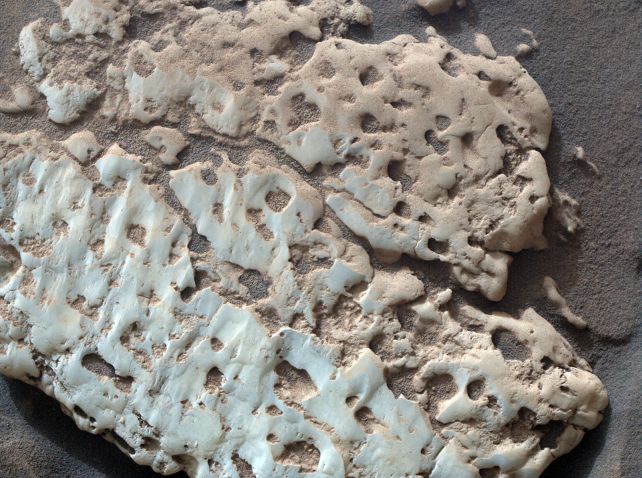
What's even more exciting is that the Gediz Vallis Channel, where Curiosity found the rock, is littered with objects that look suspiciously similar to the sulfur rock before it got fortuitously crushed – suggesting that, somehow, elemental sulfur may be abundant there in some places.
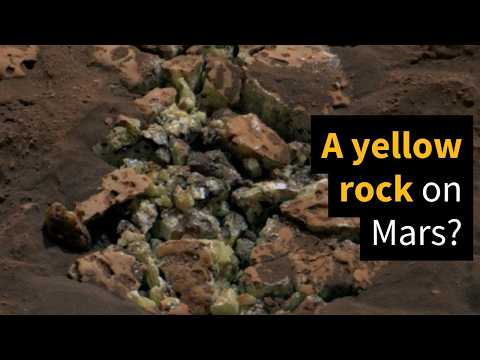
Watch the video below for a summary:
"Finding a field of stones made of pure sulfur is like finding an oasis in the desert," said Curiosity project scientist Ashwin Vasavada of NASA's Jet Propulsion Laboratory in July 2024.
"It shouldn't be there, so now we have to explain it. Discovering strange and unexpected things is what makes planetary exploration so exciting."
Sulfates are salts that form when sulfur, usually in compound form, mixes with other minerals in water.
When the water evaporates, the minerals mix and dry out, leaving the sulfates behind.
These sulfate minerals can tell us a lot about Mars, such as its water history, and how it has weathered over time.
Pure sulfur, on the other hand, only forms under a very narrow set of conditions, which are not known to have occurred in the region of Mars where Curiosity made its discovery.
There are a lot of things we don't know about the geological history of Mars, but the discovery of scads of pure sulfur just hanging about on the Martian surface suggests that there's something pretty big that we're not aware of.

Sulfur, it's important to understand, is an essential element for all life. It's usually taken up in the form of sulfates, and used to make two of the essential amino acids living organisms need to make proteins.
Since we've known about sulfates on Mars for some time, the discovery doesn't tell us anything new in that area. We're yet to find definite signs of life on Mars, anyway.
But we do keep stumbling across the remains of bits and pieces that living organisms would find useful, including chemistry, water, and past habitable conditions.
Stuck here on Earth, we're fairly limited in how we can access Mars.
Curiosity's instruments were able to analyze and identify the sulfurous rocks in the Gediz Vallis Channel, but if it hadn't taken a route that rolled over and cracked one open, it could have been sometime until we found the sulfur.
The next step will be to figure out exactly how, based on what we know about Mars, that sulfur may have come to be there.
That's going to take a bit more work, possibly involving some detailed modeling of Mars's geological evolution.
Meanwhile, Curiosity will continue to collect data on the same.
Related: Mysterious Streaks on The Slopes of Mars Might Finally Be Solved
The Gediz Vallis channel is an area rich in Martian history, an ancient waterway whose rocks now bear the imprint of the ancient river that once flowed over them, billions of years ago.
Curiosity is still trundling its way along the channel, to see what other surprises might be waiting just around the next rock.
You can follow Curiosity's adventures in the rover's science update blog.
And more than five years into its own mission, NASA's Mars Perseverance rover is still ambling across the surface of the red planet, doing what any five-year-old loves to do – stopping to look at every rock on its path.
One of its latest discoveries happens to look surprisingly out of place, prompting scientists to wonder if it may not have come from Mars at all.
Related: Life on Mars? NASA's Stunning Discovery Is The Best Evidence Yet
On June 19 this year, the six-wheeled explorer set a new record, officially completing the longest road trip of any robot vehicle on another planet.
In a single drive, the rover rolled over 411 meters of Mars' rocky surface. That may not sound like much, but compared to Curiosity and Opportunity, which inch along at a relative snail's pace, Percy is a speed demon.
The Mars robots really are a marvel. They represent the intrepidity of the human spirit, resilience, and determination. And, of course, our boundless curiosity about the Universe in which we live.
An earlier version of this article was published in July 2024.