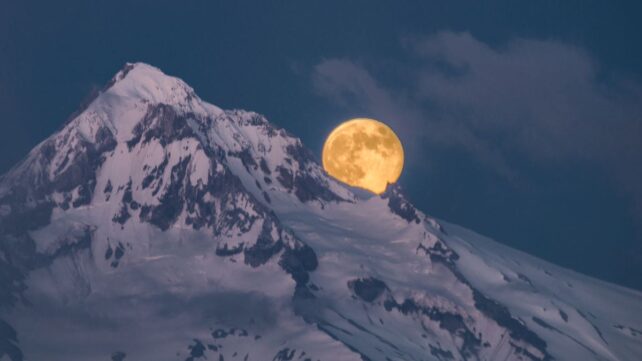
The last full Moon of 2025 is going to rise with all the panache conferred by a simultaneous perigee.
On the night of Thursday, December 4, as the Northern Hemisphere enters winter, a Cold Supermoon will rise over the eastern horizon at sunset, sailing into the sky with an apparent boost in size and brightness.
Since cold air has less humidity — making the sky clearer and more transparent – the event offers a brilliant opportunity for moonrise photography.
Related: Does The Full Moon Really Affect Our Sleep? Here's The Science

Supermoons are a natural consequence of the shape of the lunar orbit around Earth. It's not perfectly round, but slightly oval; as a result, there are points along the Moon's path at which it is slightly closer or slightly farther than its average distance of 384,400 kilometers (238,855 miles) from Earth.
The point at which it is closest to Earth is known as a perigee, of which there are around 13 a year, give or take. But, because the lunar orbit precesses, the oval doesn't follow the exact same path every time, so the timing of the perigees is not exactly aligned with the lunar cycle.
It's only when the perigee occurs on a full or new Moon that we refer to it as a supermoon.
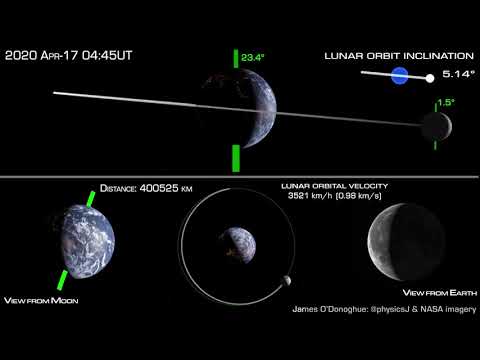
Interestingly, the perigee distance changes quite a bit, too, thanks to other contributing factors like the gravitational tug of the Sun and the shifting, long-term relationship between Earth and the Moon. At its closest perigees, the Moon can appear up to 14 percent larger and 30 percent brighter in the sky.
The perigee of 4 December 2025 will bring the full Moon to a distance of 357,219 kilometers (221,965 miles) from Earth, increasing its apparent size by 8 percent compared to the average full Moon and its brightness by about 16 percent.
That'll be a smidge farther than the Beaver supermoon of November 2025, but still closer than any other supermoon since April 2020, so it's going to be a good one.

Technically, a supermoon is a syzygy, a fun Scrabble word that refers to the straight-line alignment of three or more astronomical bodies – in this case, Earth, the Moon, and the Sun. Because the Moon will be on the opposite side of Earth from the Sun, you can look for the supermoon at the eastern horizon opposite sunset, wherever you are in the world.
You're probably also thinking: if there's a name for the full Moon at the closest point in the lunar orbit, there must be a name for the full Moon at the farthest point.
You'd be correct; this is known as a micromoon, although it doesn't get as much attention, likely because the photography and Moongazing opportunities aren't as exciting.
Supermoons and micromoons are a normal thing for the Moon to do, but any opportunity to go outside and marvel at the night sky is worth your time. Just make sure to take plenty of blankets and a flask of something warm to drink.