We all know the frustration of being stuck behind a tentative motorist, but there may be something to be said for driving like a person with a will to live after all.
Hooning your car like you needed to arrive yesterday is known to accelerate vehicular wear and tear.
Owners of electric vehicles (EVs) likely have something additional to worry about.
According to a new analysis of real-world battery-powered EVs, aggressive driving can accelerate the battery's degradation.
And not by a small amount, either. The most aggressive driving style could cause around 2.5 times as much battery capacity loss as the safest eco-driving style.
"This result," writes a team of researchers at Shanghai Dianji University in China, "demonstrates that optimizing driving style is an effective way to alleviate the aging of power batteries and extend cycle life."
The findings appear in Scientific Reports.

With EV sales rising globally, the lithium-ion batteries that power them are becoming an increasingly important part of the world's vehicle fleet.
A lithium-ion battery doesn't suddenly just pop its clogs after a certain number of charges.
Instead, over time, it gradually loses the ability to store as much charge as it could when it was new. So an EV that once had, say, 100 percent of its original usable capacity might eventually retain only 80 percent.
That means less mileage from a full charge, for one thing. In addition, battery degradation can also affect things like performance and the vehicle's residual value.
An EV battery is, at the end of the day, replaceable, but not for peanuts. The battery represents an estimated quarter of the vehicle's total retail cost.
Some battery life degradation is normal and expected. It's just time and use working their magic. But researchers Hao Cheng, Zhongwei Gu, and Wangqiang Gao wanted to know how much degradation could be attributed to driving style.
The researchers analyzed a full year of real driving data from 15 EVs in Guangzhou in 2022.
These cars were driven in typical urban, suburban, and highway conditions throughout the year, recording use data every 10 seconds.
The researchers compiled this data into 60-second chunks containing vehicle speed, battery current, state of charge, voltage, and temperature. They then used those chunks to characterize how the car was being driven into five categories.
Speed, current, and state of charge were the main metrics used to identify patterns representing how smoothly or aggressively the driver accelerated and decelerated, as well as the overall intensity of driving.
The smoothest category was eco-driving. Their most aggressive category involved pulling very high electrical current from the battery, and included situations such as repeated high-torque demands at relatively low speeds.
Then, they set about calculating the impact of these driving styles on overall battery capacity.
Rather than simply looking for correlations between factors like acceleration and battery stress, the researchers developed a machine-learning framework to separate the effects of driving behavior from other factors that can influence battery aging – in particular, the battery's starting charge, temperature, and time spent idling.
At extremes, the most aggressive driving style produced the most marked and immediate effect on the battery – 18.4 times more aging stress for the most aggressive driving than for eco-driving.
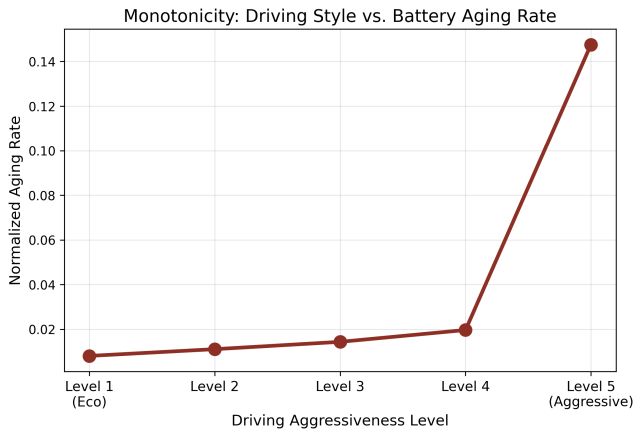
That's the immediate stress, though, not the long-term degradation prognosis. For that part, the researchers fed each driving style's characteristics into a battery-aging model and calculated how much capacity the battery would be expected to lose after 1,000 charge-discharge cycles.
The difference was pretty shocking.
For the smoothest driving style, the battery lost 21.15 percent of its maximum capacity after 1,000 cycles.
The most aggressive style lost a whopping 53.22 percent.
The reason? Hard acceleration and deceleration, along with excessive demands on the battery current, made the difference, the researchers found.

Both the aggressive and eco group had a similar average speed – but the extreme aggressive-driving group drew an average RMS current of 66.02 amps, compared with 20.56 amps for the eco-driving group.
Related: Data Are Finally in: Electric Cars Really Do Produce Less CO2 Pollution
The researchers also modeled to see what would happen if all the other driving data stayed consistent while only the driving behavior changed from aggressive to eco. Short-term stress on the battery dropped by 91.3 percent.
Now, this final degradation rate is just a prediction. The team didn't have data on the battery life for 1,000 charge cycles for any driving group.
However, the results are supported by several different strands of the analysis, all pointing in the same direction – demanding more from your battery appears to make it age faster.
For now, though, EV drivers could help prolong the life of an expensive battery by taking a few pounds off the lead foot.
The research has been published in Scientific Reports.
This article was fact-checked by Fiona MacDonald and edited by Fiona MacDonald. While we pride ourselves on our process, we are only human. If you spot a mistake, please let us know.